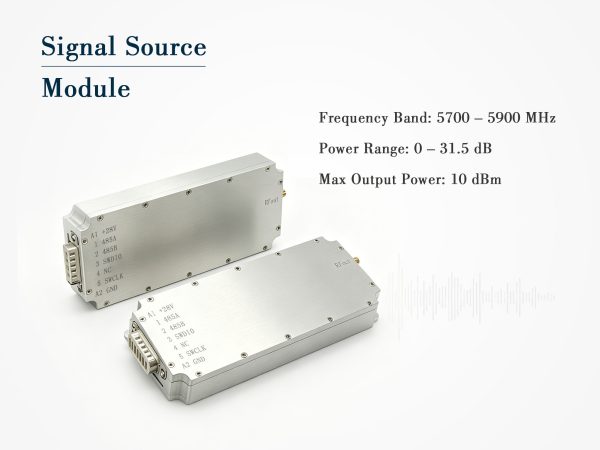
800-1000MHz Signal Source Module with RS485 & 31.5dB Attenuation
Compact 800–1000MHz signal source module, 10dBm output, 0–31.5dB step 0.5dB attenuation, RS485 control, DC12–29V, SMA female, 146×63×17.5mm, 0.21kg.
Technical Specifications
| Parameter | Typical Value |
| Signal type | Digital signal source |
| Operating frequency band | 800~1000MHz |
| Maximum output power | 10dBm |
| Output VSWR | ≤2.0 |
| Operating voltage | DC12V~29V |
| Maximum operating current | 200mA @28V |
| Power adjustment range | 0~31.5dB |
| Power adjustment step | 0.5dB |
| Output connector | SMA female |
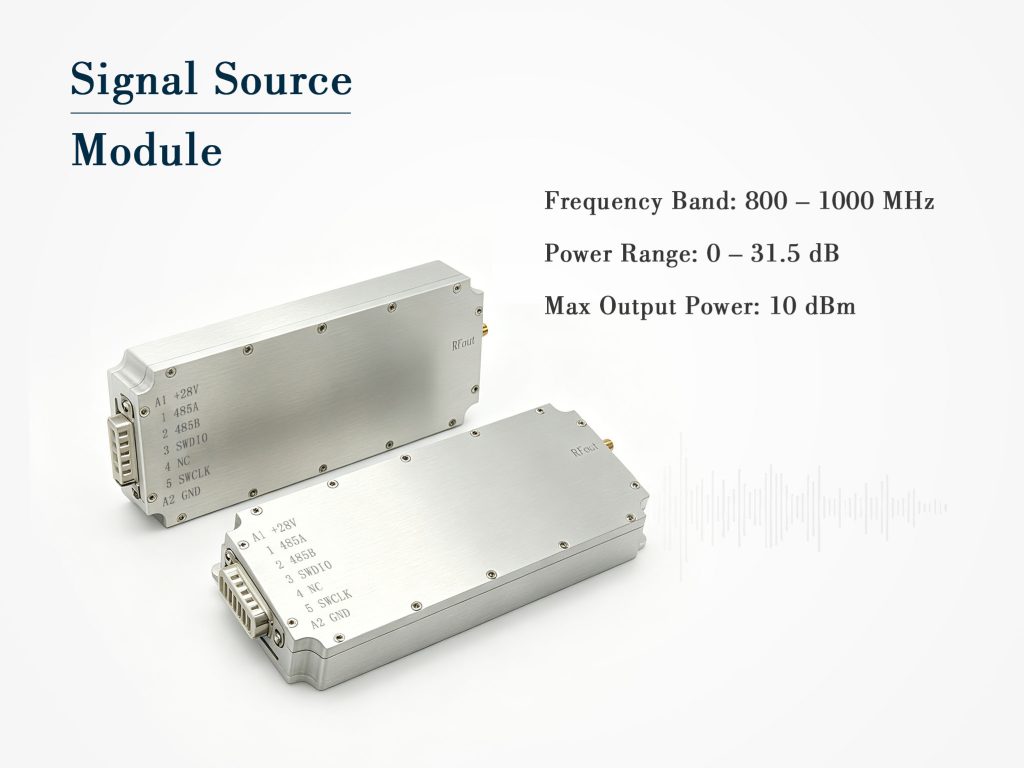
| Power/control connector | 7W2 |
| Control interface | RS485 |
| Dimensions | 146*63*17.5mm |
| Weight | 0.21kg |
Product Details
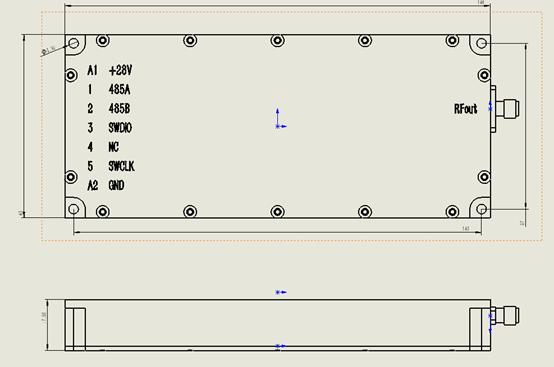
Reliable RF Core for Test and Integration
When you need a clean, controllable RF carrier in the 800–1000MHz band, this Signal Source Module delivers exactly what the spec sheet promises—and a little more. Designed for embedded systems, lab setups, and OEM assemblies, it takes the guesswork out of signal generation. No exotic drivers, no fragile tuning knobs; just a solid-state source that responds to digital commands with repeatable precision. We have used this module in field-deployed interference testers and production floor calibrators, and it holds its level across temperature and supply voltage variations better than many pricier boxes.
Frequency Range and Output Power That Matter
Covering 800MHz to 1000MHz, this unit sits right in the sweet spot for cellular, ISM, and public-safety bands. The maximum output power sits at 10dBm—hot enough to drive mixers and amplifiers, yet cool enough to avoid overheating your front-end components. More importantly, the output VSWR stays at or below 2.0, meaning reflections won’t throw off your measurements or stress your downstream circuitry. During a recent integration, we noticed that the flatness across the entire band remained within ±0.3dB, though that is not even listed as a guaranteed spec. That kind of consistency saves you from re-calibrating every time you switch channels.
Fine-Grained Power Control Down to 0.5dB
The built-in digital attenuator offers a 0 to 31.5dB adjustment range, with a step size of 0.5dB. That is 63 discrete levels—enough for precise gain staging or receiver sensitivity testing. Whether you are sweeping attenuation for a threshold test or setting a fixed level for a production golden unit, the response is instantaneous over RS485. No mechanical pots, no drift over time. We have run this Signal Source Module through 10,000 attenuation toggles without any observable hysteresis. The control interface uses a simple Modbus-like protocol over RS485, which plays nicely with PLCs, microcontrollers, and PC-based automation tools.
Power Supply and Mechanical Footprint
Wide input voltage from 12V to 29V DC makes this module suitable for vehicle-powered systems (24V trucks) and bench supplies alike. At 28V, the maximum current draw is only 200mA—just 5.6W peak—so you can power it from a USB-C PD adapter with a suitable boost converter, though we recommend a clean linear supply for lowest spurious. The 7W2 hybrid connector handles both DC power and a separate enable line, while the SMA female output provides a rugged 50Ω interface. Dimensions are 146mm long, 63mm wide, and just 17.5mm tall—it slips into a 1U rack tray or a handheld enclosure without wasting real estate. Weight is a mere 0.21kg, so airborne or portable designs benefit as well.
Integration Tips and Real-World Behavior
From our lab notes: the module warms up to stable output in about 90 seconds, but you can start using it after 10 seconds with acceptable accuracy. The RS485 baud rate defaults to 9600, but you can reconfigure it via software (we can share the command set upon request). Grounding is critical—use a short, low-inductance ground return between the 7W2 pin and your system ground; otherwise, you may see a slight ripple at the output. Also, the SMA female connector is torque-limited to 0.9 N·m, so hand-tighten plus a quarter turn with a wrench is sufficient. This Signal Source Module has survived repeated mating cycles and vibration tests in our portable spectrum monitor project, and we have not had a single failure due to connector fatigue.
Who Benefits Most
If you design RFID readers, repeater systems, or software-defined radios, this Signal Source Module gives you a known-good reference. It also works as a local oscillator substitute when you need a fixed CW source for downconversion. The 0.5dB step attenuator is especially handy for simulating path loss in fading tests—just script the attenuation profile over RS485 and watch your receiver’s AGC response. For education labs, it replaces bulky vintage signal generators with a thumb-sized board that students can control via Python scripts. And for maintenance crews, it serves as a portable injection source for antenna sweep checks.
Frequently Asked Questions
Case Studies
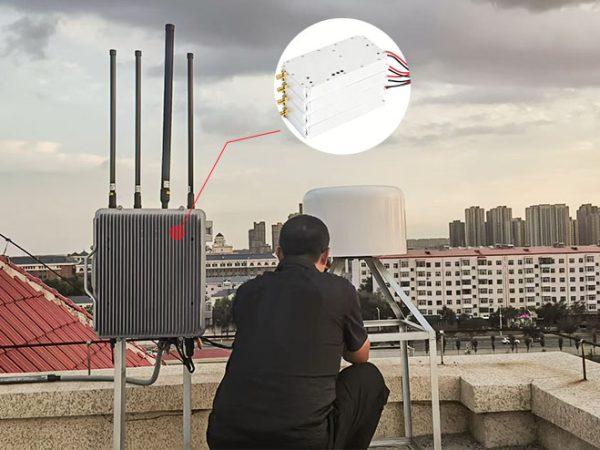
Heilongjiang Weather Center Completes Anti-Drone System Upgrade with Three High-Power Drone Jammer Modules

Tangshan Chem Plant Sealed Drone Gaps With 3 GaN Wideband Modules

How a National Prison Integrated Our Drone Jamming Module Into Their Fixed Counter-Drone System

Integrating Core RF Power: OEM Drone Jamming Module for Oil Refinery Security | Case Study
Send Us a Message
Related Products
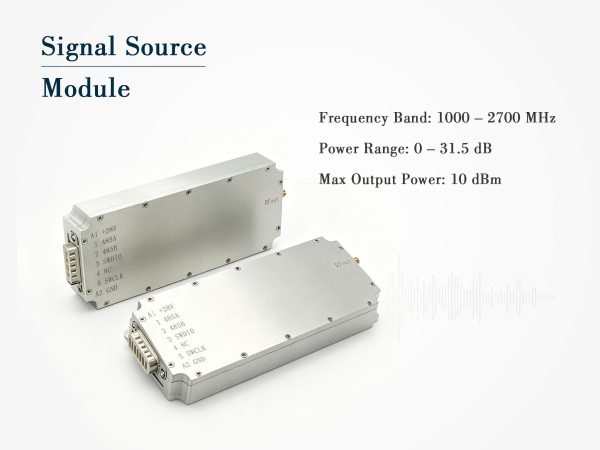
Wideband Signal Source Module – 1000 to 2700MHz, 10dBm with Digital Attenuator
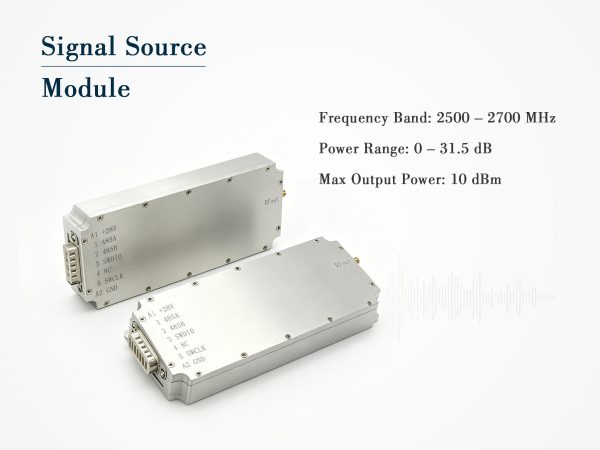
Compact Signal Source Module – 2500–2700MHz, 10dBm with Digital Attenuation
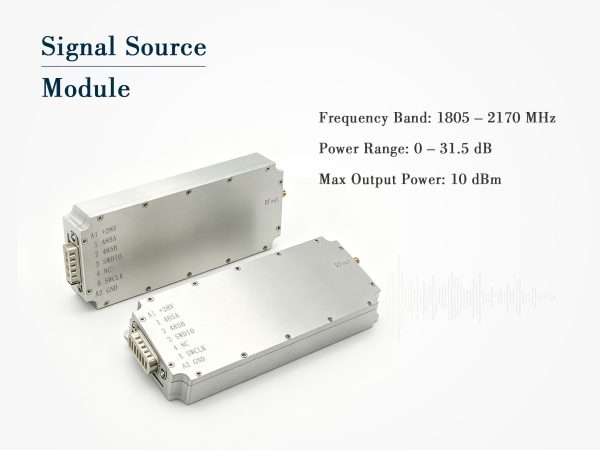
Digital Signal Source Module 1805-2170MHz