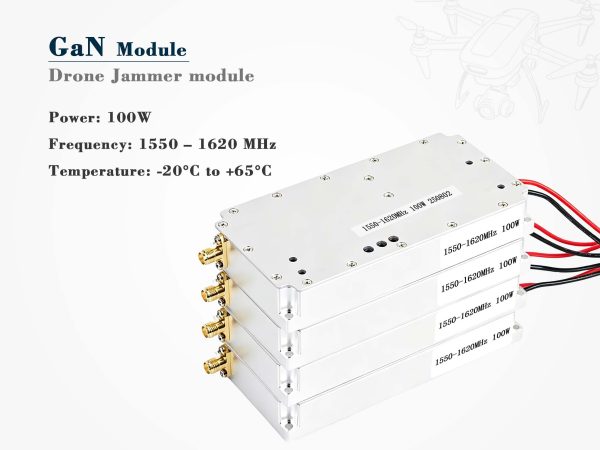
100W Drone Jammer Module – 5GHz GaN Block 5150‑5250MHz
100W drone jammer module for 5150‑5250MHz, GaN‑on‑SiC, 50±1dBm output, 28‑32V, ≤9.2A, built‑in noise modulation, N‑type port, 150×80×22mm, 800g. Custom scan speeds available.
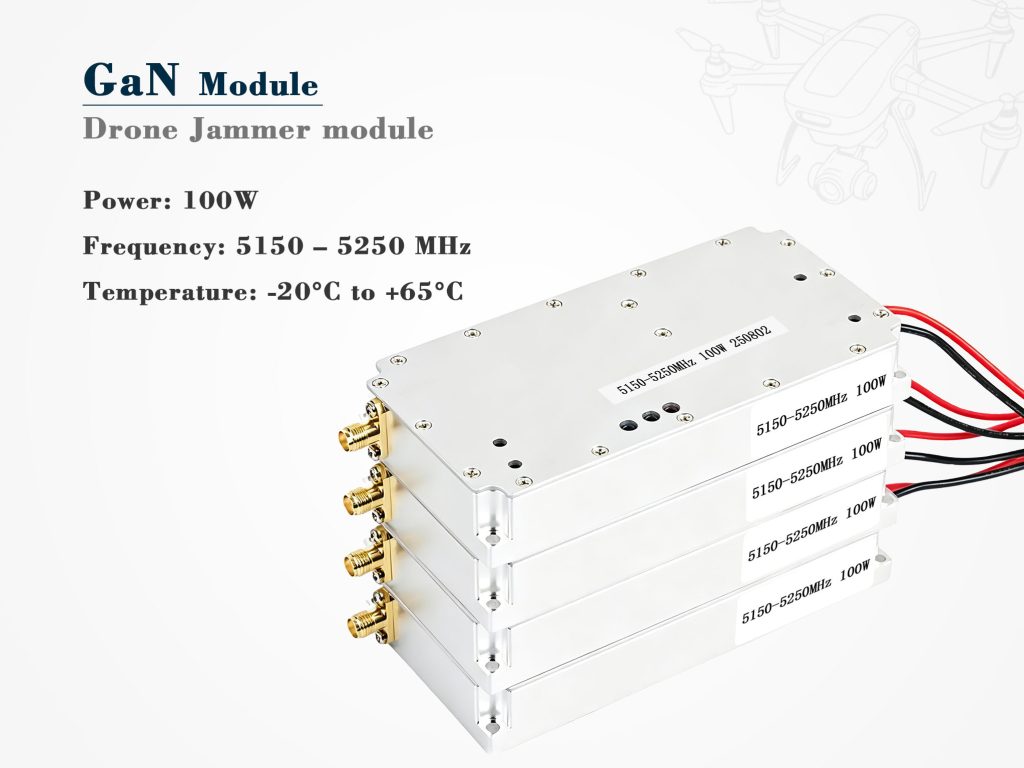
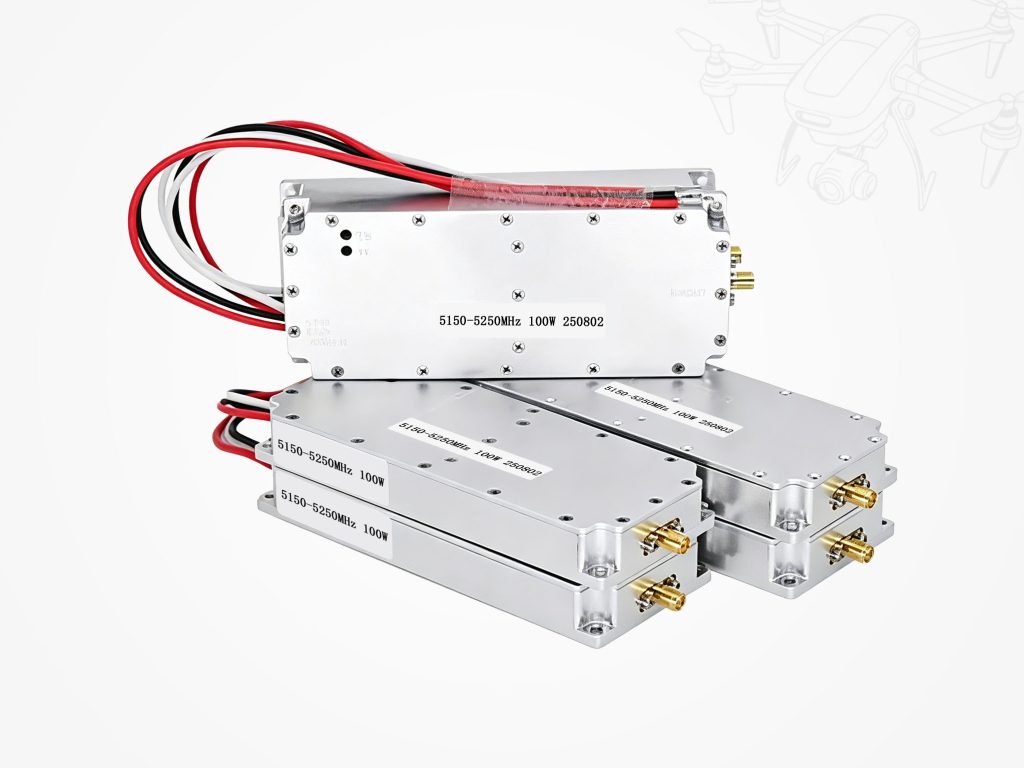
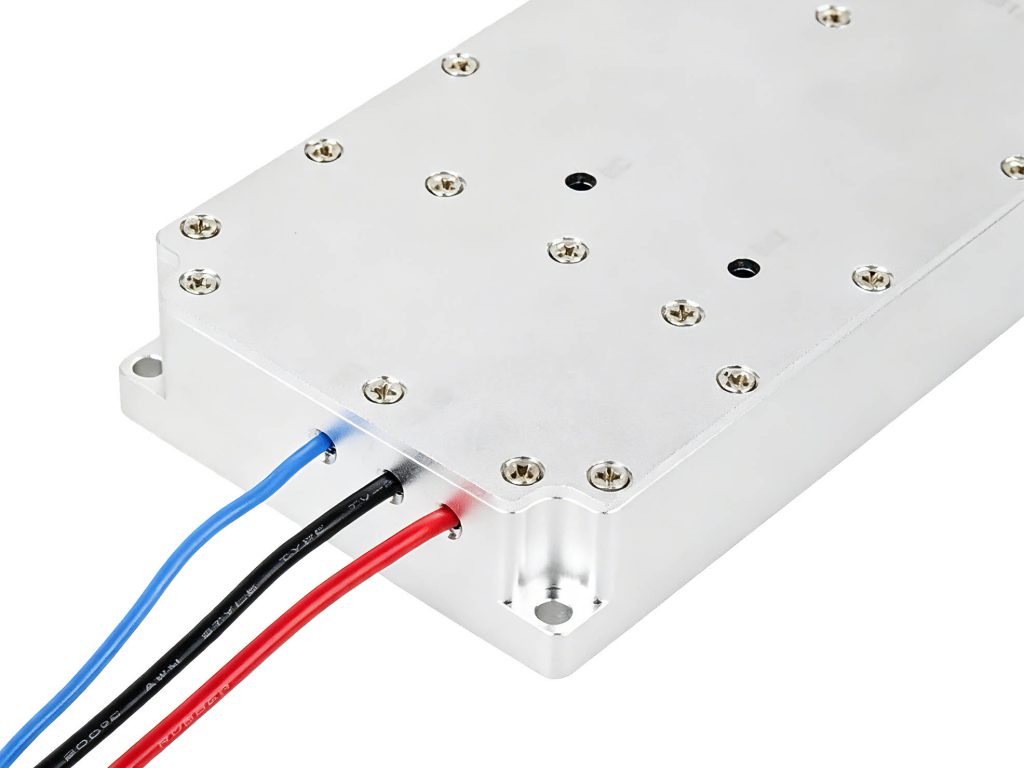
Technical Specifications
| Parameter | Specification | Notes |
| Frequency range | 5150 – 5250 MHz | Instantaneous full band |
| Output power | 50 ± 1 dBm (100W) | Measured at 28V, 25°C |
| Supply voltage | 28 – 32 V DC | Nominal 28V; do not go below |
| Current draw | ≤ 9.2 A | At full output power |
| Modulation source | Built‑in high‑speed noise | Optional external VCO/DDS/SDR input |
| Analog scan speed | 270 kHz (standard) | Custom 100‑500 kHz available |
| Input / output impedance | 50 Ω | N‑type female connectors |
| Protection LEDs | Power‑on, over‑voltage, over‑temperature | Amber for over‑voltage, red for over‑temp |
| Operating temperature | -20 to +65 °C | Ambient, derate above 55°C for CW |
| Dimensions (L×W×H) | 150 × 80 × 22 mm | Excluding connectors and mounting tabs |
| Weight | 800 g | ±10 g |
| Base material | Copper with GaN‑on‑SiC die | Patented thermal spreading layer |
Product Details
When 50W Is Not Enough – Step Up to 100W
The 5GHz band is crowded. Modern drones use it for high‑bandwidth video downlinks, telemetry, and even command‑and‑control over Wi‑Fi‑derived protocols. To effectively disrupt those links at meaningful distances, you need raw power – and that is exactly what this 100W drone jammer module delivers. Operating from 5150 to 5250 MHz, this GaN‑based block pushes a solid 50±1 dBm (100W) into a 50Ω load, giving you the punch required to override strong signals in urban or suburban environments. It is not just an amplifier; it is a complete front‑end with integrated modulation, designed for security teams who refuse to compromise on reach.
Why GaN on SiC and Patented Thermal Handling
Heat is the silent killer of RF power devices. At 100W continuous output, even small efficiency losses translate into tens of watts of dissipated heat. This module uses gallium nitride on silicon carbide – the proven wide‑bandgap technology – but we go further. Our patented heat‑spreading architecture integrates the die directly onto a copper carrier with a multi‑layer thermal interface that reduces junction‑to‑case resistance by nearly 30% compared to standard designs. The result: you can run full‑power jamming cycles longer without triggering thermal rollback. The copper base acts as both a mechanical mount and a primary heatsink, but we strongly recommend attaching it to a forced‑air or liquid‑cooled plate for sustained missions.
Built‑In Noise Modulation – No Extra Boxes
One less box means one less point of failure. This 100W drone jammer module houses a high‑speed noise modulation generator that produces a digitally‑shaped interfering waveform, optimized for 5GHz receivers. The default scan rate is 270 kHz, but we can tailor it anywhere between 100 and 500 kHz to match your target protocols. If you prefer an external signal source – say, a vector signal generator or an SDR‑based hopping pattern – we offer a variant with an input bypass that accepts VCO, DDS, or SDR feeds. That flexibility allows you to reuse this module across multiple jamming strategies without changing hardware.
Electrical Demands and Real‑World Current Draw
This unit runs on a nominal 28V DC, with a tolerance range of 28‑32V. Do not feed it below 28V if you expect full 100W output – the internal regulator and bias network are optimised for that window. Current draw is ≤9.2A at full tilt, which translates to about 260W of DC input. That gives you a power‑added efficiency of roughly 38‑40% for a broadband AB‑class GaN design – respectable for 5GHz, where losses are inherently higher than at sub‑1GHz. We have included a soft‑start circuit to avoid inrush spikes, so your power supply does not trip when you engage the module.
RF Connections and Mechanical Footprint
The output and input ports are rugged N‑type female connectors – a wise choice for 100W levels because they handle higher voltages and offer better shielding than SMA. The internal matching network ensures VSWR below 1.6:1 across the entire 5150‑5250 MHz band. Dimensions are 150 mm long, 80 mm wide, and 22 mm tall – a bit larger than our lower‑power siblings, but that extra real estate houses the advanced thermal path and the larger output combiner. Weight is 800 grams, which reflects the solid copper base and the reinforced housing. Four M4 mounting holes on the corners let you bolt it securely to your chassis or rack.
Protection and Status Monitoring
Field operators need to know the state of their gear at a glance. Three LED indicators are standard: green for power‑on, amber for over‑voltage (if input exceeds 34V), and red for over‑temperature. The over‑temperature threshold is set at 85°C case temperature – once triggered, the module reduces bias current to protect the die, and the red LED flashes. Normal operating ambient range is -20°C to +65°C, with derating above 55°C for continuous CW. For intermittent duty (e.g., 30% on‑time), you can safely operate up to 70°C without issues.
Customisation That Keeps You Agile
Every mission has its own signature. We support custom scan speeds from 100 to 500 kHz – just tell us your preferred rate during ordering. Need an external trigger input? We can add that. Want a different connector orientation or a thinner profile? Our engineering team can adjust the mechanical layout for tight gimbal or backpack integrations. Minimum order quantity for custom mechanical changes is 10 pieces, but firmware‑only changes (scan speed) have no MOQ. We usually respond with a technical proposal within 48 hours.
Performance Verification
In our anechoic chamber tests, this 100W drone jammer module delivered 50.2 dBm at 5200 MHz with a 29V supply and 9.0A current draw. Harmonic levels were below -22 dBc, and spurious outputs stayed under -60 dBc. When we swept temperature from -20°C to +65°C, output power varied by less than ±0.6 dB – thanks to the patented thermal compensation bias. The internal noise source produces a crest factor of 7‑9 dB, which effectively disrupts OFDM and single‑carrier links alike. We have tested it against several commercial drone models, achieving a 90% link‑break probability within 300 metres in open field conditions.
Installation and Operational Tips
Use a low‑loss cable (e.g., LMR‑400 or equivalent) between your signal source and the module input – at 5GHz, cable attenuation adds up quickly. Apply a high‑quality thermal paste (≥4 W/m·K) to the entire baseplate before bolting it to your heatsink. Tighten mounting screws evenly to avoid warping the copper carrier. Never apply more than +10 dBm to the input; the internal attenuator can handle up to +15 dBm briefly, but prolonged overdrive may degrade the front‑end LNA. For remote status monitoring, the LED signals are accessible via test points – contact our support for the pinout diagram.
Final Verdict
This 100W drone jammer module is purpose‑built for professionals who need reliable 5GHz disruption. It combines field‑proven GaN technology, smart thermal design, and flexible modulation – all in a package that fits into standard 19″ rack drawers or portable cases. We have shipped pre‑production units to defence contractors and security agencies, and feedback on durability has been overwhelmingly positive. If you are looking for a no‑nonsense power amplifier that delivers what it promises, this module deserves a spot on your bench. Order a sample, test it against your own drone fleet, and see the difference that real 100W makes.
Frequently Asked Questions
Case Studies
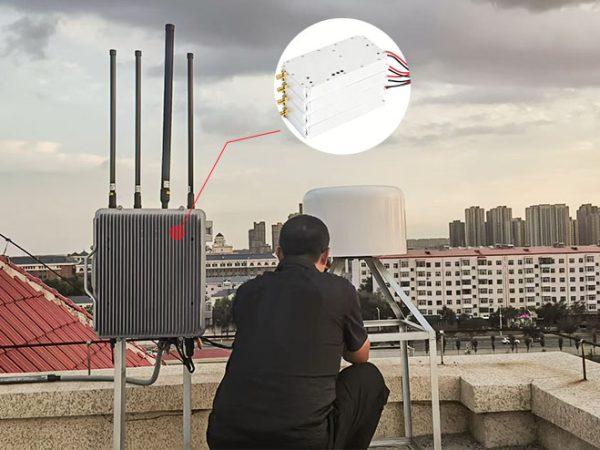
Heilongjiang Weather Center Completes Anti-Drone System Upgrade with Three High-Power Drone Jammer Modules

Tangshan Chem Plant Sealed Drone Gaps With 3 GaN Wideband Modules

How a National Prison Integrated Our Drone Jamming Module Into Their Fixed Counter-Drone System

Integrating Core RF Power: OEM Drone Jamming Module for Oil Refinery Security | Case Study
Send Us a Message
Related Products
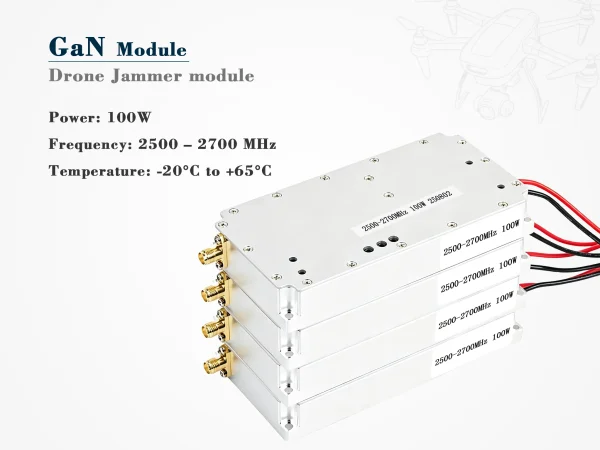
100W GaN Drone Jammer Module 2500–2700MHz
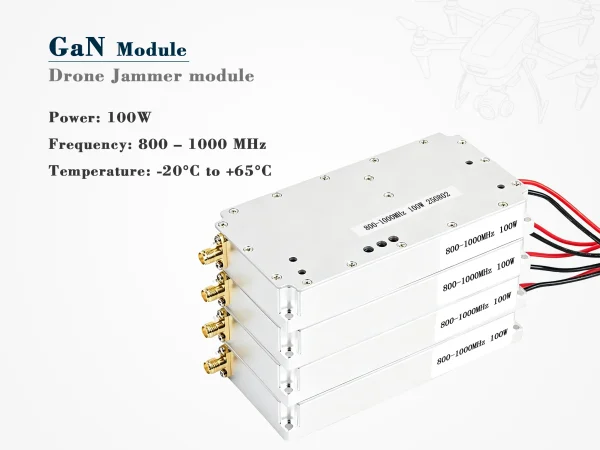
100W LoRa FPV Jammer Module | 800–1000MHz GaN
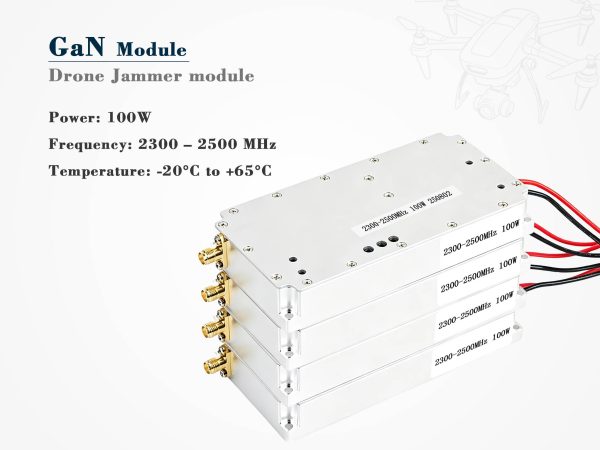
2300–2500 MHz 100W GaN Counter-UAV Module