The Situation
A national prison in Latin America was losing a quiet war. Inmates were getting contraband — phones, drugs, even small weapons — dropped straight into the exercise yard by consumer drones. The worst part? These flights almost always happened between 2 and 4 a.m., when the guards on tower duty were tired and the sky was pitch black.

The prison had already invested in a fixed detection system a year earlier. It included RF sensors and PTZ cameras mounted on the perimeter towers, all linked to a control room software. The problem? Detection without action. The security team could see the drone coming on their screen, they could watch it hover and drop the payload, and they could do nothing except send a patrol to chase shadows. They needed a jamming capability that would actually stop the drone before the drop.
They looked at fully integrated jammer units, but the quotes were high and the lead times long. What they really wanted was a way to add active RF disruption into the system they already owned — without ripping everything out.
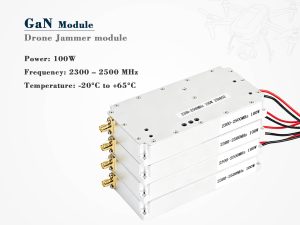
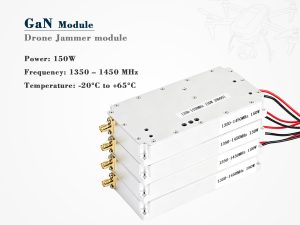
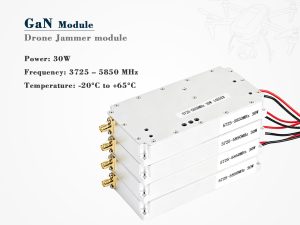
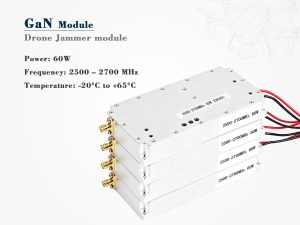
What We Provided-OEM Drone Jamming Modules
We got a call from the integrator who maintains the prison’s electronic security. He was direct: “Give me a module I can mount inside our existing weatherproof enclosures on the towers, feed with 48V DC, and control through the same RS-485 bus our cameras and sensors use. I don’t want another box with its own software.”
We shipped four of our ProDefender-800 OEM drone jamming modules.

Quick specs of what was delivered:
-
RF output: 100W average / 400W peak across 7 bands (433 MHz to 5.8 GHz plus GNSS L1/L2)
-
Form factor: 320 × 220 × 85 mm sealed aluminum chassis with mounting flanges
-
Control interfaces: RS-485 and Ethernet (TCP/IP), simple ASCII command set
-
Power: 24–48V DC
-
Cooling: fully passive, conduction-only — no fans, no vents, silent
Each module was designed to be a drop-in RF engine. The integrator didn’t need to be an RF engineer. He just needed to bolt it down, connect the antennas, wire the power and serial line, and send ASCII commands.
The Integration
The prison already had four corner towers with sturdy weatherproof cabinets containing power supplies, network switches, and a local PLC for the sensors. In each cabinet, the integrator mounted one ProDefender-800 onto a metal sub-plate — the module’s flange holes lined up perfectly with pre-drilled threads. Seven directional panel antennas were added to each tower’s external railing, cabled through N-type bulkhead connectors to the module’s SMA ports.
The control integration was even simpler than the mechanical part. The prison’s existing security management software — a Linux-based platform developed by the integrator — already handled event triggers from the RF detectors. The integrator’s programmer added just three commands to the platform: ARM, DISARM, and STATUS. When the RF detector classified a target as an unauthorized drone and the camera confirmed the track, the software sent an ARM command via TCP/IP to the module in the corresponding sector. No extra screens. No extra logins. The guards’ interface didn’t change at all.
We also helped them set the band activation logic. They wanted to jam 2.4 GHz, 5.8 GHz, and GNSS bands as a default preset, with the option to manually disable GNSS jamming for drones overflying but not directly threatening the prison — a request from their aviation authority liaison.
What Happened Next
The system went hot in March. The prison’s security chief agreed to keep detailed logs for 30 days. Here’s what he shared with us later:
-
11 unauthorized drone flights were detected inside the protected perimeter.
-
All 11 were jammed successfully. In 9 cases, the drone performed a clean return-to-home. In 2 cases, it auto-landed in a designated safe zone inside the outer wall where guards recovered the payloads.
-
Average time from detection to jammer activation: 1.9 seconds.
-
The existing communication systems — UHF radios, staff cell phones, Wi-Fi — showed zero impact. A spectrum monitoring log confirmed no unintended interference.
One incident stood out. Around 3:15 a.m., a drone approached from the east carrying a package wrapped in duct tape. The tower 2 module jammed it within seconds. The drone climbed briefly, then entered a controlled descent and landed near a storm drain. Guards found 4 smartphones and a charger in the package. The chief told us, “Before this, that package would have been inside a cell by breakfast.”
Why This Matters for Other Prisons
What made this project work wasn’t just the jamming performance — it was the fact that the prison didn’t buy a whole new system. They bought a capability and plugged it into infrastructure they already trusted. That kept costs down, training requirements near zero, and deployment time under two weeks.
And the modules are built to last. No fans, no air filters, no moving parts. The heat on those tower cabinets pushes 50°C in the summer, and the ProDefender-800 handles it passively. If new drone bands appear — and they will — the module’s architecture allows field upgrades without replacing the whole unit.
For us, this project validated a belief we’ve held for a while: the market doesn’t always need another shiny complete system. Sometimes it just needs the right module, with the right interfaces, that does one job extremely well.