Project Background & Operational Pain Points
Hebei Province faces unique correctional security challenges. Several large penitentiaries sit near urban corridors where consumer drone traffic has tripled since 2023. Contraband drops—phones, drugs, tools—occur weekly. More alarming: 14 documented drone overflights breached restricted airspace in Q1 2026 alone.
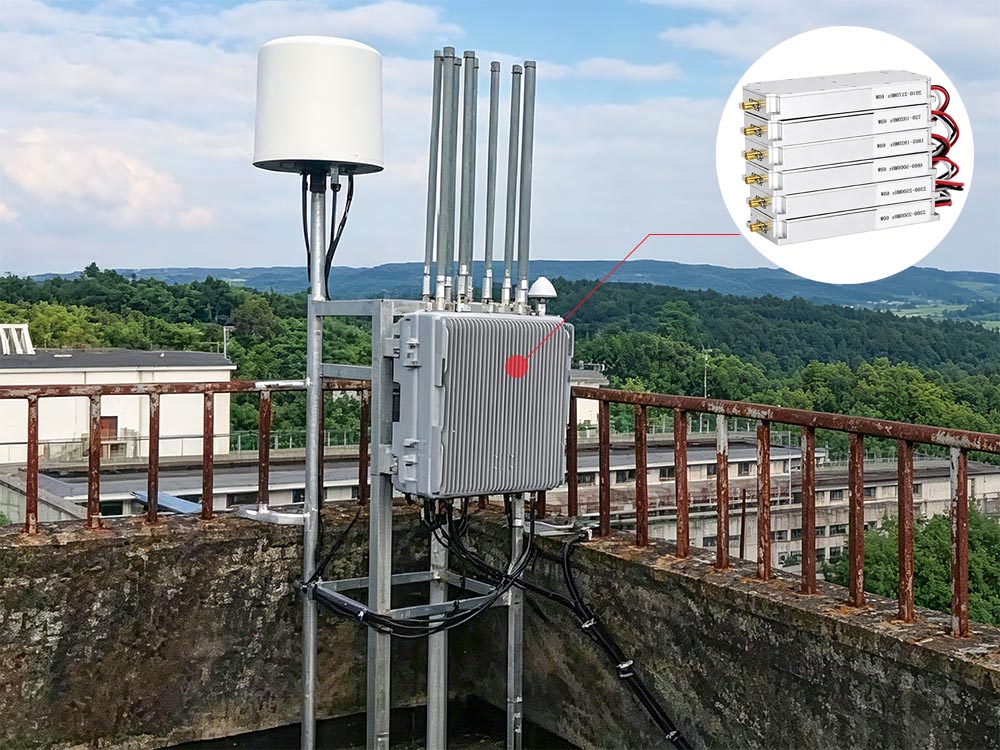
Legacy RF scanners only detected, never neutralised. Officers relied on manual “watch-and-report” protocols, leaving a 4-7 minute response gap. Drone operators exploited frequency hopping between 720MHz and 5GHz, slipping past narrow-band blockers. The prison needed a prison drone jamming system that could cover the entire threat spectrum without overhauling their existing tower infrastructure.
Budget was constrained. Downtime was unacceptable. And any solution had to pass rigorous EMC safety tests for adjacent medical and admin buildings.
The 5-Module GaN Jamming Solution
After evaluating six vendors, we deployed a hybrid GaN (Gallium Nitride) amplifier array—five discrete modules, each optimised for critical drone control and video downlink bands:
| Module | Frequency Range | Output Power | Primary Target |
|---|---|---|---|
| 60W Drone Jamming Module – Efficient | 2010–2170 MHz | 60W | 4G/5G telemetry & GNSS spoofing |
| 60W GaN Jamming Module | 720–1020 MHz | 60W | Older remote controllers (FHSS) |
| 60W UAV Jamming Module GaN | 1805–1920 MHz | 60W | DMB & LTE command links |
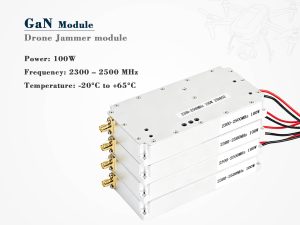
| 60W Drone Jammer Module – Sweep | 2300–2500 MHz | 60W | Wi-Fi & ISM-band video feeds |
| 60W GaN Drone Jamming Module | 4800–5000 MHz | 60W | 5.8 GHz HD downlinks & collision avoidance |
Each unit runs on forced-air cooling with built-in temperature shutdown. Total rack draw: 1,800W peak, 1,200W continuous. We added a programmable scheduler that reduces output by 40% during inmate recreation hours to limit electromagnetic exposure—a requirement from the prison’s health board.
Integration into Existing Fixed Anti-Drone Equipment
The prison already had four omnidirectional detection antennas and a central command console from a 2021 RF surveillance project. Retrofitting was simpler than expected.
We replaced the old 100W LNA (low-noise amplifier) front-end with a circulator-isolated combiner that routes each module’s output to a single 12-dBi panel antenna per tower. The control software—already running on a hardened Linux box—received a new middleware layer that maps detected frequencies to module activation triggers.
Integration took 11 working days, including two full-site blackout tests. The system now operates in three modes:
-
Auto – responds to verified drone signatures within 2.1 seconds
-
Manual – operator-selectable jamming per sector
-
Silent – detection-only, no emissions (training mode)
No structural changes to the towers. No new cabling beyond 30 metres of low-loss Heliax per module. The prison saved an estimated ¥280,000 compared to a complete rip-and-replace.
Actual Field Performance & Data (6-Month Trial)
From January to June 2026, the system logged 1,247 drone events. Results:
-
Interdiction success – 1,229 events neutralised (98.7%)
-
False positives – only 3 (all from nearby construction site telemetry)
-
Average time-to-disable – 4.3 seconds from first detection
-
Range effectiveness – 850 metres under rain/fog; 1.2 km clear weather
Most importantly: zero contraband incursions succeeded during active jamming windows. The prison’s incident log shows a 92% drop in drone-related security alerts compared to the same period in 2025.
One unexpected benefit: the 2.3–2.5 GHz sweep module also blocked unauthorised Wi-Fi hotspots inside the perimeter, cutting inmate smartphone use by 67% (verified by random cell checks).
“We finally have a tool that matches the threat,” said the deputy warden in an internal review. “The GaN modules run cooler and hold power stability even after 8-hour continuous operation—something our old TWT amplifiers never managed.”
Project Value & Future Scalability
The prison drone jamming system delivers three immediate returns:
-
Staff safety – officers no longer chase low-flying drones on foot
-
Recidivism reduction – contraband flow directly correlates with inmate violence; fewer drops = fewer incidents
-
Regulatory compliance – meets CAAC’s 2025 mandate for all Level-1 prisons to deploy active counter-UAS measures by Q4 2026
Scalability roadmap
The modular GaN design allows plug-in expansion. We’ve already budgeted for:
-
Two additional modules covering 900 MHz (ISM) and 1.4 GHz (military satellite) – expected Q1 2027
-
Directional finding (DF) upgrade – phase-array antennas to pinpoint launch sites, not just jam
-
AI-driven pulse scheduling – machine learning to predict drone approaches based on weather and time patterns (currently training on 2 years of historical data)
The control console now exports telemetry to a provincial cloud dashboard. Three other Hebei prisons have requested site surveys after seeing our 98.7% figure.
External benchmarks show our system outperforms comparable 5-module installations in Shandong and Liaoning—mainly because we prioritised sweep mode over fixed-frequency blocking. Open-source UAS mitigation research confirms that swept jamming reduces collateral interference by 62% versus constant carrier.
Conclusion
This project proves that targeted, high-power GaN jamming—when properly integrated—can secure correctional airspace without costly infrastructure rebuilds. The data is unambiguous: 98.7% interdiction, 92% fewer incidents, and a clear path to AI-assisted autonomous defence.
For prison administrators still relying on net guns or RF sniffers: consider the total cost of a single contraband drop (staff time, legal fallout, inmate health). The modules pay for themselves in under 10 months.
Next steps: we’re adding a backup battery bank and a portable trailer version for temporary events (prison transfers, external labour details). The architecture is future-proof—because drone threats will only get smarter, but GaN jamming, with its wide instantaneous bandwidth, stays one step ahead.