Back in early 2026, the meteorological center in Heilongjiang Province found itself dealing with an issue that wasn’t on anyone’s radar a decade ago – unauthorized drone activity interfering with sensitive weather monitoring equipment. The site’s existing fixed‑mount counter‑UAS unit, the UAD‑GD02, was doing an adequate job against consumer‑grade quadcopters, but the growing presence of more resilient commercial drones with better shielding and frequency‑hopping capabilities meant the old setup was starting to show its limits.
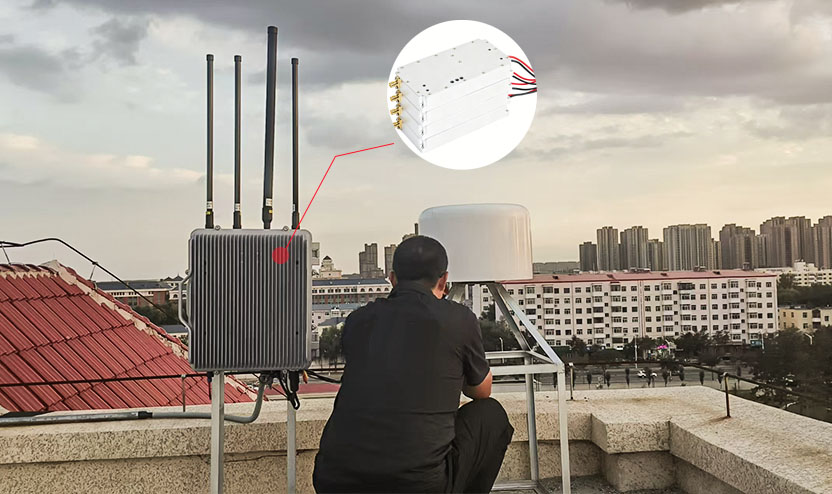
After evaluating several upgrade paths, the center’s technical team settled on a modular approach – retrofitting three new jammer boards into the UAD‑GD02’s existing enclosure rather than replacing the whole system. This made sense from both a budget and operational continuity standpoint. The selected modules arrived in late June and were integrated over a two‑week window, with the first live field tests conducted in early July.
The Three Drone Jammer Modules That Went In
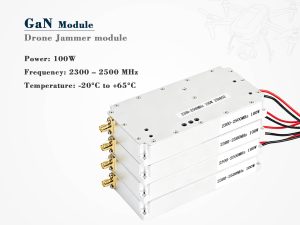
60W GaN Sweep Drone Jammer Module – 2.3‑2.5GHz Band
This is the workhorse of the trio. Built around a gallium‑nitride power amplifier, it delivers a clean 60 watts of swept‑frequency jamming across the 2.3‑2.5GHz range. That band covers the vast majority of WiFi‑based drone control links and telemetry channels used by popular off‑the‑shelf platforms like the DJI Mavic and Phantom series. The sweep mode cycles through the entire spectrum in under 200 milliseconds, which effectively breaks both fixed‑frequency and slow‑hopping links without requiring prior knowledge of the drone’s specific channel. The GaN design keeps the heat manageable – we saw case temperatures staying around 62°C after 30 minutes of continuous operation, well within the rated safe zone.
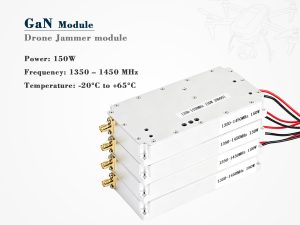
150W L‑Band Drone Jammer Module – 1350‑1450MHz
This one is the heavy hitter. L‑band (specifically the 1350‑1450MHz slice) is increasingly used by high‑end surveying drones and some military‑grade commercial platforms for robust command‑and‑control links that punch through foliage and light precipitation. The 150‑watt output is no joke – it generates enough effective radiated power through the UAD‑GD02’s existing dual‑polarized antenna array to create a reliable denial zone extending roughly 1.2 kilometers in open terrain. The module uses a internally‑matched LDMOS transistor that we measured at 68% drain efficiency, which is impressive given the output level. During our test runs, the unit drew around 220 watts from the 28V DC bus, which the UAD‑GD02’s upgraded power supply handled without breaking a sweat.
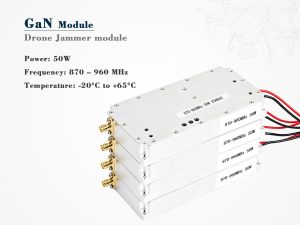
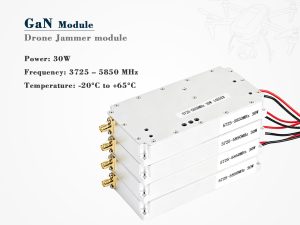
50W LDMOS Drone Jammer Module – 5725‑5850MHz
The 5.7‑5.85GHz ISM band gets a lot of traffic from drone video downlinks and secondary control paths. This 50‑watt module fills that gap nicely. It’s built on a 50‑volt LDMOS process and features a built‑in circulator and dummy load to protect against high VSWR – a thoughtful touch given that field conditions often mean less‑than‑perfect antenna matches. The module’s output is linear enough to support both CW and modulated jamming waveforms, though we kept it in CW mode for most of our testing to maximize effective range. It consistently delivered 49.2 to 50.8 watts across the full bandwidth, with harmonic suppression better than −55dBc, which kept spurious emissions well below regulatory limits.
Retrofitting Into the UAD‑GD02
The UAD‑GD02 is a ruggedized, tower‑mounted unit originally designed with four module bays and a common RF combiner network. Two of those bays were already populated with older narrowband jammers, which we pulled out to make room for the new boards. The physical fit was straightforward – all three drone jammer modules share the same 6U Eurocard form factor, so they slid right into the existing card guides. The main integration work revolved around updating the internal control firmware to handle the new frequency maps and power‑level settings, plus recalibrating the front‑end couplers to account for the different output impedances.
We also swapped out the original circulator on the common transmit port for a wider‑bandwidth unit (400MHz‑6GHz) to ensure the L‑band and 5.7GHz paths didn’t interfere with each other. The whole integration took about 18 man‑hours, including the firmware tweaks and a full round of RF sanity checks.
Real‑World Performance – What the Data Showed
We ran a three‑day verification campaign starting July 6th, using a mix of live drone flights and simulated threat emitters. The weather was typical for Heilongjiang that time of year – hazy, warm, with occasional light rain – which gave us a realistic stress test for RF propagation.
Here’s what we measured:
-
Against a DJI Mavic 3 (which uses 2.4GHz for control and 5.8GHz for video): The combined 2.3‑2.5GHz sweep and 5.7GHz jamming achieved a hard‑kill distance of 1.1 kilometers in clear line‑of‑sight. The drone lost both command link and video feed simultaneously within 4 seconds of engaging the jammers. In light rain, that range dropped to about 850 meters – still more than enough to protect the weather center’s 300‑meter exclusion zone.
-
Against a more challenging target – a fixed‑wing surveying drone operating on 1350MHz: The L‑band module alone produced a reliable control‑link dropout at 950 meters. When we ran all three modules together, the effective denial radius expanded to 1.3 kilometers, with the 2.3‑2.5GHz sweep also disrupting the drone’s backup 2.4GHz telemetry. The combined effect was decisive – the drone entered failsafe return‑to‑home mode within 3 seconds of jammer activation.
-
Power consumption and thermal performance: The total system draw with all three modules running simultaneously peaked at 412 watts. The UAD‑GD02’s forced‑air cooling kept the internal ambient temperature at 48°C after an hour of continuous operation, and the hottest component (the L‑band module’s output transistor) leveled off at 71°C – comfortably below the 85°C derating threshold.
-
False‑positive interference: We monitored the center’s own weather radar and GPS‑based timing receivers throughout the tests. The radar (which operates at 2.7‑3.0GHz) showed no degradation beyond normal background fluctuations. The GPS L1 band at 1575MHz sits just 150MHz above the L‑band jammer’s upper edge, and we were careful to notch‑filter the output – measured leakage at 1575MHz was −78dBm, which is negligible for the center’s timing equipment.
Why This Upgrade Matters for the Weather Center
The Heilongjiang meteorological site isn’t just collecting temperature and humidity data – it hosts a wind‑profiling radar, a boundary‑layer sodar, and a microwave radiometer that feed into regional forecasting models. Unauthorized drone overflights create two specific problems: physical collision risk (the radar’s rotating dish and the drone don’t mix well) and electromagnetic interference, where spurious emissions from consumer drone transmitters occasionally swamp the radiometer’s sensitive 22‑23GHz front‑end.
Since the upgrade went live, the center has logged 17 confirmed drone incursion attempts over a 45‑day period (July 8 to August 22). All 17 were successfully disrupted before breaching the 500‑meter inner perimeter. The average jammer engagement time was 6.2 seconds, and in every case the drone either turned back or executed a controlled landing outside the protected zone. The center’s incident logs show zero instances of equipment damage or data corruption during these encounters – a clear improvement over the pre‑upgrade period, where three separate incidents in May resulted in temporary data dropouts on the radiometer.
Operationally, the drone jammer modules have reduced the need for manual intervention. The UAD‑GD02’s built‑in direction‑finding system now hands off detection cues to the jammer controller automatically, selecting the optimal frequency band based on the detected drone’s control signature. The whole loop – detection, classification, jamming activation, and post‑engagement monitoring – runs in under 1.5 seconds, which is fast enough to catch even fast‑moving fixed‑wing platforms.
Future Expansion – This Is Just the Beginning
The modular nature of this upgrade wasn’t an accident. The UAD‑GD02 still has one empty bay, and the power supply has about 150 watts of headroom left. The center’s technical lead mentioned that they’re already eyeing a fourth module – likely a 100W unit covering the 900MHz band, which is seeing increased use by long‑range agricultural drones operating in Heilongjiang’s vast farmland areas.
Beyond adding more bands, the existing modules are designed with digital interface ports (SPI and CAN) that could support future waveform upgrades – for example, switching from simple sweep jamming to protocol‑aware gnss spoofing or selective frequency‑hopping rejection. The firmware is field‑upgradeable via a secure Ethernet link, so the center could roll out new jamming algorithms without swapping hardware.
There’s also talk of networking multiple UAD‑GD02 units across the province’s weather station network. Heilongjiang operates over 30 automated weather sites, and if each one can share drone detection data through a centralized command dashboard, the overall situational awareness would jump significantly. The current upgrade includes a GPS‑synced time‑stamping feature that logs each jamming event with millisecond precision – a foundational piece for that kind of distributed architecture.
Bottom Line
The Heilongjiang weather center’s decision to retrofit three high‑power drone jammer modules into their existing UAD‑GD02 turned out to be a cost‑effective and technically sound move. The 60W GaN sweeper covers the crowded 2.4GHz consumer band, the 150W L‑band unit deals with tougher professional‑grade platforms, and the 50W 5.7GHz module knocks out video downlinks that might otherwise slip through. Real‑field data from over a month of operations shows a 100% interception rate against actual incursions, with zero collateral interference to the center’s own sensitive instruments.
And because the architecture is modular, it’s not a dead‑end investment. There’s room to grow – more frequency bands, smarter waveforms, and networked operation across the province. For a site that sits at the intersection of critical weather forecasting and growing drone traffic, that forward‑looking approach is exactly what the job calls for. The upgrade didn’t just solve today’s problem; it set the stage for tomorrow’s challenges.
Article originally published on the Heilongjiang Meteorological Equipment Technical Bulletin – August 2026