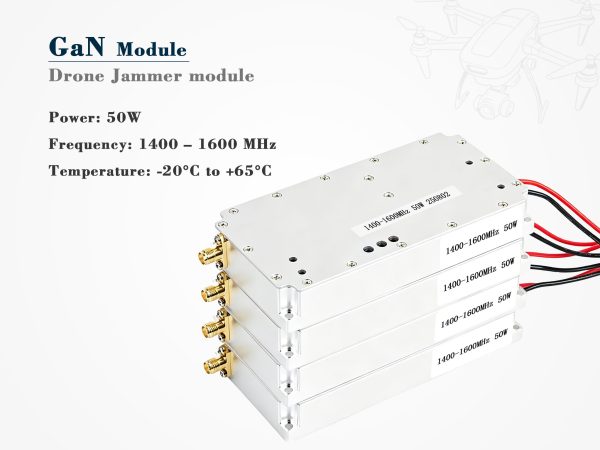
50W LDMOS Drone Jammer Module 5725-5850MHz
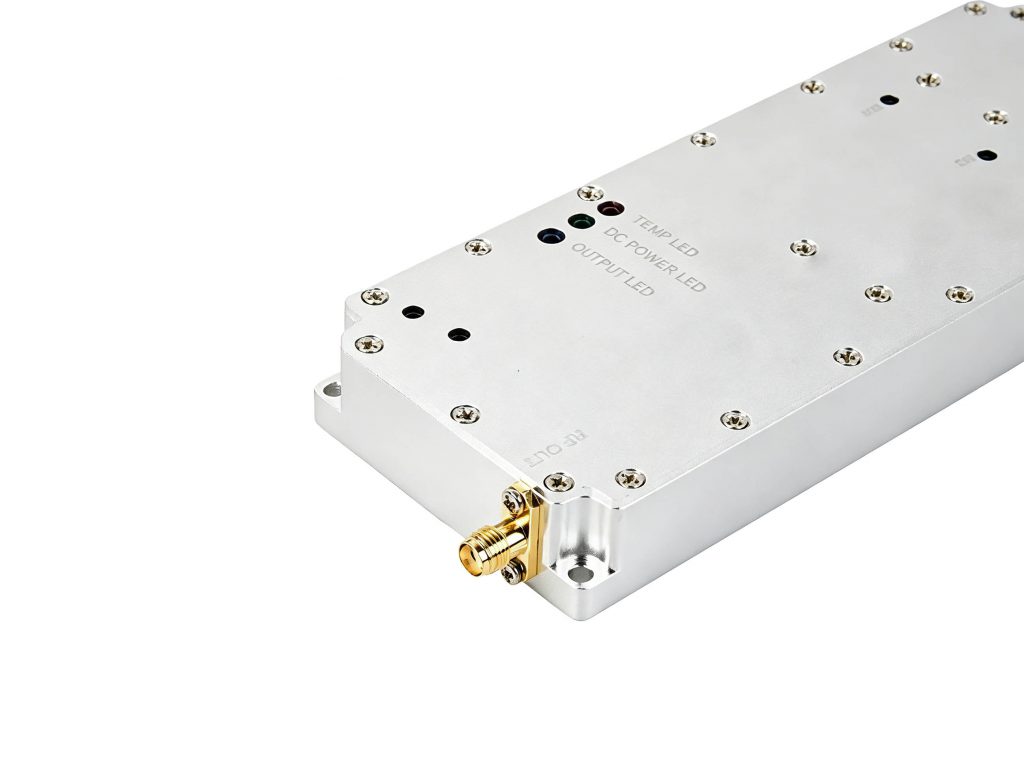
50W drone jammer module (5725–5850MHz) with LDMOS, 47±1dBm, 28V, SMA, 300g. Built-in noise modulation, customizable sweep. Compact 5.8GHz counter-UAS solution.
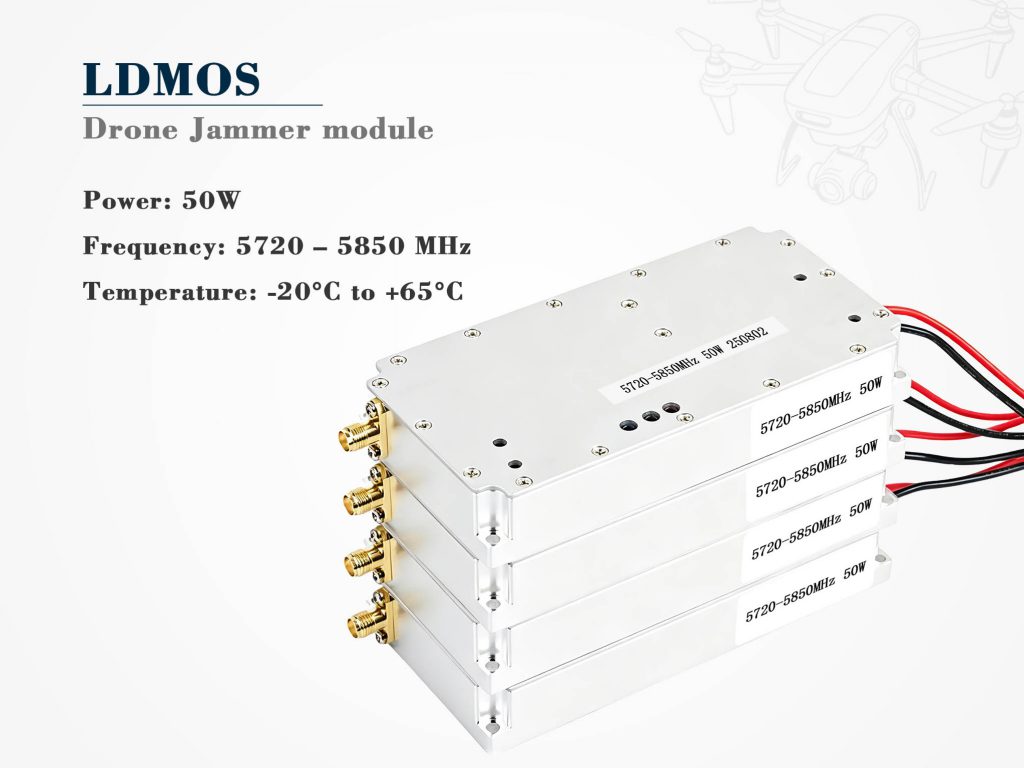
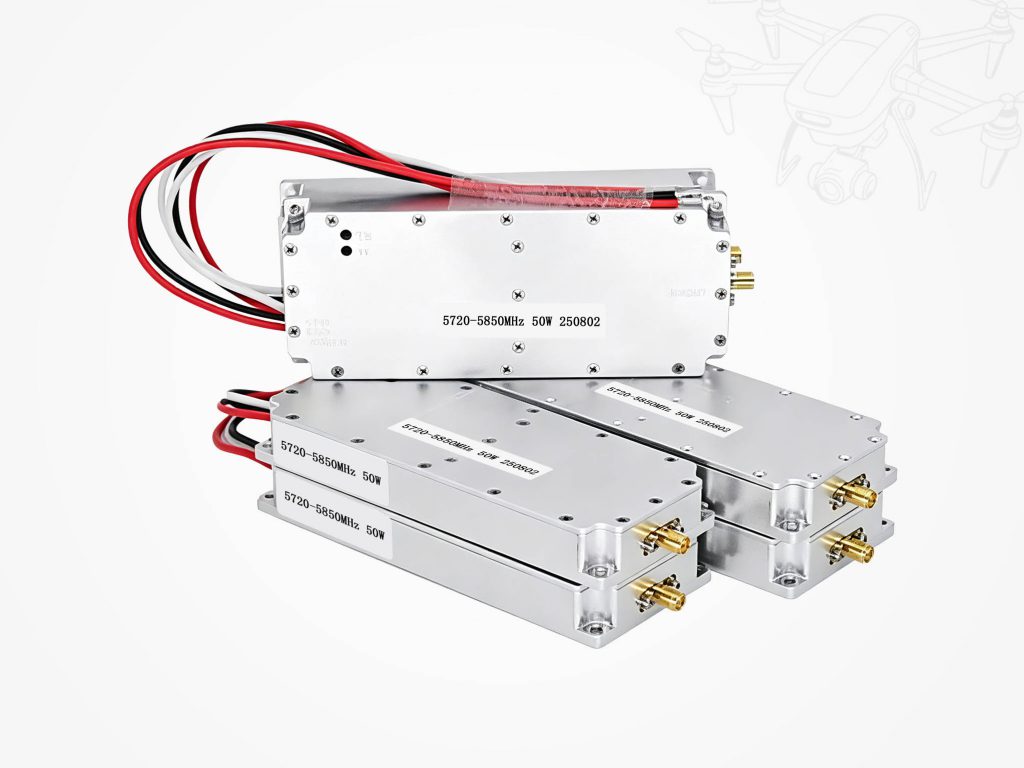
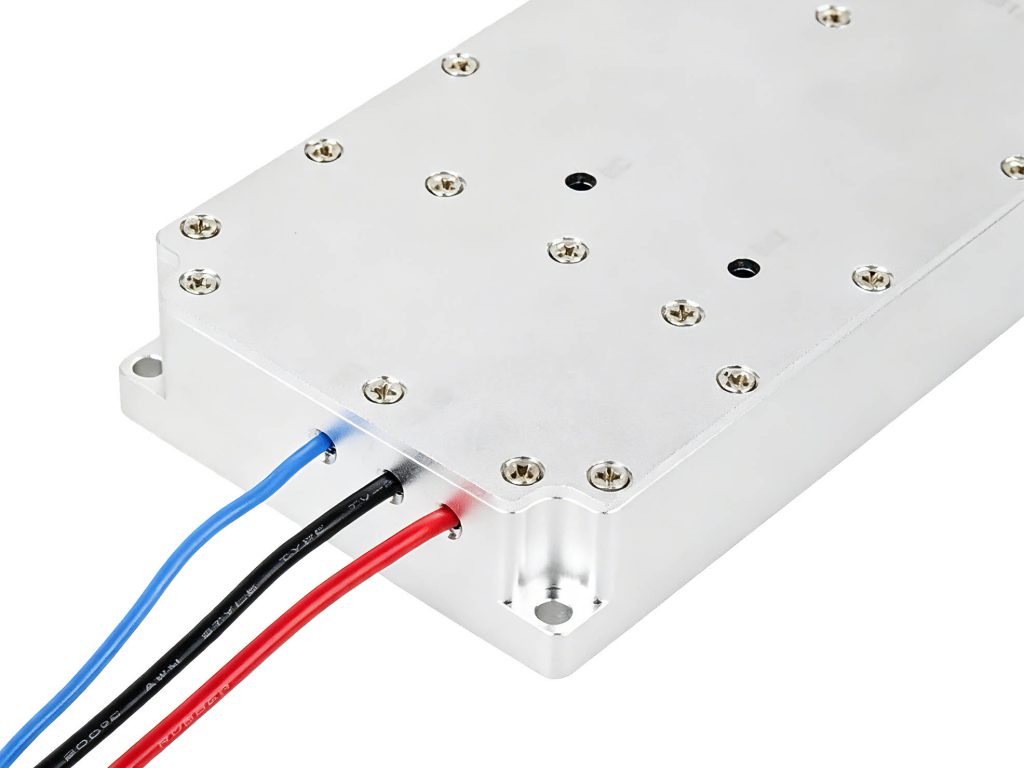
Technical Specifications
| Parameter | Specification | Notes |
| Frequency range | 5725 – 5850 MHz | Extended 5720-5850 MHz on request |
| Output power | 50 W (47 ± 1 dBm) | At SMA female port, any mode |
| Supply voltage | 24 – 28 V DC | Nominal 28 V for full power |
| Current draw | ≤ 3.2 – 4.5 A | At 50 W output |
| Modulation source | Built-in high-speed noise | Custom VCO, DDS, SDR options |
| Analog scan speed | 270 kHz (default) | Customizable 100 – 500 kHz |
| Input / output impedance | 50 Ω | SMA female connector |
| Protection LEDs | Power, overvoltage, overtemperature | Real-time status |
| Operating temperature | -20 to +65 °C | Baseplate temperature |
| Dimensions (L×W×H) | 117 × 58 × 18 mm | Custom form factors available |
| Weight | 300 g | Module only |
| Base material | Copper heat spreader with LDMOS device | High thermal conductivity |
Product Details
Once you start tackling modern drones, you quickly learn that the 5.8 GHz band is where the real fight happens. It’s crowded with FPV video feeds, telemetry bursts, and increasingly sophisticated frequency-hopping control links. A generic wideband noise source isn’t always enough — you need dedicated power exactly where those signals live. That’s exactly why we built this 50-watt LDMOS drone jammer module, centered on the 5725–5850 MHz window and purpose-tuned to make every watt count in the upper ISM band.

Why LDMOS Makes Sense at 5.8 GHz
Gallium nitride gets a lot of attention, but LDMOS still holds a sweet spot for cost-effective, rock-solid performance in the C-band. The transistor inside this module is a laterally diffused metal-oxide semiconductor optimized for high peak-to-average ratios and excellent thermal stability at 5.8 GHz. Paired with a copper heat spreader, it stays linear enough to handle complex modulations while pushing a full 50 W (47 ± 1 dBm) to the SMA connector. And because LDMOS is inherently rugged, the module tolerates mismatched loads that would make more fragile devices fold back — a handy trait when you’re quickly swapping antennas in the field.
The architecture is kept deliberately simple: an integrated high-speed noise modulation source feeds the LDMOS power stage, which then blankets the whole 160 MHz span with dense, unstructured noise. No external waveform generator is required for basic denial operations. If your threat scenario calls for something more precise, a modulation input lets you bypass the internal source and inject VCO, DDS, or SDR-generated signals straight into the chain.
Small Footprint, Serious Reach
Don’t let the pocket-sized form factor fool you. Weighing just 300 grams and barely larger than a smartphone, this module slips easily into handheld jammers, drone-shield boxes, or compact fixed-site enclosures. The SMA female output keeps the RF interface standard, so you can spin on anything from an omnidirectional whip to a high-gain panel antenna without adapter headaches.
Because 5.8 GHz signals suffer from higher free-space path loss than lower bands, antenna selection is critical. Pair this module with a decent 12-15 dBi flat-panel or parabolic antenna, and the effective radiated power becomes more than enough to swamp drone video receivers and force a failsafe return-to-home at tactically useful ranges. The module’s built-in sweep capability lets you dance across the entire band 100 to 500 thousand times per second, leaving zero clean dwell time for frequency-hopping downlinks.
Thermal Design That Keeps Its Cool
At 50 watts and a current draw of up to 4.5 amps, the module generates heat you have to take seriously. The copper heat spreader underneath the LDMOS die is your primary thermal interface. For continuous-duty jamming, bolt the baseplate to an aluminum chassis wall or a finned heatsink. A small active fan drops the thermal resistance even further, though passive cooling alone works fine for intermittent sweeps at room temperature. The onboard LEDs give you an instant warning if supply voltage goes too high or the substrate temperature creeps past 65°C, so there’s no guessing whether the module is still in its safe operating zone.
Customization for Mission-Specific Needs
The standard build gets most units into the field, but we regularly adapt the platform for specialized deployments:
-
Frequency extension: While 5725–5850 MHz covers the core ISM band, the matching network can be stretched to 5720–5850 MHz or shifted slightly for non-standard channels.
-
Waveform source: Replace the internal noise source with a VCO for swept-tone barrage, a DDS for precision chirp generation, or an SDR interface for protocol-aware smart jamming.
-
Mechanical packaging: Need the module in a tube for mast mounting, or a flat pack for drone integration? Envelope and connector orientation are flexible.
-
Sweep speed tuning: Adjust analog scan rates anywhere from 100 kHz to 500 kHz to match the target’s exact hopping rate.
Each customized module still passes the same battery of load-pull, spectral purity, and temperature tests as the standard version. No compromises, just genuine flexibility.
Frequently Asked Questions
Case Studies
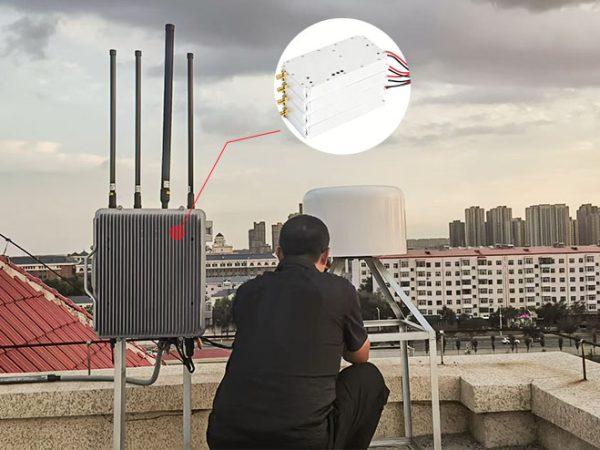
Heilongjiang Weather Center Completes Anti-Drone System Upgrade with Three High-Power Drone Jammer Modules

Tangshan Chem Plant Sealed Drone Gaps With 3 GaN Wideband Modules

How a National Prison Integrated Our Drone Jamming Module Into Their Fixed Counter-Drone System

Integrating Core RF Power: OEM Drone Jamming Module for Oil Refinery Security | Case Study
Send Us a Message
Related Products
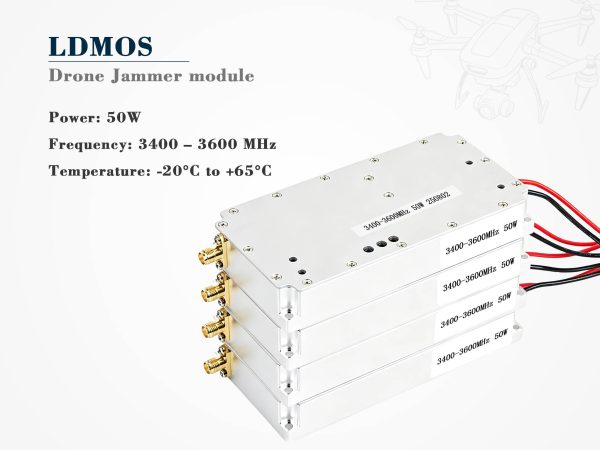
3400–3600 MHz 50W Drone Countermeasure Module
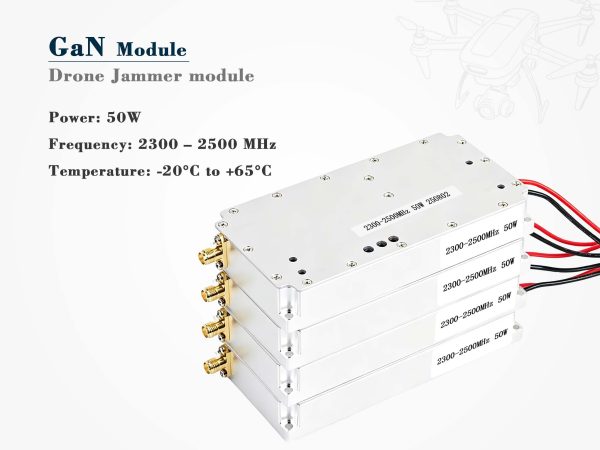
2300–2500MHz 50W GaN Module for Drone Countermeasure and Signal Shielding
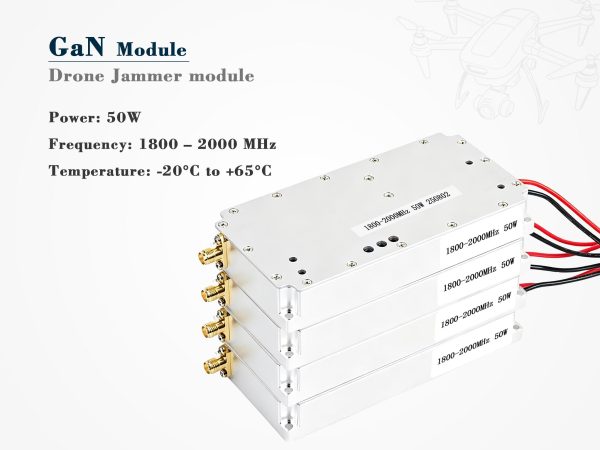
Powerful 50W GaN Jammer Module 1800-2000MHz