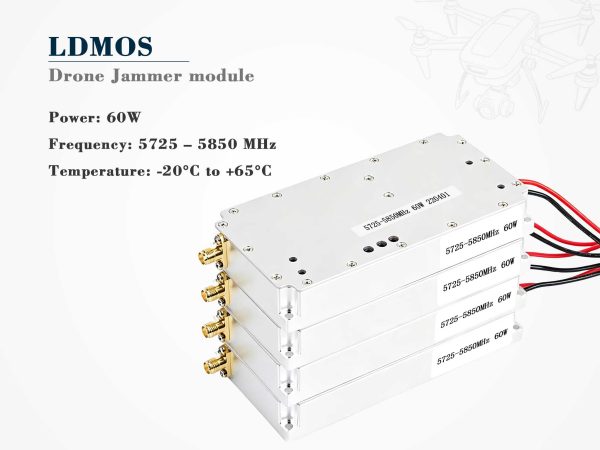
60W LDMOS Drone Jamming Module 2000-2200MHz
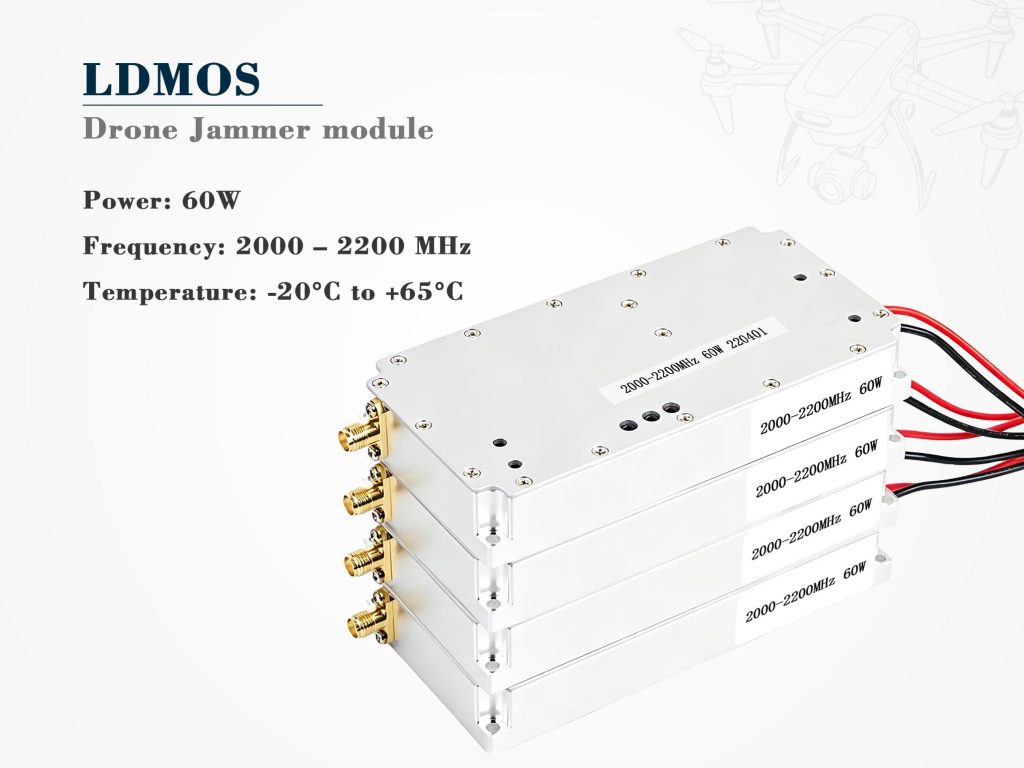
60W LDMOS drone jamming module covers 2000-2200MHz with built-in analog sweep, 60W output, 12-14V DC, 12A max, 138x50.5x17mm, SMA, lightweight 0.22kg.
Technical Specifications
| Parameter | Specification | Notes |
| Frequency range | 2000-2200 MHz | Covers common drone control and FPV video links |
| Output power | 60 W (47.8 dBm) typical | LDMOS saturated output |
| Supply voltage | DC 12-14 V | Compatible with 3S/4S LiPo or vehicle DC |
| Current draw | ≤12.0 A at 13.8 V, 60 W output | Maximum draw under full load |
| Modulation source | Built-in high-speed analog sweep | No external generator required |
| Analog scan speed | <2 ms full band (2000-2200 MHz) | Factory preset, customizable |
| Input / output impedance | 50 Ω | SMA female connector |
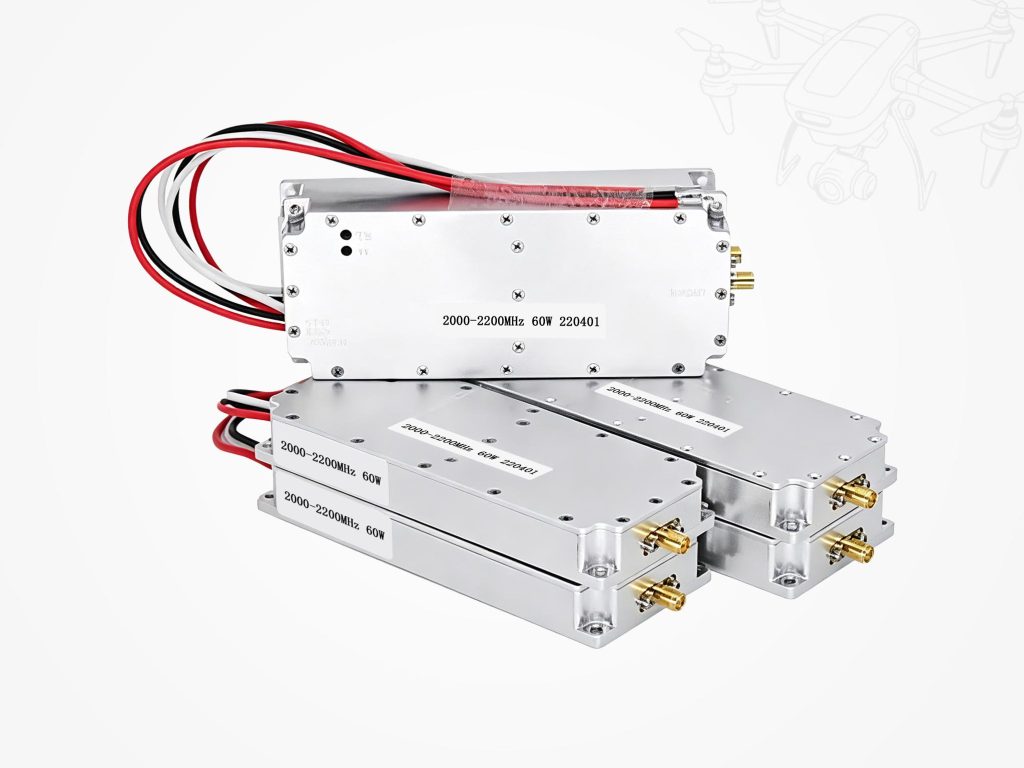
| Protection LEDs | Green: Power, Red: VSWR alarm | Indicates absorptive protection active |
| Operating temperature | -20 to +65 °C | Derating recommended above 60 °C |
| Dimensions (L×W×H) | 138 x 50.5 x 17 mm | Ultra-compact low-profile design |
| Weight | 0.22 kg | Integrated baseplate included |
| Base material | Aluminum alloy, high-thermal PCB | Corrosion-resistant, efficient heat spreader |
Product Details
When physical space and DC power are limited but effective drone disruption is non-negotiable, a focused S-band solution makes sense. This 60W drone jamming module delivers solid 60-watt output across the 2000–2200 MHz range, targeting the control and FPV video links commonly used by consumer and commercial drones. Built around a proven LDMOS amplifier stage and an integrated high-speed analog sweep source, it eliminates the need for bulky external signal generators. The module measures just 138 x 50.5 x 17 mm and weighs 0.22 kg, making it an easy fit for handheld jamming guns, compact fixed-site boxes, and lightweight UAV payloads.
Why LDMOS for 2.0–2.2 GHz
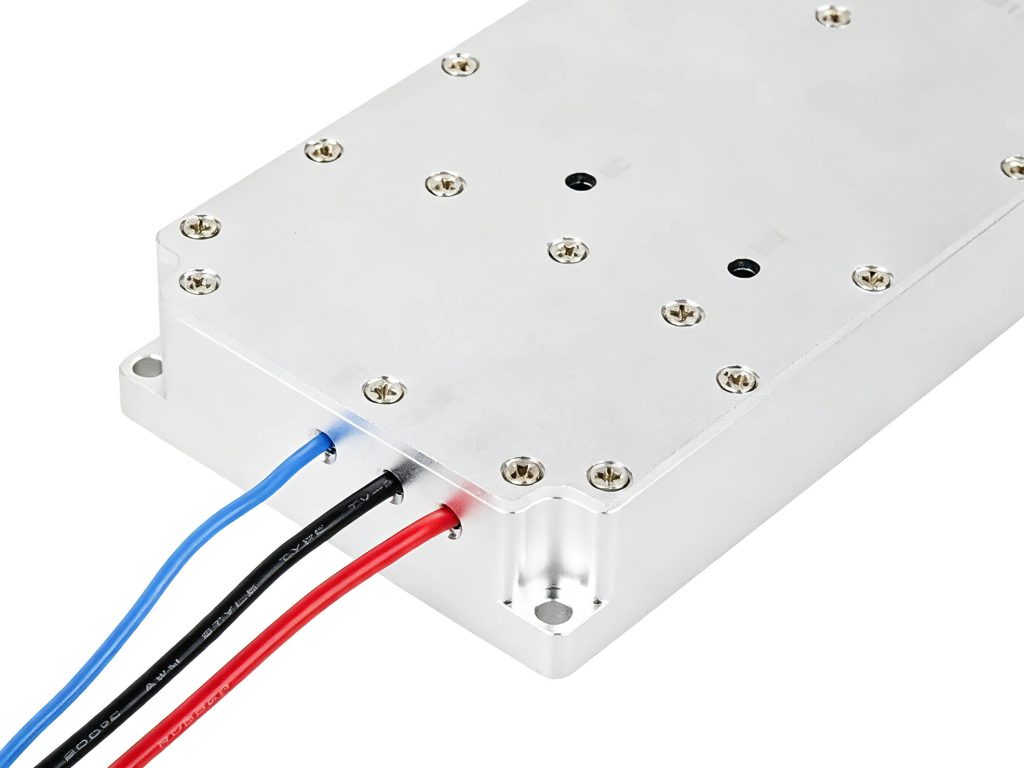
LDMOS technology still offers an excellent balance of cost, linearity, and ruggedness at S-band. In this 60W drone jamming module, the LDMOS device operates at an efficiency of ≥40%, fed by a low-voltage 12–14 V DC supply. Peak current draw reaches 12 A at full saturated output, which aligns well with 3S or 4S LiPo battery packs or standard vehicle DC buses. The aluminum alloy base material and high-thermal-conductivity PCB pull heat away from the transistor, keeping junction temperatures safe across the full -20°C to +65°C ambient range without forced air in most applications.
Built-in Analog Sweep Source
A key differentiator is the fully self-contained modulation engine. The 60W drone jamming module generates its own high-speed analog chirp, sweeping the entire 2000–2200 MHz band in under 2 milliseconds. This creates a dense, gap-free jamming signal that overwhelms frequency-hopping receivers. Sweep speed is preset at the factory and can be customized if specific threat waveforms are needed. No external DDS module, reference oscillator, or control software is required—just connect DC power and an antenna via the SMA female output port.
Simple Control and Rugged Protection
TTL on/off logic keeps integration simple: apply +5 V or leave the control pin floating to enable the 60W drone jamming module; pull the pin to ground to disable it. Onboard protection includes an absorptive VSWR safeguard right at the RF output. Should an antenna disconnect or break, reflected energy gets dissipated harmlessly instead of travelling back into the LDMOS stage. A red LED illuminates to flag a high-VSWR condition, while a green LED confirms normal powered operation. Output VSWR is specified at ≤2.0 across the band when connected to a 50 Ω load.
Integration-Ready Footprint
The 138 mm length, 50.5 mm width, and 17 mm height allow this 60W drone jamming module to slide into tight enclosures with room to spare. Four corner mounting holes simplify mechanical integration, and the nickel-plated aluminum body resists corrosion in outdoor or humid environments. Typical deployment scenarios include fixed perimeter defense at critical infrastructure sites, vehicle-mounted convoy protection, and portable drone countermeasure devices. When combined with a detection trigger, the module responds instantly, filling the 2.0–2.2 GHz band with continuous swept power to create a reliable no-fly bubble.
Frequently Asked Questions
Case Studies
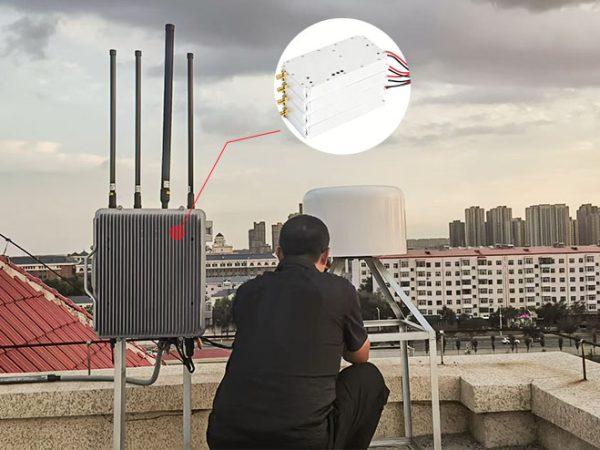
Heilongjiang Weather Center Completes Anti-Drone System Upgrade with Three High-Power Drone Jammer Modules

Tangshan Chem Plant Sealed Drone Gaps With 3 GaN Wideband Modules

How a National Prison Integrated Our Drone Jamming Module Into Their Fixed Counter-Drone System

Integrating Core RF Power: OEM Drone Jamming Module for Oil Refinery Security | Case Study
Send Us a Message
Related Products
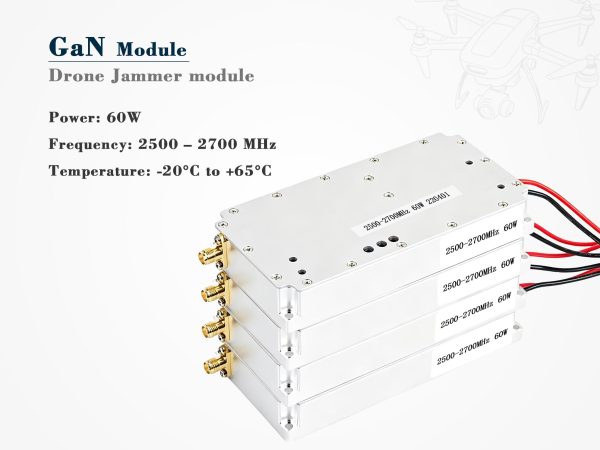
60W 2500–2700MHz GaN Drone Jammer Module
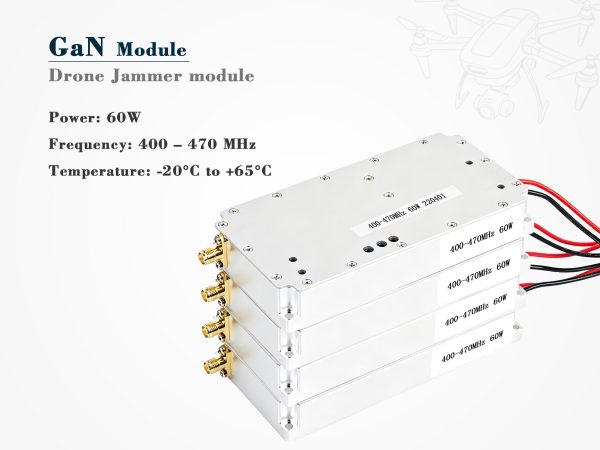
60W GaN Drone Jammer Module 400-470MHz
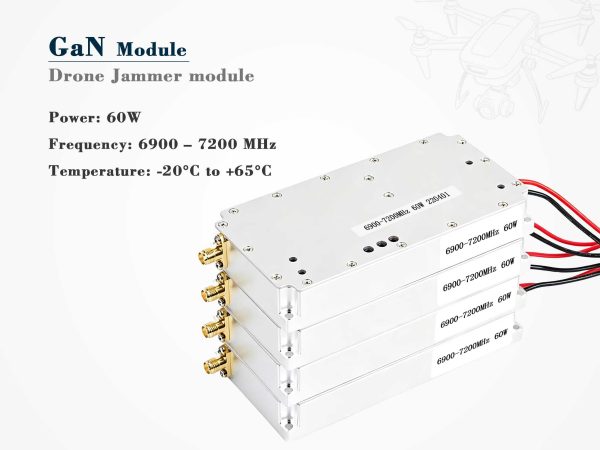
60W GaN Jamming Module: Compact 6900–7200MHz Counter-Drone Power