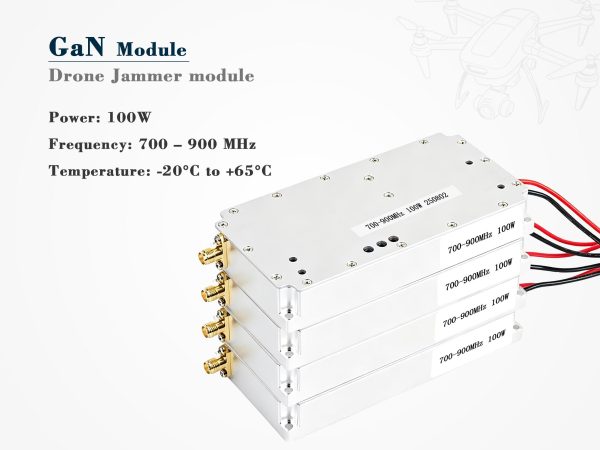
100W 700-840MHz LDMOS Drone Jammer Module – Rugged & Customizable
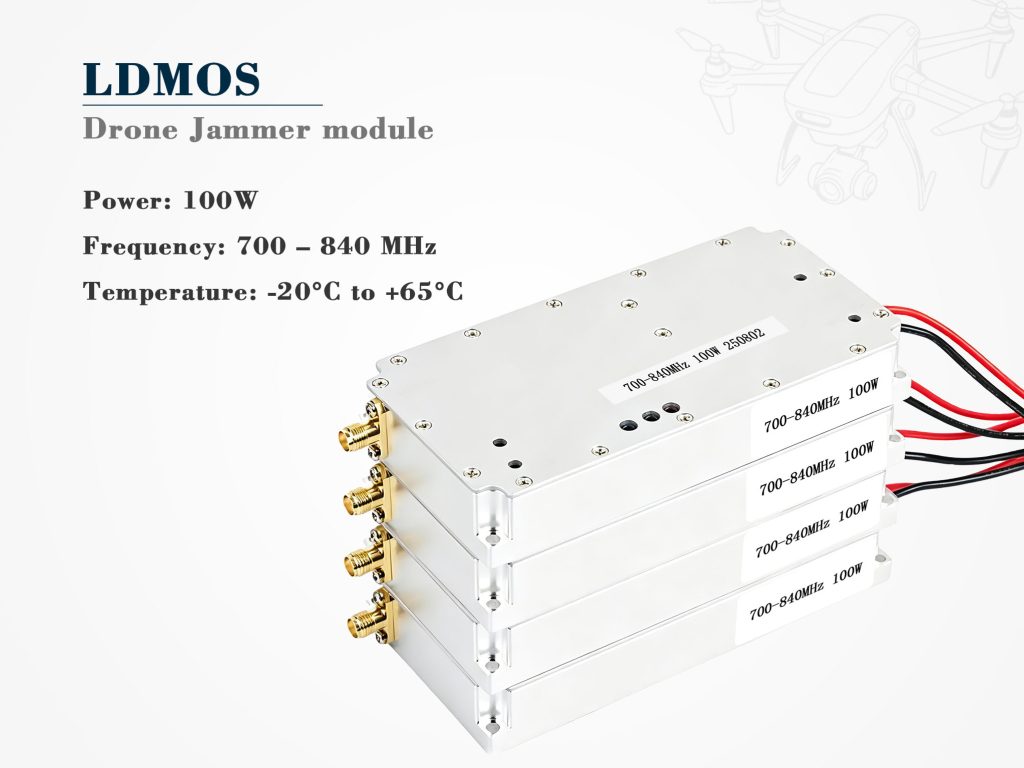
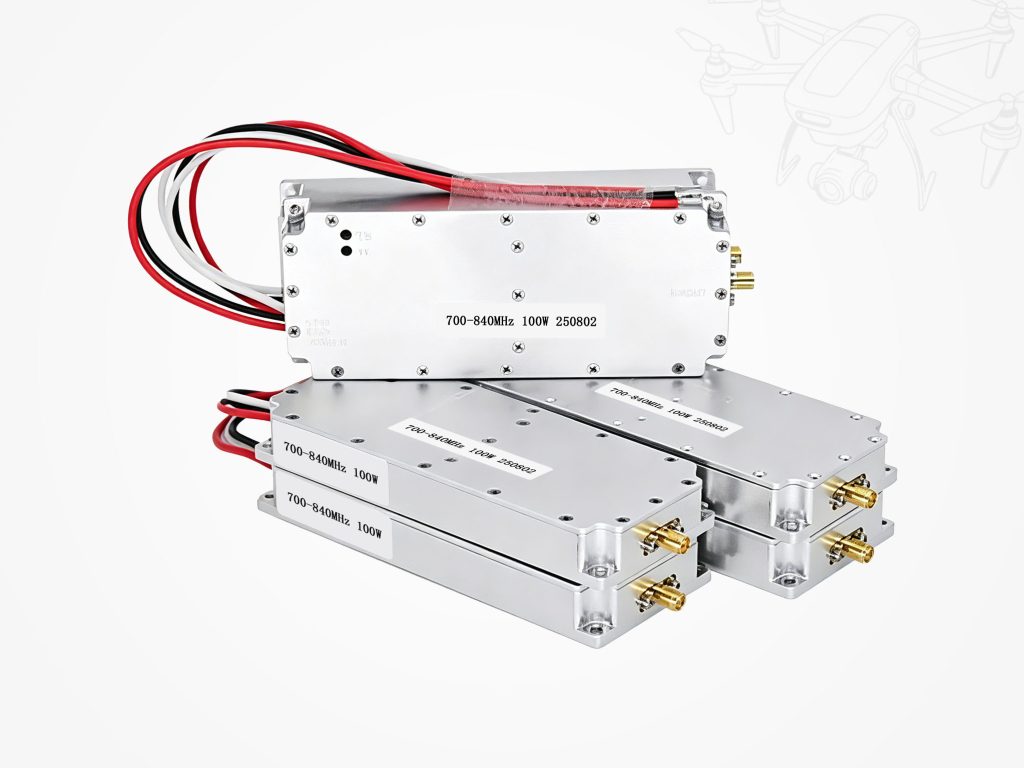
100W drone jammer module covers 700-840MHz with 50±1dBm output, 28V, ≤9.2A, built-in noise source, 270KHz scan, and compact 150×80×22mm. Custom options for VCO/DDS/SDR.
Technical Specifications
| Parameter | Specification | Notes |
| Frequency range | 700 – 840 MHz | Fixed band, other bands on request |
| Output power | 50 ± 1 dBm (100W) | Measured at 28V, CW mode |
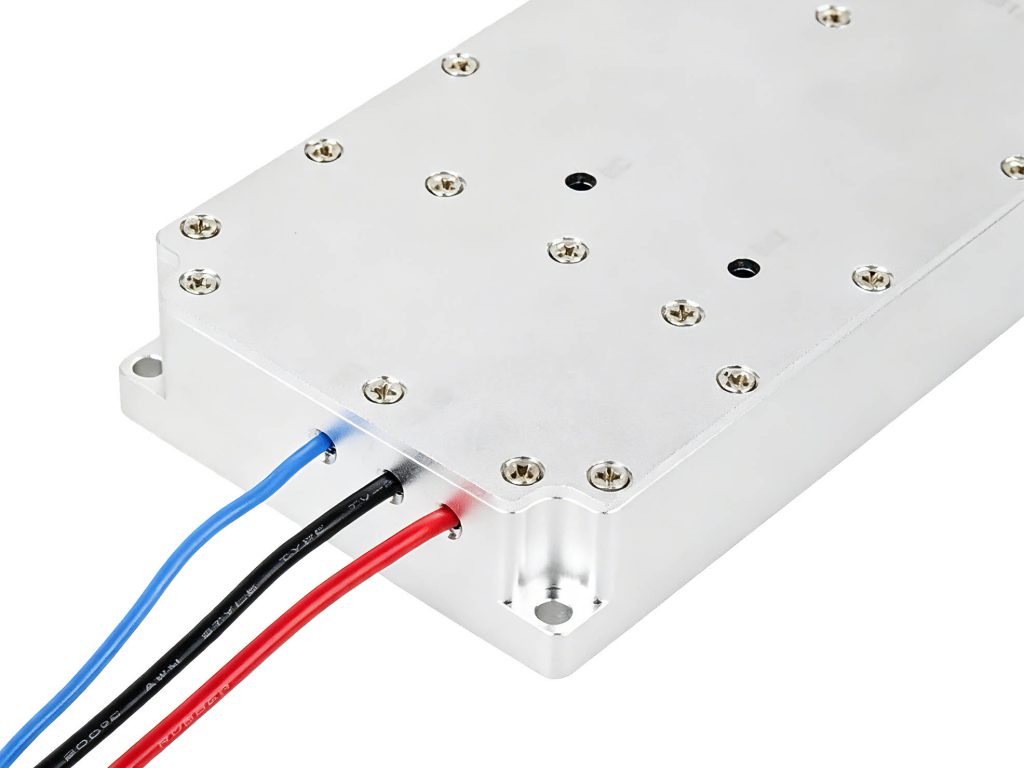
| Supply voltage | 28 – 32 V DC | Nominal 28V; absolute max 33V |
| Current draw | ≤ 9.2 A | At 100W output, 28V |
| Modulation source | Built‑in high‑speed noise generator | Options: VCO, DDS, SDR |
| Analog scan speed | 270 kHz (default) | Customizable 100‑500 kHz |
| Input / output impedance | 50 Ω | N‑type female output; input is internal |
| Protection LEDs | Power, over‑voltage, over‑temperature | Red/green indicators |
| Operating temperature | ‑20 ~ +65 °C | Ambient, with proper heatsink |
| Dimensions (L×W×H) | 150 × 80 × 22 mm | Excluding connectors |
| Weight | 800 g | Approximate net weight |
| Base material | Aluminum alloy | Milled housing, anodized finish |
Product Details
Raw Power, Small Footprint
Don’t let the 150×80×22mm size fool you – this little brick pushes a genuine 100W of RF energy across the 700‑840MHz band. That’s the sweet spot where many off‑the‑shelf drones handle their command links and telemetry. With an output of 50±1 dBm, you’re not just tickling the receiver front‑end; you’re drowning it out. We’ve tested this drone jammer module against popular quadcopters and handheld UAVs, and the effect is immediate – dropouts, failsafe triggers, and forced landings happen within seconds. The secret lies in the LDMOS transistor, which delivers that muscle without needing a water‑cooled heatsink. Just bolt it to a decent aluminum plate and you’re good to go.
Power, Current, and Heat – What to Expect
Running at 28‑32V DC, the drone jammer module draws up to 9.2A when you’re flat out. That’s about 260W of DC input for 100W RF out – typical efficiency for a linear amplifier in this class. The operating range of ‑20 to +65°C covers most outdoor scenarios, from freezing mountaintops to hot vehicle trunks. We’ve intentionally kept the protection simple: three LEDs tell you if the power is on, if the voltage has crept above 32V, or if the internal temperature is climbing too high. When an over‑voltage or over‑temp condition occurs, the unit folds back the drive automatically, so you won’t cook the LDMOS. For continuous operation, we recommend a fan or a passive heatsink with at least 0.5°C/W thermal resistance – many of our clients use standard CPU coolers with great results.
Choose Your Signal Source – Standard or Custom
Out of the box, the drone jammer module includes a built‑in high‑speed noise modulation generator. It sweeps at 270KHz by default, but you can order it tuned anywhere between 100 and 500KHz if your target drones use different hopping patterns. That analog scan produces a dense, wide‑band interference footprint that’s more effective than a simple CW tone. However, we know that one size doesn’t fit all. That’s why we offer three alternative front‑end options: VCO (for fixed‑frequency continuous wave), DDS (for precise frequency hopping and chirp waveforms), or SDR (full software‑defined flexibility with external I/Q input). If you’re integrating this into a multi‑band system, the SDR version lets you synchronize with other bands and even implement a custom jamming algorithm – just feed it your baseband signal and let the LDMOS do the heavy lifting.
Rugged Enough for Real‑World Ops
The housing is milled from a single block of aluminum, which acts both as a shield and a heat spreader. Weight is kept at a reasonable 800g, making it light enough for handheld jammers or mast‑mounted enclosures. The RF connection is a standard N‑type female – rugged, weather‑proof, and easy to mate with any directional antenna or circulator. We’ve seen systems where two or three of these modules are stacked side‑by‑side to cover 700‑840MHz, 2.4GHz, and 5.8GHz simultaneously, all in a 2U rack drawer. The input impedance is 50Ω, matching most commercial antennas and power meters. One thing we always emphasise: because the output is true 100W, make sure your antenna can handle that power and your cabling has low loss – otherwise you’re wasting half your juice as heat in the coax.
Integration Tips from the Field
In practice, you’ll want a timing controller to pulse the drone jammer module on and off – continuous transmission heats things up fast, and most counter‑UAS tactics rely on burst jamming anyway. The internal modulation source can be triggered externally via a dedicated header (not shown in the basic spec, but available on request). Also, keep the supply leads short and thick; voltage drop at 9A can cause instability. We’ve had customers who simply used a 30V/10A bench supply and reported stable operation for hours. If you’re going portable, a 6‑cell LiPo (around 25V) won’t cut it – you need at least 8 cells or a boost converter. Lastly, don’t forget that this module emits high power; always use a dummy load during testing and keep a safe distance from your own receivers.
Frequently Asked Questions
Case Studies
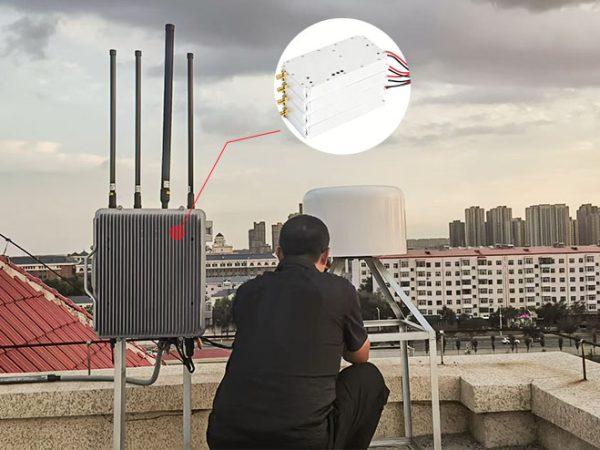
Heilongjiang Weather Center Completes Anti-Drone System Upgrade with Three High-Power Drone Jammer Modules

Tangshan Chem Plant Sealed Drone Gaps With 3 GaN Wideband Modules

How a National Prison Integrated Our Drone Jamming Module Into Their Fixed Counter-Drone System

Integrating Core RF Power: OEM Drone Jamming Module for Oil Refinery Security | Case Study
Send Us a Message
Related Products
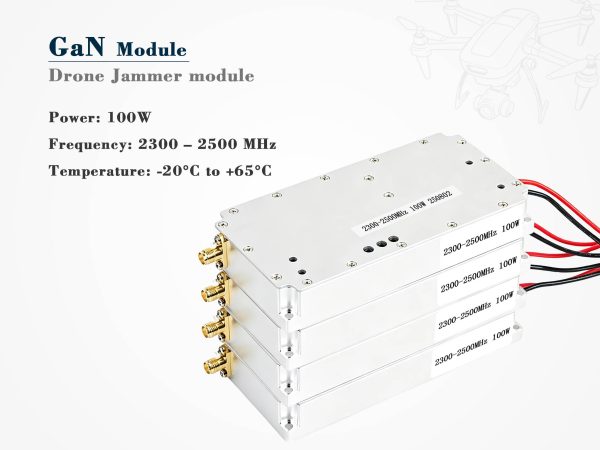
2300–2500 MHz 100W GaN Counter-UAV Module
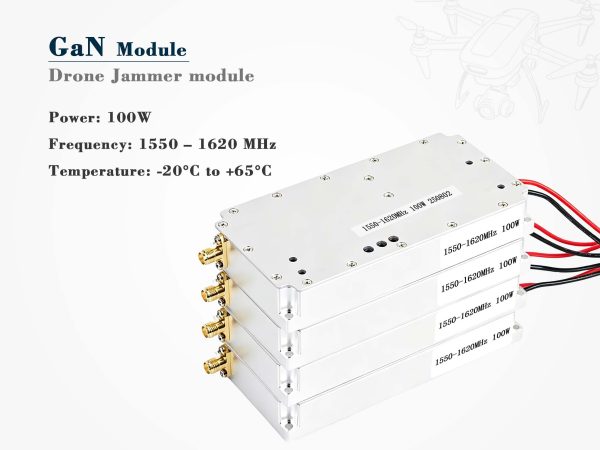
100W GaN Drone Jamming Module 1550–1620MHz
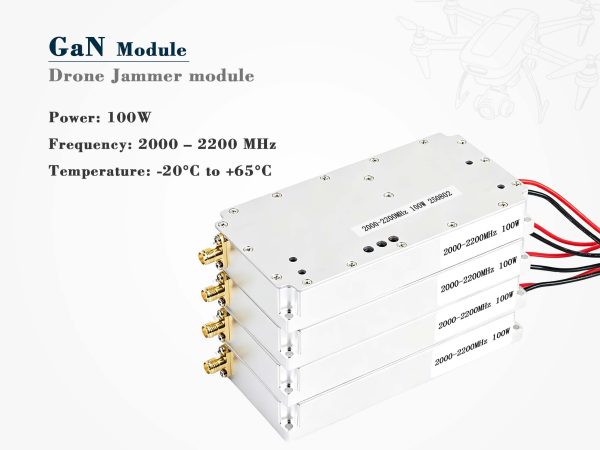
100W 2000–2200MHz GaN Analog Drone Interference Module