80W 3400–3600MHz Drone Jamming Module with VSWR Protection
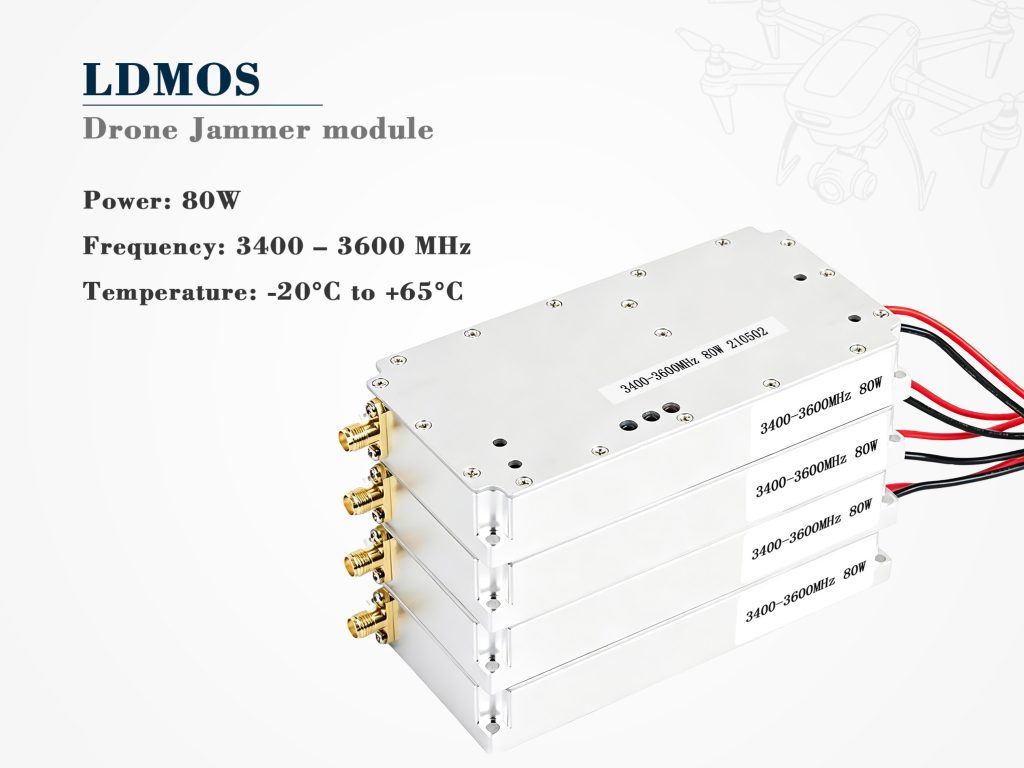
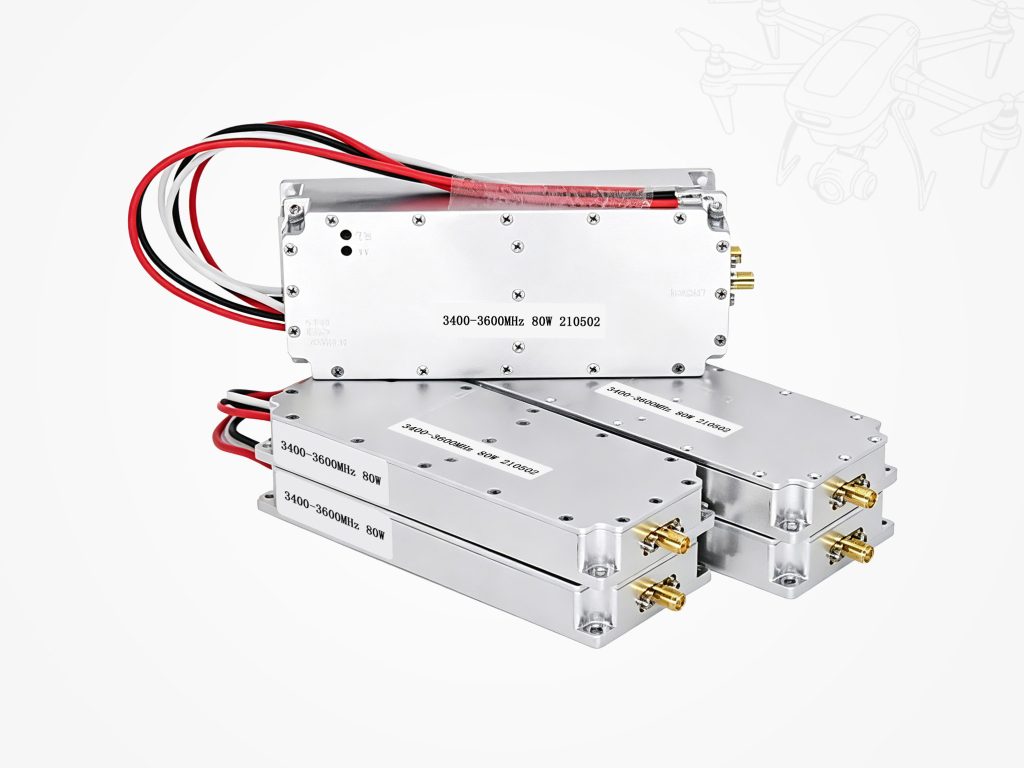
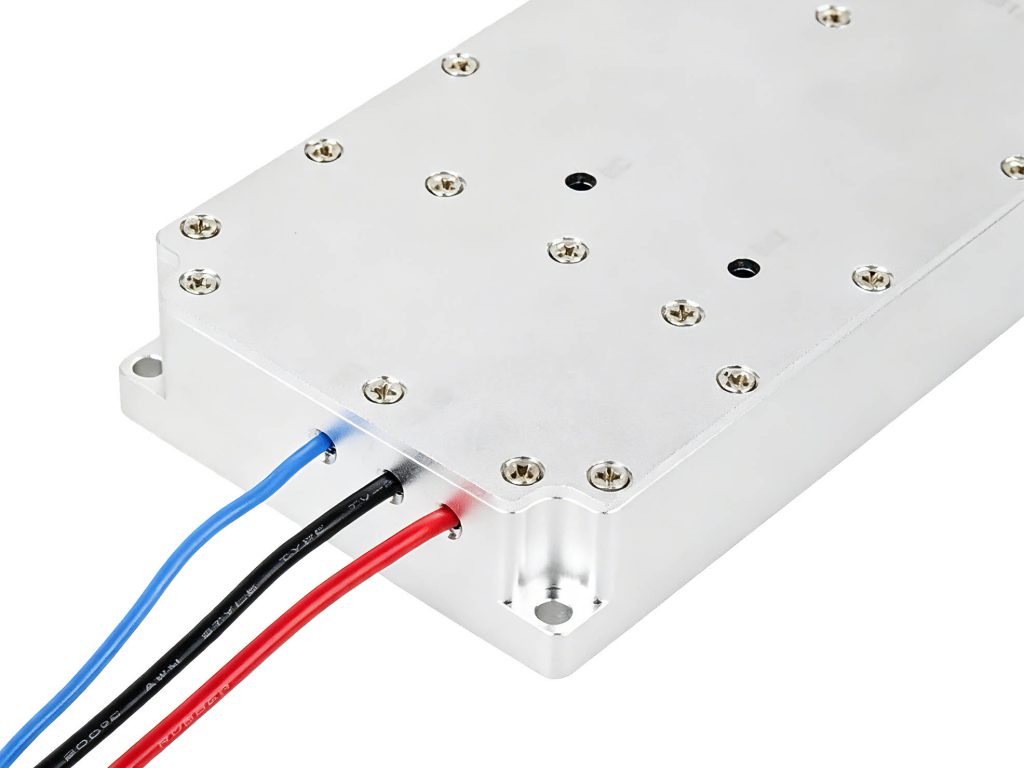
80W drone jamming module for 3400–3600MHz with built‑in analog sweep and absorptive VSWR protection. DC 24–29V, 10A, SMA out, 168×84×23mm. For heavy‑duty counter‑UAS.
Technical Specifications
| Parameter | Specification | Notes |
| Frequency range | 3400 – 3600 MHz | Full 200 MHz coverage |
| Output power | 80W (typical) | Measured at 50Ω load, 26V supply |
| Supply voltage | DC 24V – 29V | Nominal 26V recommended |
| Current draw | ≤ 10.0A | At maximum output power |
| Modulation source | Built‑in high‑speed analog sweep | VCO‑based, no external generator |
| Analog scan speed | > 50 MHz/ms | Covers band in < 4 ms |
| Input / output impedance | 50Ω (RF output) | Control input is high‑impedance TTL |
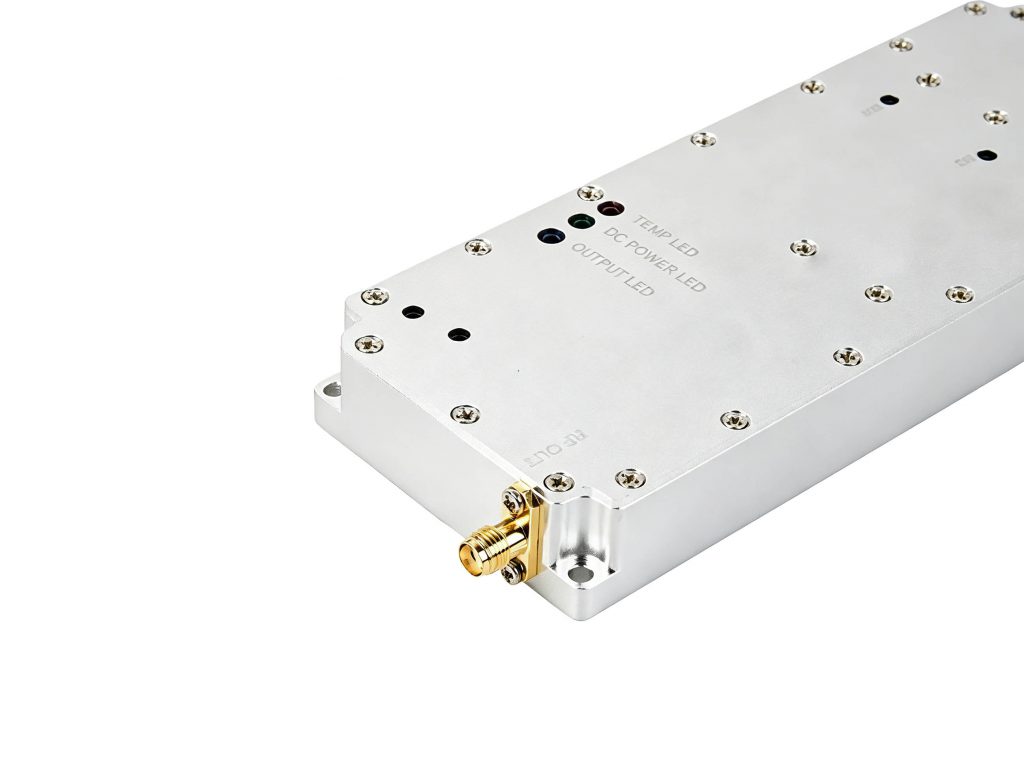
| Protection LEDs | Built‑in absorptive VSWR protection; over‑temp & over‑current (internal) | No external LED pins – protection is automatic and self‑resetting |
| Operating temperature | -20°C to +65°C | Ambient, with adequate heatsinking |
| Dimensions (L×W×H) | 168.5 × 84.5 × 23 mm | Excluding connectors and mounting tabs |
| Weight | 0.55 kg | Approximately |
| Base material | Aluminium alloy (6061) | Provides thermal spread and structural strength |
Product Details
Why 3.5GHz Is Becoming a Hot Battlefield for Drone Jamming
If you’ve been paying attention to the latest drone developments, you’ll notice that 3.4–3.6GHz is no longer just a cellular band. More and more military‑grade and high‑end commercial drones are using this spectrum for secure command links, beyond‑line‑of‑sight telemetry, and even radar payloads. The 3.5GHz range offers better propagation than 5.8GHz and more available bandwidth than 2.4GHz, making it attractive for long‑range and interference‑resistant drone operations. That means if your counter‑UAS system doesn’t cover this band, you’re leaving a serious blind spot.
This drone jamming module is built to fill that gap with authority. It puts out a genuine 80W of swept interference across the entire 3400–3600MHz range, and it does it without needing an external signal generator. The built‑in high‑speed analog sweep source handles the modulation internally – just apply power and you’re good to go.
80W – That’s a Different League
Eighty watts is a significant step up from the typical 20W modules you see on the market. With that kind of power, and a decent 12–15dBi directional antenna, you’re looking at effective jamming ranges well beyond 1 kilometre in open terrain – sometimes up to 1.5–2km depending on line‑of‑sight conditions. This is the kind of power you need for vehicle‑mounted systems, fixed site defence, or any scenario where the drone threat is at medium to long range.
Of course, power comes with appetite. The module draws about 10A at 26V, which works out to roughly 260W of DC input. With an efficiency of ≥40%, you get over 80W of RF out – and the rest becomes heat. This is not a module you can run without serious cooling. We’ll talk more about thermal management in a moment, but the short version is: you need a proper heatsink and active airflow for continuous operation.
Built‑In VSWR Protection – a Lifesaver
One of the standout features here is the built‑in absorptive VSWR protection. What does that mean? If your antenna gets damaged, disconnected, or severely mismatched, the reflected power can fry a normal amplifier in milliseconds. This module includes an internal circulator/isolator that absorbs that reflected energy, protecting the output stage from catastrophic failure. It’s the kind of feature you usually only find on expensive military‑grade units, and it gives you real peace of mind when you’re deploying in the field where antennas can take a beating.
The output VSWR is specified at ≤2.0, which is perfectly acceptable for a broadband amplifier. But even if the load swings beyond that, the protection circuitry will kick in and save the day. No external control or monitoring needed – it’s all automatic.
Control and Integration – Still Simple
Despite the higher power, we kept the control interface as simple as its smaller siblings. A +5V signal or a floating pin turns the module on; grounding it turns it off. That’s it. You can drive it from a GPIO, a toggle switch, or a relay. No serial commands, no I²C, no firmware headaches.
The RF output is a standard SMA female connector, so you can attach any 50Ω antenna or external filter. The input impedance is also 50Ω, but since the module has its own internal sweep source, you don’t need to feed it an external RF signal – just connect the antenna and power, and you’re jamming.
Power supply needs are straightforward: DC 24–29V, capable of delivering at least 12A continuously to give some headroom. This is a common range for 6‑cell Li‑ion packs, lead‑acid batteries, and industrial power supplies. For a portable system, you’d need a fairly hefty battery pack – but that’s the price you pay for 80W.
Size, Weight, and Mounting
At 168.5 × 84.5 × 23mm and 0.55kg, this drone jamming module is larger and heavier than the 20W versions, but it’s still remarkably compact for 80W of RF power. It’s about the size of a small paperback book and weighs a bit over a pound. The aluminium baseplate (6061 alloy) doubles as a heat spreader, and there are mounting holes for secure attachment to a heatsink or chassis.
We recommend bolting it directly to a finned heatsink with thermal paste in between. For continuous operation, add a fan – a 80mm or 120mm fan blowing across the fins will keep temperatures in check. The operating temperature range is -20°C to +65°C ambient, so it can handle harsh outdoor conditions as long as the heatsink is sized appropriately.
Who Needs This Kind of Power?
This drone jamming module is for serious operators – defence contractors, government agencies, and large‑scale security integrators who need to protect airports, military bases, border areas, or critical infrastructure from drone threats. It’s also suitable for R&D teams testing drone resilience against high‑power jamming. The 3.5GHz band is particularly relevant for modern military drones, so if you’re dealing with that class of threat, 80W is not overkill – it’s the minimum.
We also see interest from event security for large stadiums and open‑air gatherings, where drones can pose safety and privacy risks. With this module, you have the range and power to cover a whole venue from a single point.
Thermal Management – Be Honest With Yourself
Let’s not sugarcoat it – 80W amplifiers get hot. Without a heatsink, you might get 5–10 seconds of operation before the internal over‑temperature protection shuts you down. With a good passive heatsink (say, 200×100×40mm with fins), you can run a 30% duty cycle – 30 seconds on, 60 seconds off. Add a high‑airflow fan, and you can run continuously at full power, as long as the heatsink temperature stays below 65°C. The module has internal over‑temp and over‑current protection (no external LEDs, but the protection trips automatically), so it won’t destroy itself if you push too hard – but you’ll get nuisance shutoffs if you undersize your cooling.
The Sweep Advantage – Fast and Wide
The internal analog VCO sweeps the entire 3400–3600MHz band at a speed faster than 50MHz per millisecond. That means the whole 200MHz range is covered in under 4 milliseconds. Against frequency‑hopping drones, that’s devastating – the jammer cycles through every possible channel so quickly that the drone can’t lock onto any frequency long enough to maintain a link. This is not a fixed‑frequency jammer; it’s a true broadband denial system.
Final Thoughts
This 80W 3.5GHz drone jamming module is a serious piece of kit. It’s not for hobbyists – it’s for professionals who need reliable, high‑power interference in a band that’s becoming increasingly crowded with drone traffic. The built‑in VSWR protection alone makes it worth a look, because replacing a blown output transistor on a 80W amp is expensive and time‑consuming. With this module, you get power, protection, and simplicity in one package.
Frequently Asked Questions
Case Studies
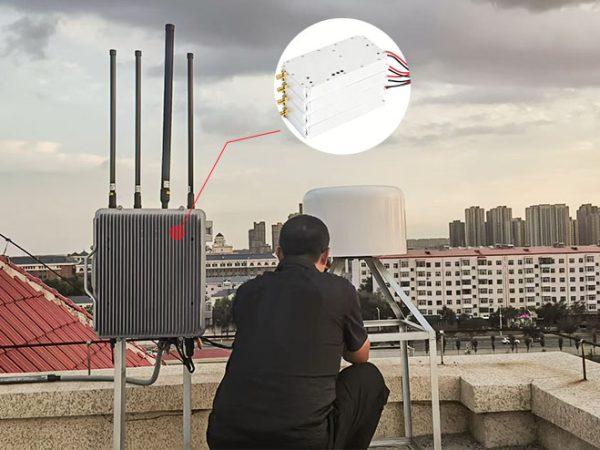
Heilongjiang Weather Center Completes Anti-Drone System Upgrade with Three High-Power Drone Jammer Modules

Tangshan Chem Plant Sealed Drone Gaps With 3 GaN Wideband Modules

How a National Prison Integrated Our Drone Jamming Module Into Their Fixed Counter-Drone System

Integrating Core RF Power: OEM Drone Jamming Module for Oil Refinery Security | Case Study
Send Us a Message
Related Products
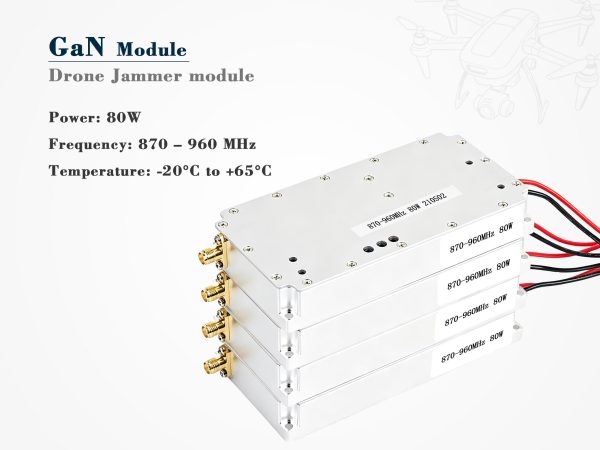
80W GaN Drone Jammer Module 870–960MHz | Analog Sweep
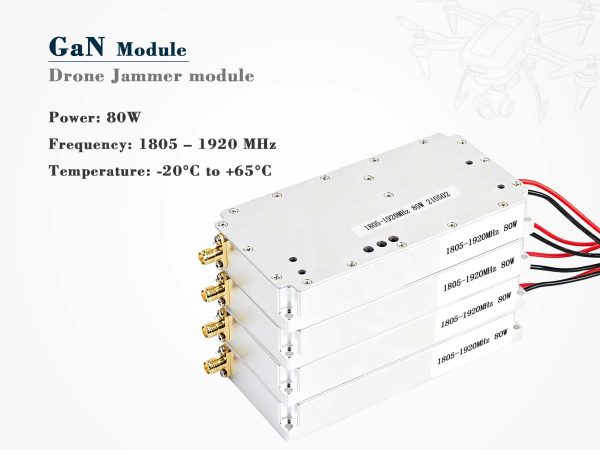
80W 1805–1920MHz GaN UAV Countermeasure Jammer Module
80W GaN Jammer Module: Powerful 2200–2400MHz Counter-UAS Solution