60W Anti-Drone Jamming Module: 135-175MHz LDMOS
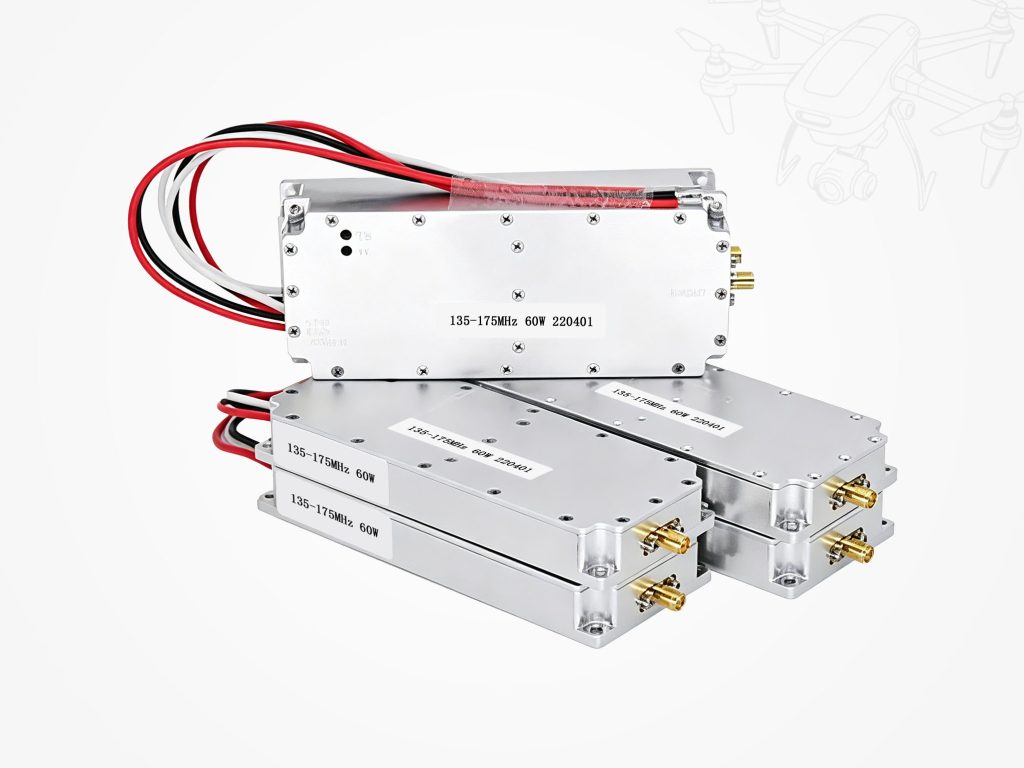
60W LDMOS anti-drone jamming module for 135-175MHz. Integrated analog sweep, 12-14V DC, 12A max. Compact: 138x50.5x17mm, 0.22kg. SMA output.
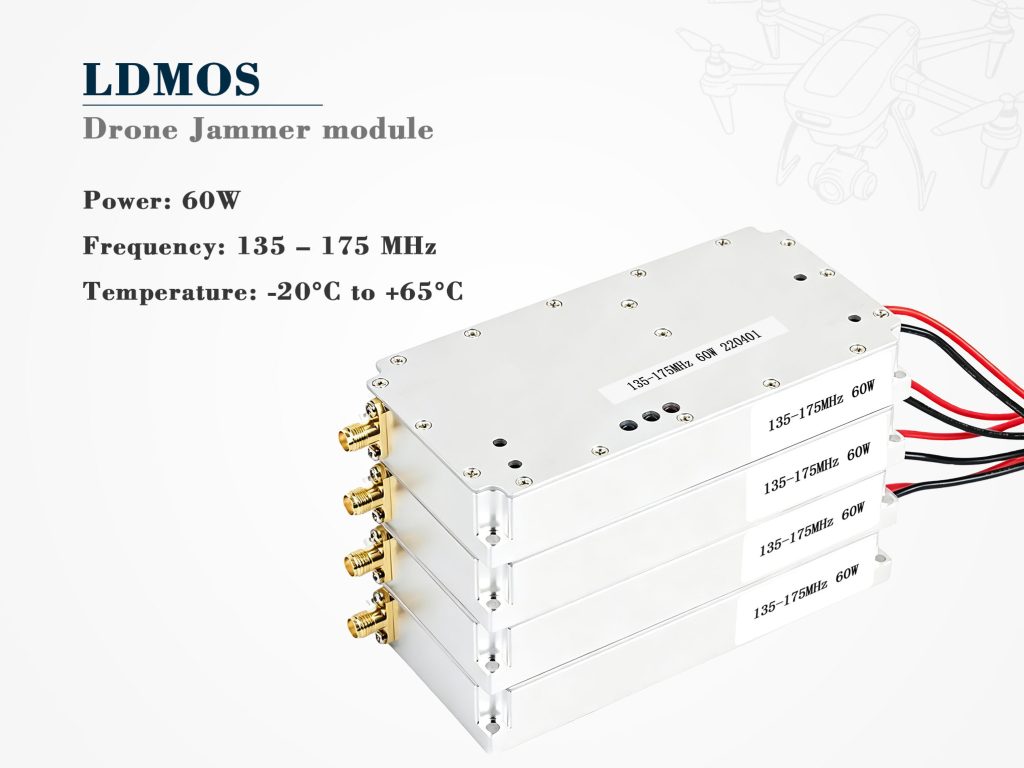
Technical Specifications
| Parameter | Specification | Notes |
| Frequency range | 135–175 MHz | Targets VHF drone control & telemetry bands |
| Output power | 60 W (CW) | LDMOS technology ensures stable output |
| Supply voltage | 12–14 V DC | Ideal for battery or vehicle power |
| Current draw | ≤12 A | At full 60 W output |
| Modulation source | Built-in high-speed analog sweep | No external generator needed |
| Analog scan speed | Configurable, fast sweep | Disrupts frequency-hopping signals |
| Input / output impedance | 50 Ohm | SMA female connector |
| Protection LEDs | Power‑on (green), VSWR fault (red) | - |
| Operating temperature | -20 to +65 °C | Field-ready in harsh environments |
| Dimensions (L×W×H) | 138 x 50.5 x 17 mm | Ultra-compact footprint |
| Weight | 0.22 kg | Lightweight for man-portable systems |
| Base material | Aluminum alloy, gold-plated contacts | Corrosion-resistant, excellent heat dissipation |
Product Details
When a low-flying drone depends on VHF-band control links, you need a jamming core that delivers raw power without demanding a rack full of support gear. The 60W Anti-Drone Jamming Module does exactly that. Spanning 135 to 175 MHz with a continuous 60 watts of RF, this single-board LDMOS module houses a high-speed analog sweep source, VSWR protection, and a 50-ohm SMA output inside a 138 × 50.5 × 17 mm aluminum chassis. At just 220 grams, it slides into portable drone guns, fixed-site counter-UAS boxes, or vehicle-mounted systems with minimal re-engineering.
VHF Punch Where It Counts
Many commercial and improvised drones still operate command-and-control or telemetry links in the VHF band. The 135–175 MHz window catches those signals and lets the 60W anti-drone jamming module flood them with wideband, noise-like interference. Because the power amplifier runs cleanly across the entire span, operators don’t need to pre-tune to a specific frequency. The module’s analog sweep engine hops fast enough to keep frequency-hopping receivers locked out, making it a practical choice for urban security patrols, border surveillance, or facility protection.
LDMOS: Rugged, Simple, Efficient
Why LDMOS instead of gallium nitride? For many VHF jamming tasks, LDMOS remains the sweet spot between cost, reliability, and ease of use. The device inside this 60W anti-drone jamming module pushes efficiency past 40%, pulling no more than 12 A from a standard 12–14 V DC bus. That means a compact LiFePO4 pack or a vehicle’s battery can keep it running for extended shifts. The transistor’s natural tolerance to mismatch stress is backed by an absorptive VSWR protection circuit, so the module shrugs off open or shorted antenna conditions without requiring external isolators.
Sweep Source Onboard – No Black Boxes
Field integration gets messy when a jammer needs a separate signal generator, a modulator board, and a pile of SMA jumpers. Here, everything lives on the same substrate. The integrated analog sweep generator creates a broadband jamming waveform without any extra boxes. Simply apply DC power and a TTL logic signal (+5 V or float = on, ground = off), and the module begins sweeping. The sweep rate is configurable, typically stepping fast enough to mimic noise over the entire 135–175 MHz band. For system integrators, that translates to fewer cables, lower weight, and fewer points of failure.
Built for the Tactical Edge
Operating from -20°C to +65°C, the module’s aluminum alloy baseplate pulls heat straight out of the LDMOS stage, so passive cooling is often sufficient. Gold-plated contacts on the SMA female connector withstand repeated mating cycles and resist corrosion in humid or salty air. With its simple on/off logic and compact footprint, the 60W anti-drone jamming module fits into ruggedized pelican cases, manpack frames, or pan-tilt platforms without hogging payload space. When the mission calls for a proven, no-nonsense VHF jamming building block, this module answers.
Frequently Asked Questions
Case Studies
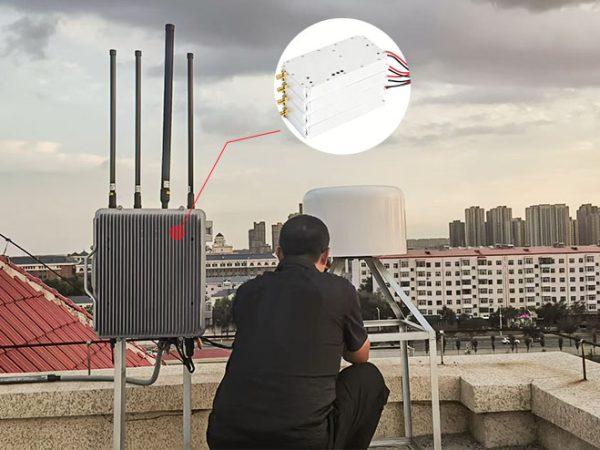
Heilongjiang Weather Center Completes Anti-Drone System Upgrade with Three High-Power Drone Jammer Modules

Tangshan Chem Plant Sealed Drone Gaps With 3 GaN Wideband Modules

How a National Prison Integrated Our Drone Jamming Module Into Their Fixed Counter-Drone System

Integrating Core RF Power: OEM Drone Jamming Module for Oil Refinery Security | Case Study
Send Us a Message
Related Products
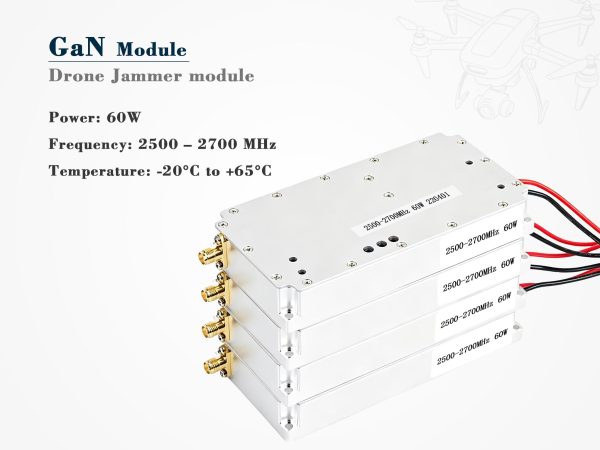
60W 2500–2700MHz GaN Drone Jammer Module
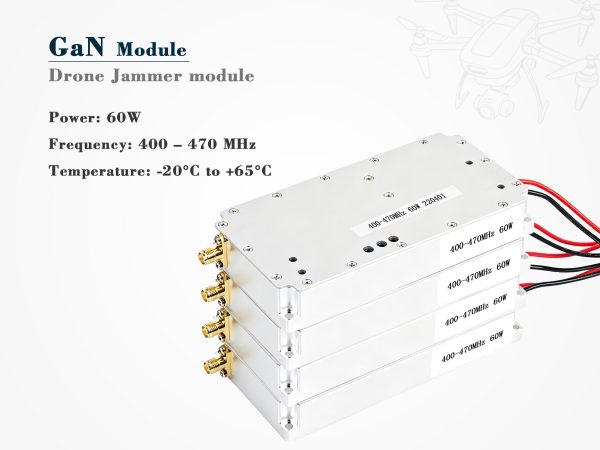
60W GaN Drone Jammer Module 400-470MHz
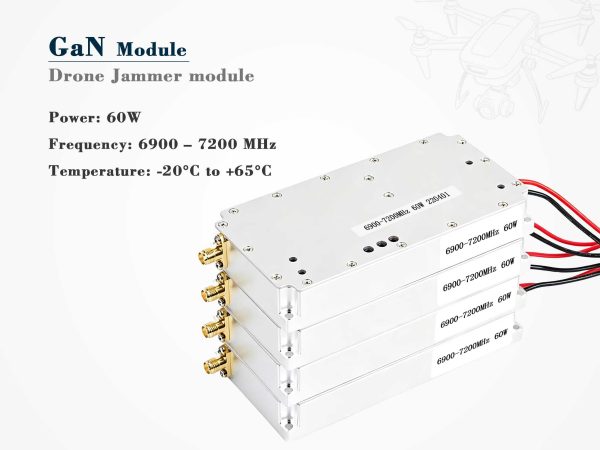
60W GaN Jamming Module: Compact 6900–7200MHz Counter-Drone Power