100W Drone Jamming Module – 500-600MHz LDMOS Blocker
100W drone jamming module covers 500-600MHz, 50±1dBm output, LDMOS design, 28-32V, ≤9.2A, 270KHz scan, N-female, 150×80×22mm, -20~+65°C. Custom VCO/DDS/SDR ready.
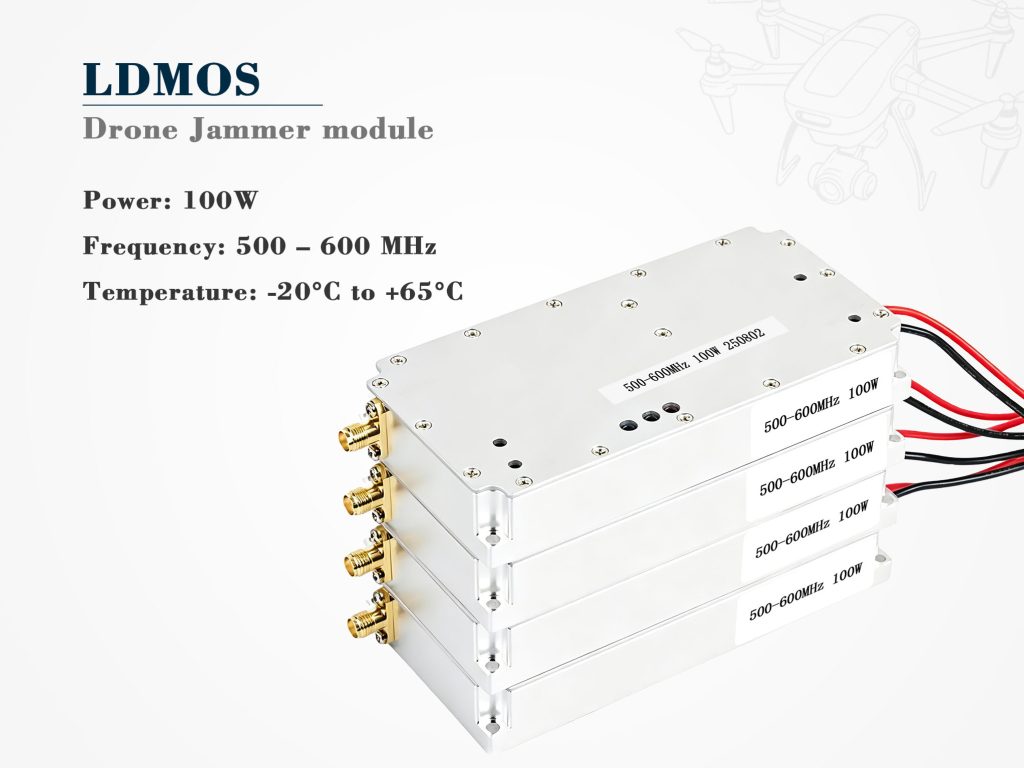
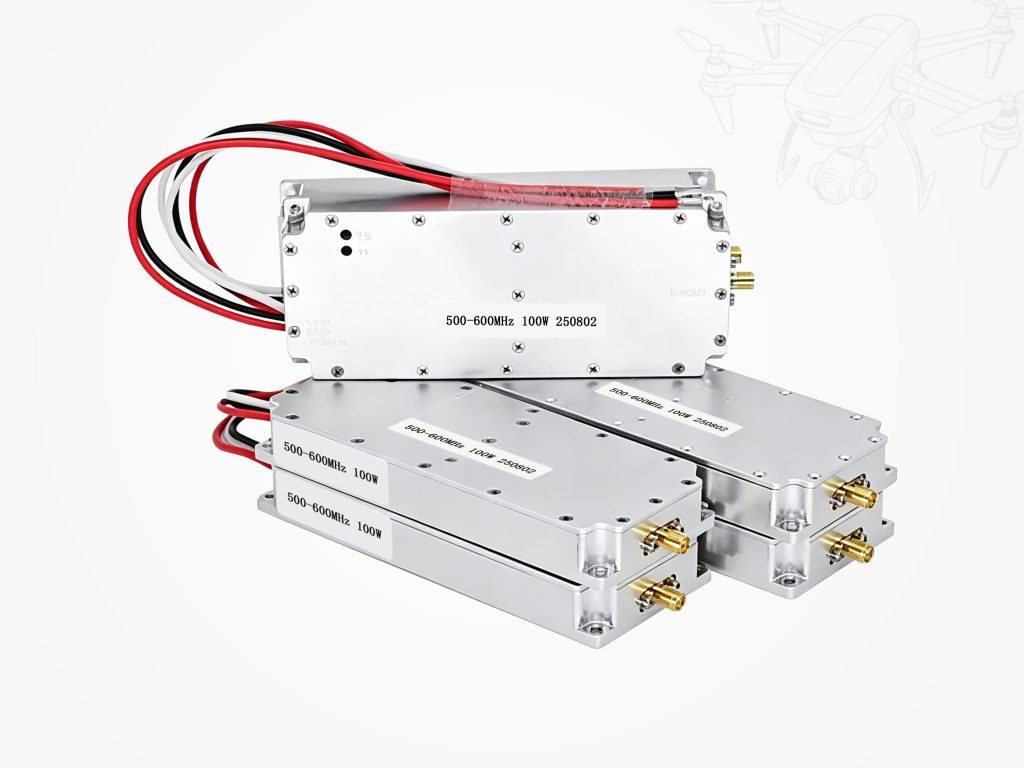
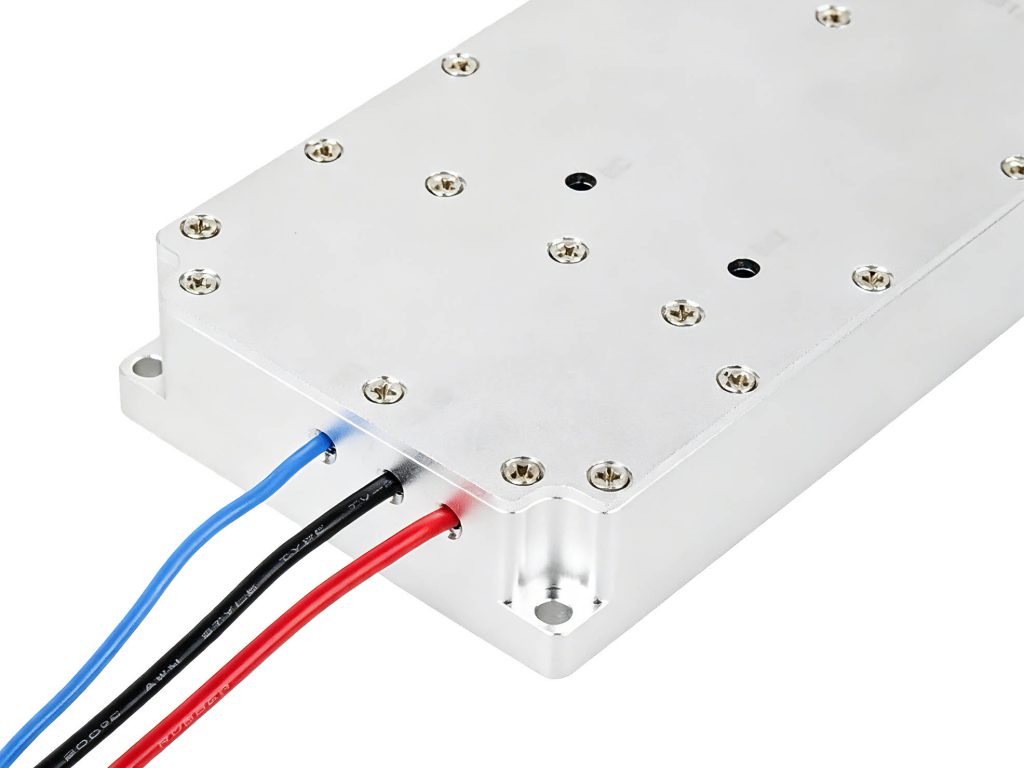
Technical Specifications
| Parameter | Specification | Notes |
| Frequency range | 500 – 600 MHz | Instantaneous full band |
| Output power | 50±1 dBm | 100W typical |
| Supply voltage | 28 – 32 V DC | 30V recommended |
| Current draw | ≤9.2 A | At 100W output |
| Modulation source | Built‑in high‑speed noise modulator | VCO/DDS/SDR optional |
| Analog scan speed | 270 KHz | Custom 100‑500 KHz |
| Input / output impedance | 50 Ω | N‑type female |
| Protection LEDs | Power, over‑voltage, over‑temp | Red/green status |
| Operating temperature | -20 ~ +65 °C | Baseplate temperature |
| Dimensions (L×W×H) | 150 × 80 × 22 mm | Standard size |
| Weight | 800 g | Without external heatsink |
| Base material | Copper with Ni‑plating | LDMOS die attached |
Product Details
Heavy-Duty LDMOS Power for Low-Band Denial
When the mission calls for saturating the lower UHF band – where many commercial and military drones still rely on legacy control links – you need raw muscle without sacrificing reliability. This 100W drone jamming module delivers that muscle through a proven LDMOS architecture, tuned specifically for the 500-600MHz range. Unlike GaN designs that excel at higher frequencies, LDMOS remains the workhorse for this band, offering excellent ruggedness and a forgiving thermal envelope. We have seen this unit deployed in vehicle‑mounted systems, fixed tower installations, and even maritime environments, where its consistent 100W punch makes short work of weak‑signal UAVs.
What Makes This 100W Blocker Stand Out
The amplifier runs on a 28‑32V DC supply, drawing up to 9.2A at full output – a reasonable demand for 100W of forward power. Output is specified at 50±1 dBm, which translates to a solid 100W into a 50‑ohm load. The built‑in high‑speed noise modulation sweeps at 270KHz standard, but you can order custom sweep rates from 100 to 500KHz to match different victim receiver bandwidths. If your system already has a waveform generator, we offer input options for VCO, DDS, or SDR front‑ends – just tell us your preferred interface. The N‑type female connector is robust and low‑loss, perfect for permanent installations or repeated cable mating in field kits.
Thermal Design and Practical Installation
Heat dissipation is critical at this power level, so the module uses a thick copper baseplate directly under the LDMOS die, paired with a thermally conductive pad for efficient transfer to your heatsink or chassis. The working temperature range covers -20°C to +65°C, and the three LED indicators – power on, over‑voltage, and over‑temperature – give you immediate visual feedback. At 150×80×22mm and 800 grams, this unit is larger than our higher‑frequency siblings, but that extra bulk pays off in sustained duty cycles. We recommend mounting it with four M3 screws and a thin layer of thermal grease; forced air cooling is advised if you plan to run continuous wave or high‑duty‑cycle sweeps.
Performance You Can Count On in the Field
One advantage of LDMOS at 500‑600MHz is its inherent robustness against load mismatch – the transistor can tolerate VSWR spikes better than many GaN parts at similar power. That translates to fewer field failures when antennas get damaged or cables loosen. The instantaneous wideband response means you do not have to retune across the 100MHz span; the 100W drone jamming module amplifies the entire band evenly, so swept noise or chirped waveforms cover all potential drone control channels. Users appreciate the repeatable output level, which stays within ±1.5 dB over temperature and supply variation, thanks to internal bias stabilisation.
Customisation and Integration Tips
We understand that no two counter‑UAV systems are identical. That is why we offer custom scan speeds, alternative modulation sources, and even modified dimensions for tight enclosures. When integrating, keep the RF input below +10 dBm to avoid compression, and always terminate the output during testing. For mobile applications, a regulated 30V supply gives the best headroom; for fixed sites, a 28V industrial PSU works fine. The N‑connector torque spec is 1.1 N·m – do not overtighten. With proper cooling, this 100W drone jamming module can run hour‑long missions without degrading output, making it a dependable choice for security forces and critical infrastructure protection.
Frequently Asked Questions
Case Studies
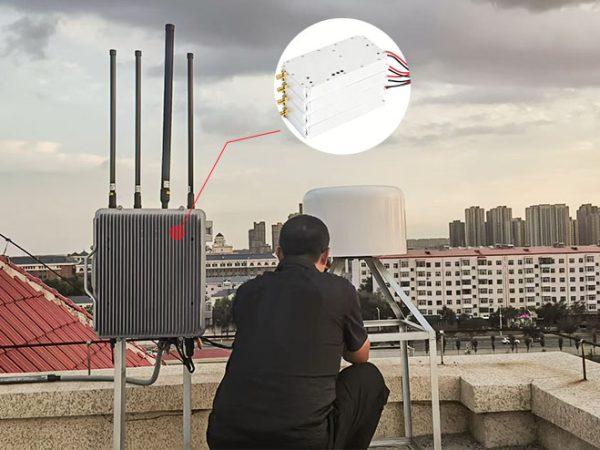
Heilongjiang Weather Center Completes Anti-Drone System Upgrade with Three High-Power Drone Jammer Modules

Tangshan Chem Plant Sealed Drone Gaps With 3 GaN Wideband Modules

How a National Prison Integrated Our Drone Jamming Module Into Their Fixed Counter-Drone System

Integrating Core RF Power: OEM Drone Jamming Module for Oil Refinery Security | Case Study
Send Us a Message
Related Products
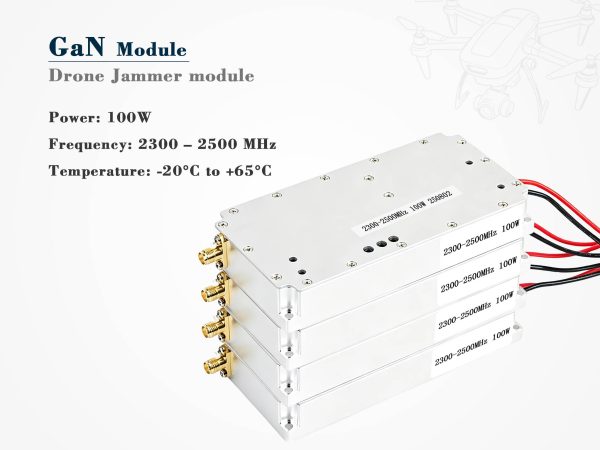
2300–2500 MHz 100W GaN Counter-UAV Module
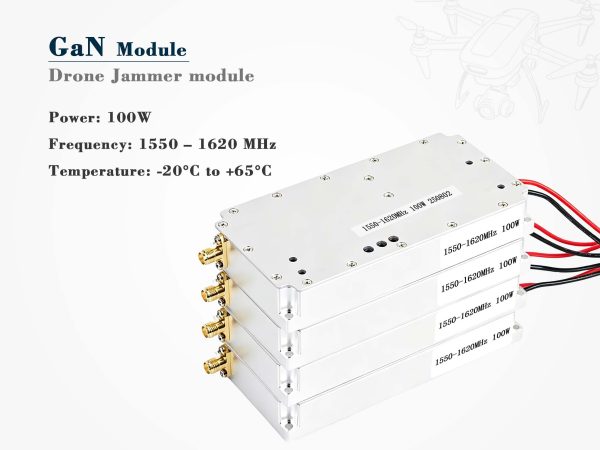
100W GaN Drone Jamming Module 1550–1620MHz
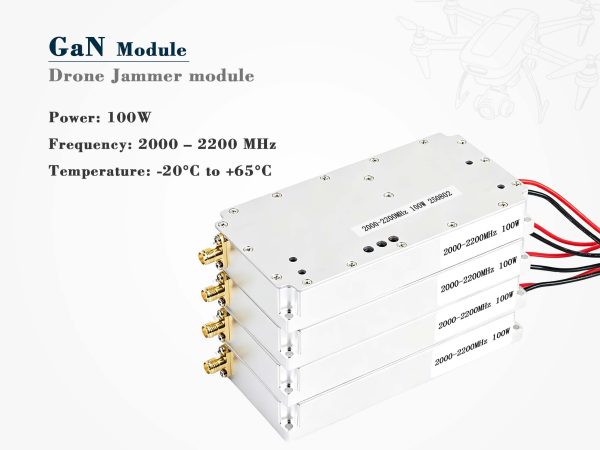
100W 2000–2200MHz GaN Analog Drone Interference Module