When the threat landscape shifts, static defenses become liabilities. This was the reality facing a military research institute in Tianjin’s Binhai area, which found its established counter-drone systems struggling against a new generation of agile UAVs. The answer wasn’t a complete overhaul, but a strategic, modular RF power upgrade—a decision that has significantly bolstered their defensive posture and offers a blueprint for the broader counter-UAS community.
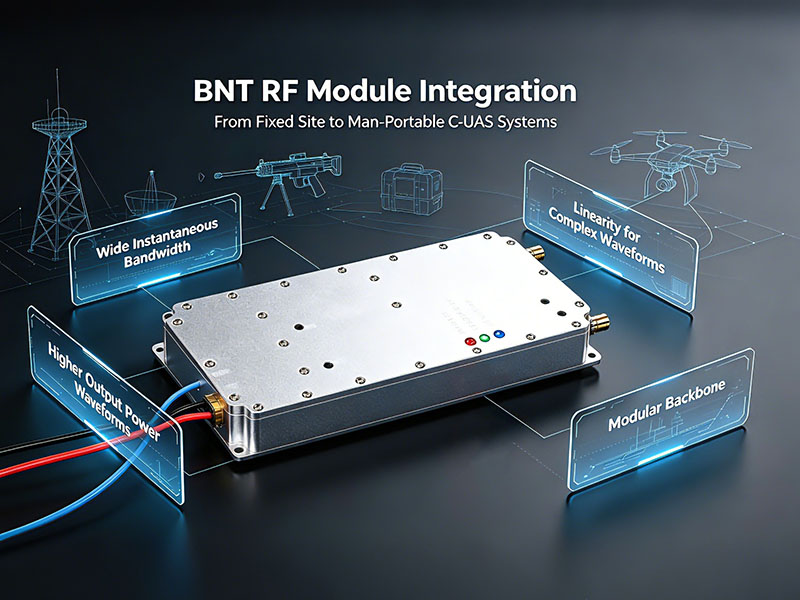
The institute’s existing fixed installations, anti-drone guns, and backpack jammers were mechanically sound. However, they were being outpaced by commercial drones now utilizing frequency-hopping protocols, aggressively leveraging the 5.8 GHz and 3.5 GHz bands, and even appearing in coordinated swarms. The core issue was clear: they needed RF power modules capable of wide instantaneous bandwidth, higher output power, and enough linearity to handle complex modulation jamming waveforms without distortion.
A Targeted Upgrade with BNT RF Modules
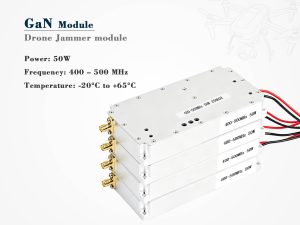
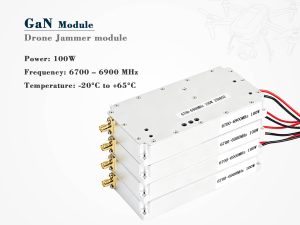
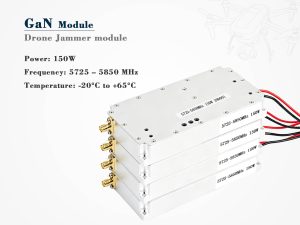
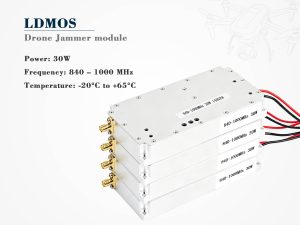
The solution was a carefully curated selection of BNT’s GaN and LDMOS power amplifier modules. The procurement focused on four key types designed to address the most operationally painful frequencies:
-
100W GaN Modules (2.5–4.0 GHz & 4.0–6.0 GHz): For high-power jamming and spoofing from fixed sites and vehicle-mounted units.
-
50W LDMOS Modules (5725-5850 MHz): The workhorse upgrade for man-portable anti-drone guns and backpack jammers.
-
20W Modules (3400-3600 MHz): Added critical 3.5 GHz band denial capability to handheld and auxiliary systems.
The integration philosophy was one of “reinvention without reinvention.” The 100W GaN modules seamlessly dropped into existing amplifier slots with minimal mechanical rework. The 50W LDMOS devices were chosen for their power density and efficiency, delivering the required effective isotropic radiated power to sever 5.8 GHz video downlinks at tactically useful distances, all while staying within the battery budget of a dismounted operator. The 20W modules filled a critical gap by adding the 3.5 GHz band denial capability that was previously absent.
Field Data: Measurable Performance Gains
Post-integration testing under the institute’s rigorous protocol delivered compelling results. The fixed-site 100W GaN system achieved a complete video downlink break and triggered return-to-home failsafe at 2.8 km on 2.4 GHz and 2.3 km on 5.8 GHz, marking roughly a 40% improvement over the legacy system.
On the portable side, a single 50W LDMOS gun module with a 12 dBi panel antenna forced a 5.8 GHz video dropout at 1.2 km line-of-sight. The 20W 3.5 GHz module interrupted the control link of a test drone at 900 meters. Crucially, in a backpack configuration, the combination of modules allowed a single operator to cover both bands simultaneously, a capability long requested by the institute’s security team.
The modules also demonstrated robust reliability, showing no measurable degradation in output power after a continuous 30-minute key-down test at 40°C ambient. Harmonic levels remained below -45 dBc, a non-negotiable requirement in a military electromagnetic environment.
A Future-Proof, Modular Backbone
The true value of this project lies in its modularity. The institute now possesses a fully modular RF backbone. When future drone standards inevitably move to new frequencies, the same amplifier chassis and control interfaces can accept a different GaN or LDMOS module without a complete system rebuild.
This extensibility is already being planned, with discussions for an L-band module (1.5–1.6 GHz) for GNSS denial and a potential C-band GaN variant. Because the institute validated the module integration workflow—covering mechanical, thermal, RF chain, and firmware adaptation—future upgrades are expected to require half the integration time.
For the wider C-UAS community, this case underscores a practical truth: the RF power amplifier is not a commodity bolt-on. The shift to GaN wideband devices and application-matched LDMOS modules directly translates into enhanced jamming range, waveform flexibility, and the ability to counter frequency-agile drones. When modules are designed for seamless integration, a military user can upgrade their own systems on their own timeline—a strategic advantage the Tianjin Binhai institute has now successfully achieved.