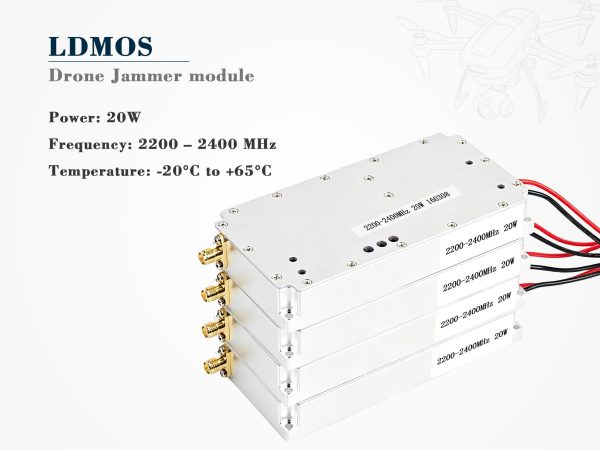
20W Anti-Drone Jamming Module 400-470MHz
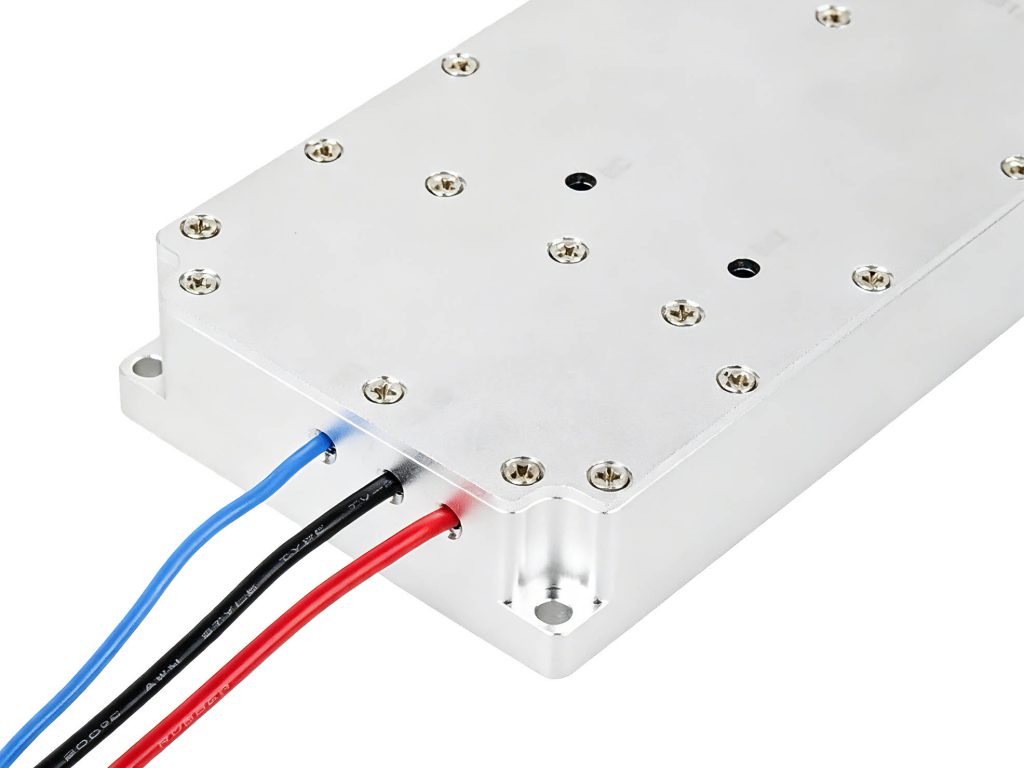
20W anti-drone jamming module, 20W output, 400-470MHz, analog sweep. 115.5x46.5x21mm, 0.21kg, 24-29V DC, SMA female. For counter-UAS integration.
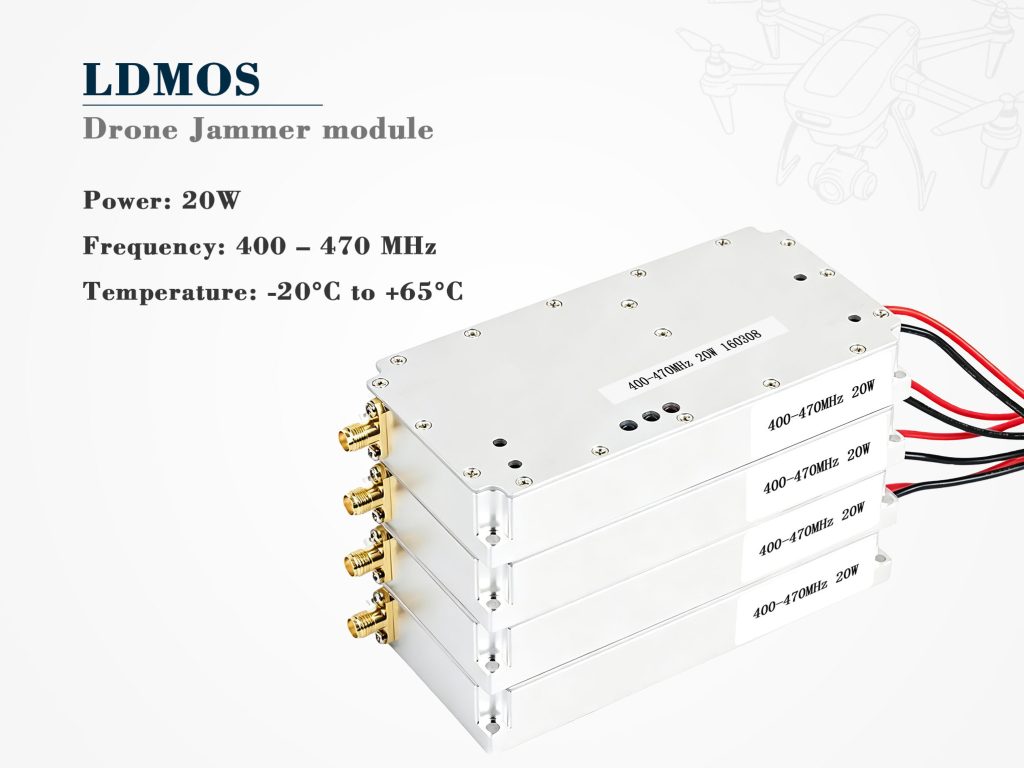
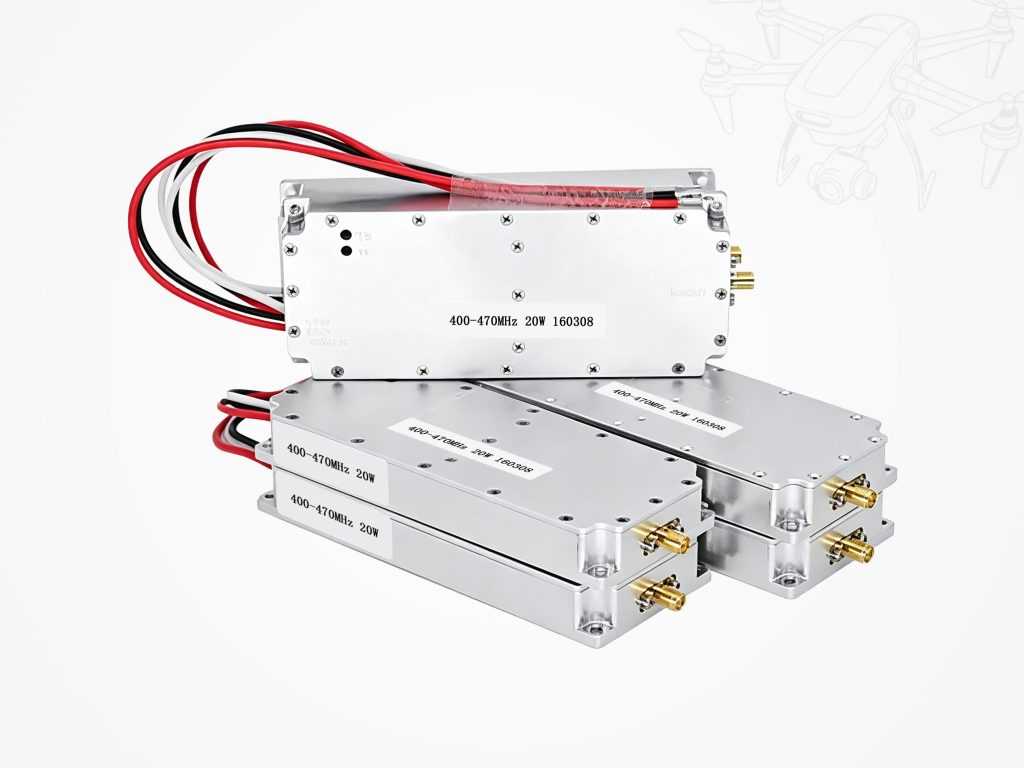
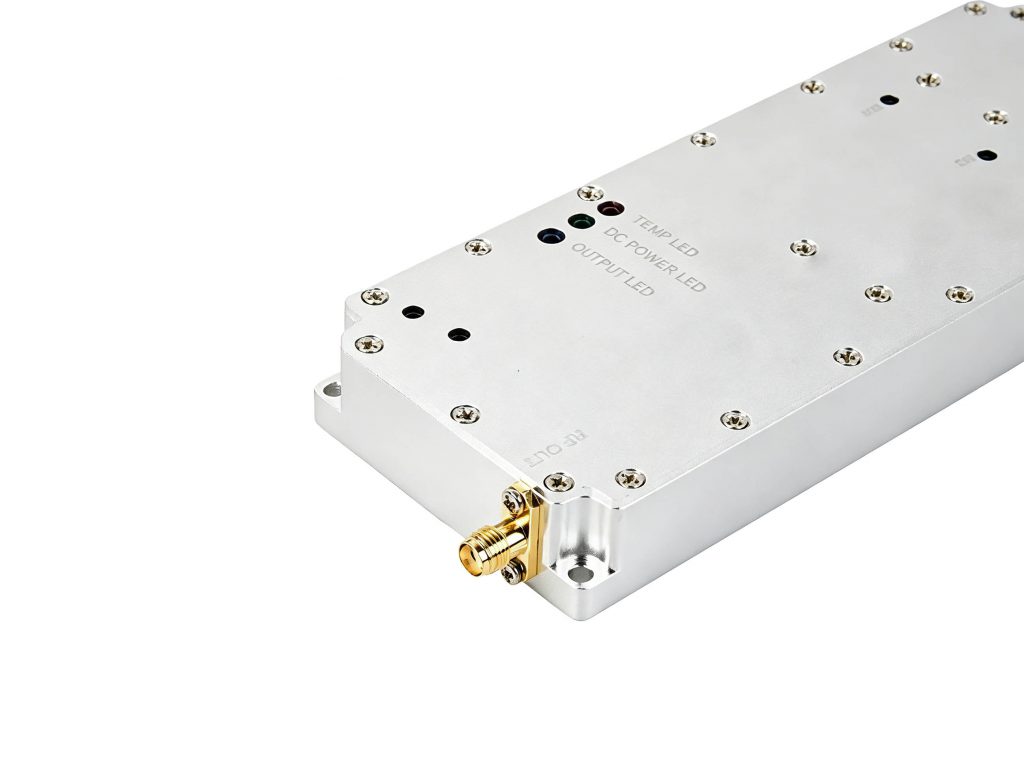
Technical Specifications
| Parameter | Specification | Notes |
| Frequency range | 400–470 MHz | Covers ISM 433 MHz and common RC bands |
| Output power | 20 W typical | Measured at 50 Ω, full band |
| Supply voltage | DC 24 V to 29 V | Regulated supply advised |
| Current draw | 2.5 A max | At 29 V, full output |
| Modulation source | Built-in high-speed analog sweep | No external generator needed |
| Analog scan speed | Full 70 MHz span <1 ms | Continuous swept waveform |
| Input / output impedance | 50 Ω, VSWR ≤2.0 | SMA female connector |
| Protection LEDs | Green (power), Red (alarm) | Overtemp and high VSWR trip |
| Operating temperature | -20 °C to +65 °C | Ambient and baseplate |
| Dimensions (L×W×H) | 115.5 × 46.5 × 21 mm | Single-board module |
| Weight | 0.21 kg | Lightweight aluminum construction |
| Base material | Treated aluminum alloy | Optimized for heat dissipation |
Product Details
Why the 400–470 MHz Band Matters for Counter-Drone Operations
When building a layered counter-UAS system, overlooking the sub-GHz band leaves a gap that many drone operators actively exploit. A significant number of commercial and DIY drones use 433 MHz or nearby frequencies for command-and-control links, thanks to excellent propagation through foliage and urban clutter. The 20W Anti-Drone Jamming Module is engineered specifically to saturate this slice of spectrum with 20 watts of continuous swept RF. Unlike broadband noise generators that spray energy inefficiently, this LDMOS module concentrates power within the 400–470 MHz window, immediately disrupting both fixed-frequency and frequency-hopping RC systems. With 20W output, it can cover wide outdoor areas when paired with a suitable antenna, making it a solid choice for perimeter security. Field teams often pair a module like this with 2.4 GHz and 5.8 GHz units to achieve full-spectrum protection. Thanks to its compact footprint and simple TTL control, integrating the 20W Anti-Drone Jamming Module into an existing enclosure or vehicle mount takes hours, not weeks. This makes it a foundational component for any comprehensive drone defense architecture.
A Self-Contained Disruption Engine: No External Generators
What truly sets this board apart is the built-in high-speed analog sweep source. Instead of wiring up an external DDS, mixer, and LO, the module’s internal oscillator continuously scans the entire 70 megahertz bandwidth in well under a millisecond. This produces a fast-moving barrage of RF energy that intersects drone telemetry bursts regardless of hopping sequence. The analog sweep rate is fast enough that a drone receiver’s AGC cannot settle, causing desensitization and link loss. Because modulation happens directly at the LDMOS final stage, the output remains spectrally clean with minimal spurs, eliminating the need for expensive post-filtering. With no external modulation cabling needed, system reliability improves because there are fewer interconnects to fail. For integration labs, the 20W Anti-Drone Jamming Module removes the headache of modulation design and delivers a repeatable, tested jamming waveform from the moment power is applied.
Integration Made Simple: Power, Control, and RF
Bringing the module online requires only a regulated 24–29 V DC supply and a single control signal. Apply +5 V or let the enable pin float to activate jamming; ground it to shut off. The RF output uses a standard 50-ohm SMA female connector, making it straightforward to attach antennas, diplexers, or coaxial switches. The SMA female output mates with most commercial antennas and coaxial relays without adapters. At full output, current draw maxes out at 2.5 A, so even compact battery banks can support extended operation. Onboard LEDs give immediate status: green for power, red for overtemperature or high-VSWR fault—visible even in direct sun. The board itself measures just 115.5 × 46.5 × 21 mm and weighs 0.21 kg. Multiple 20W Anti-Drone Jamming Module units can be stacked side-by-side for multi-band platforms without custom metalwork, and the lightweight aluminum construction makes them easy to mount on drone gimbals or telescopic masts.
Field-Ready Durability and Efficiency
Efficiency matters when you’re running off batteries. The LDMOS device achieves at least 40% power-added efficiency, meaning less energy wasted as heat and more directed at the target. The aluminum alloy base material acts as both structural frame and thermal spreader; its surface treatment resists corrosion and provides an excellent thermal interface. Bolt it to a heatsink or chassis plate and temperatures stay manageable even during continuous key-down cycles. The module is rated for operation from -20°C to +65°C, having passed extended burn-in tests with full power sweep. Automatic protection folds back output power if the antenna presents a high VSWR, preventing transistor damage and saving maintenance costs. Over the past few years, similar modules have become a staple in both portable and fixed counter-UAS deployments. Operators who have deployed the 20W Anti-Drone Jamming Module in fixed-site, vehicle, and portable configurations consistently mention its set-and-forget reliability. When you need dependable low-band jamming that survives real-world abuse, this module delivers truly consistent performance without constant tweaking.
Frequently Asked Questions
Case Studies
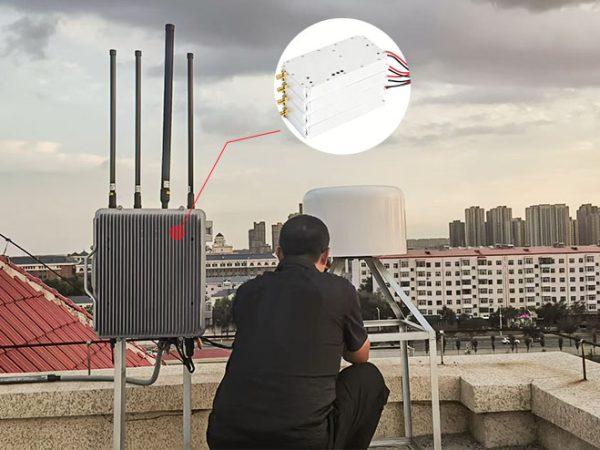
Heilongjiang Weather Center Completes Anti-Drone System Upgrade with Three High-Power Drone Jammer Modules

Tangshan Chem Plant Sealed Drone Gaps With 3 GaN Wideband Modules

How a National Prison Integrated Our Drone Jamming Module Into Their Fixed Counter-Drone System

Integrating Core RF Power: OEM Drone Jamming Module for Oil Refinery Security | Case Study
Send Us a Message
Related Products
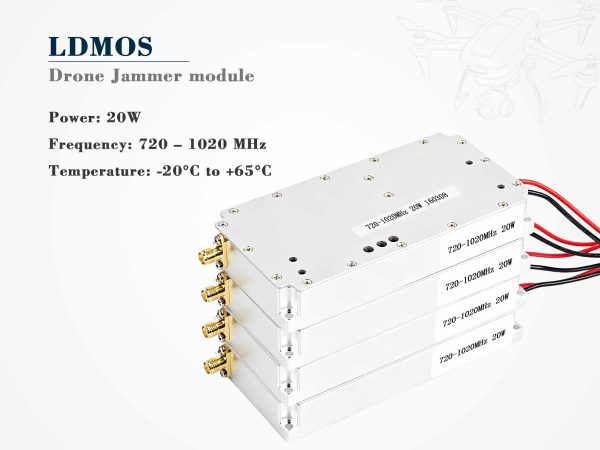
20W 720–1020MHz UAV Jammer Module | LDMOS Analog
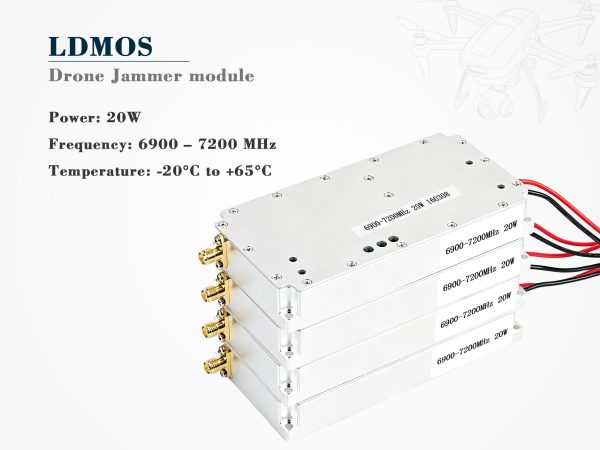
Powerful 20W LDMOS Drone Jammer Module for 6.9–7.2 GHz
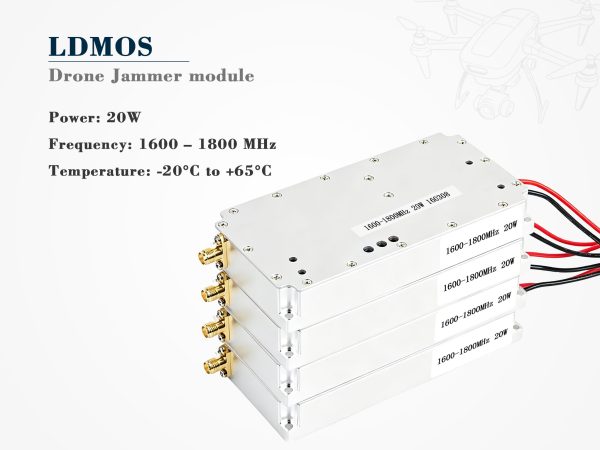
Powerful 20W Anti Drone Module 1600–1800MHz