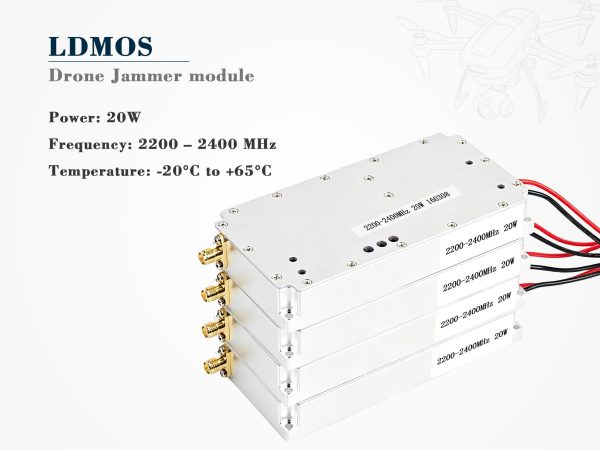
20W Drone Jammer Module 870-960MHz LDMOS
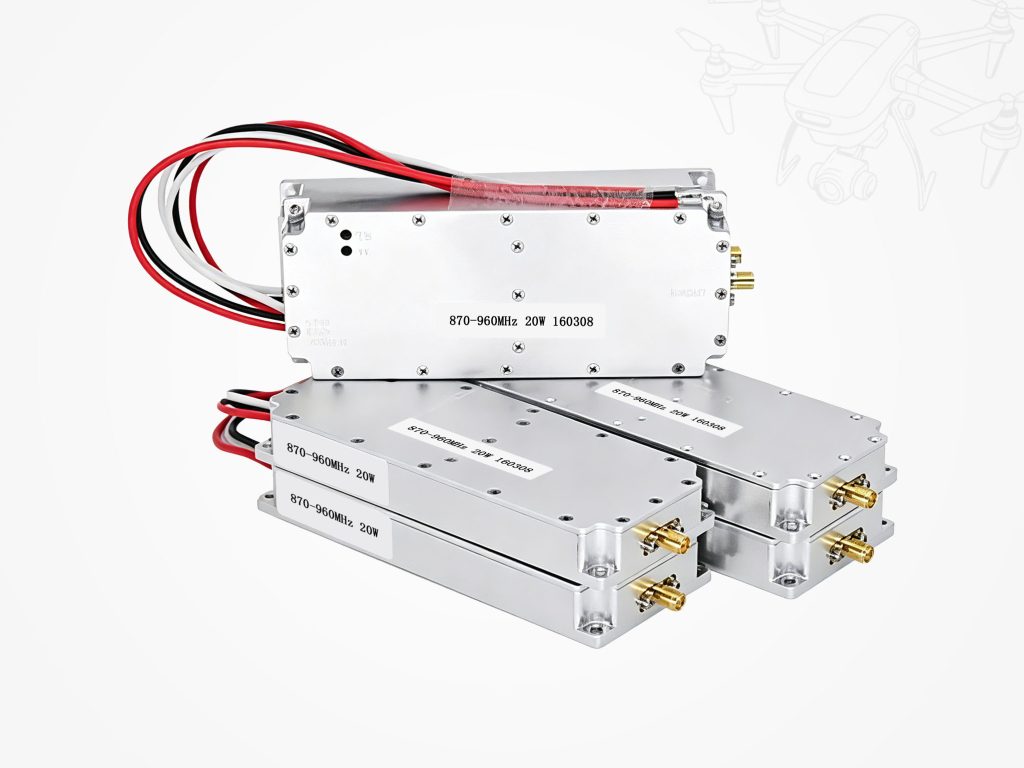
20W jammer module 870-960MHz LDMOS with built-in sweep source, 24-29V DC, 2.5A, SMA output, compact 115.5x46.5x21mm. Ideal for anti-drone systems.
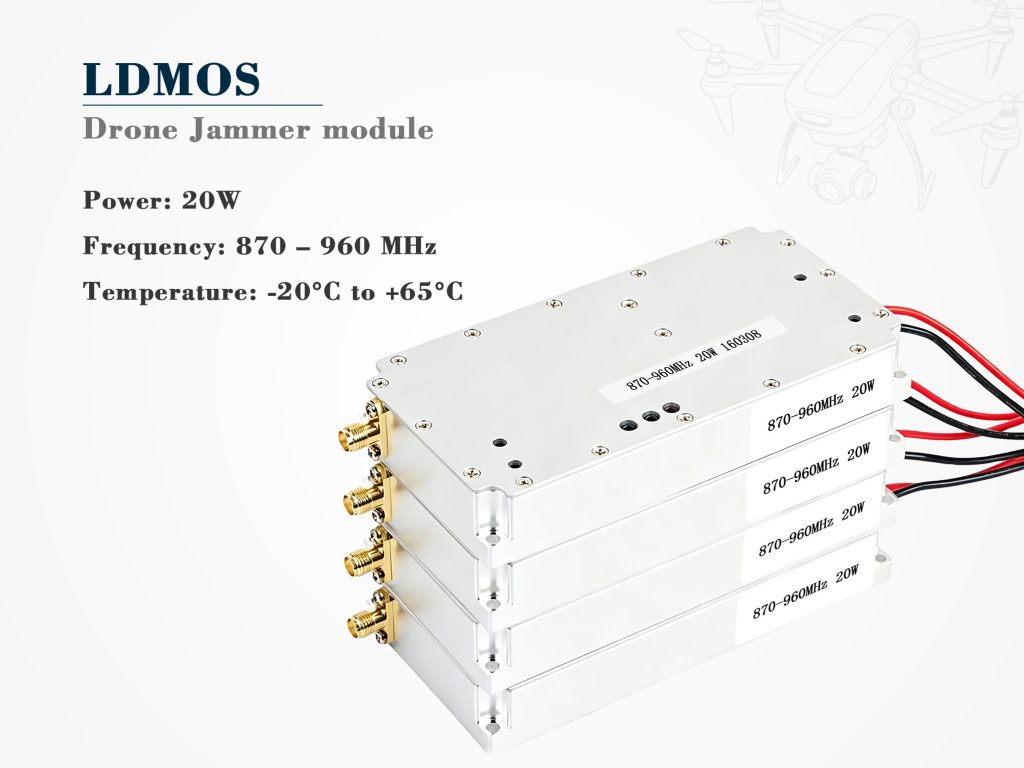
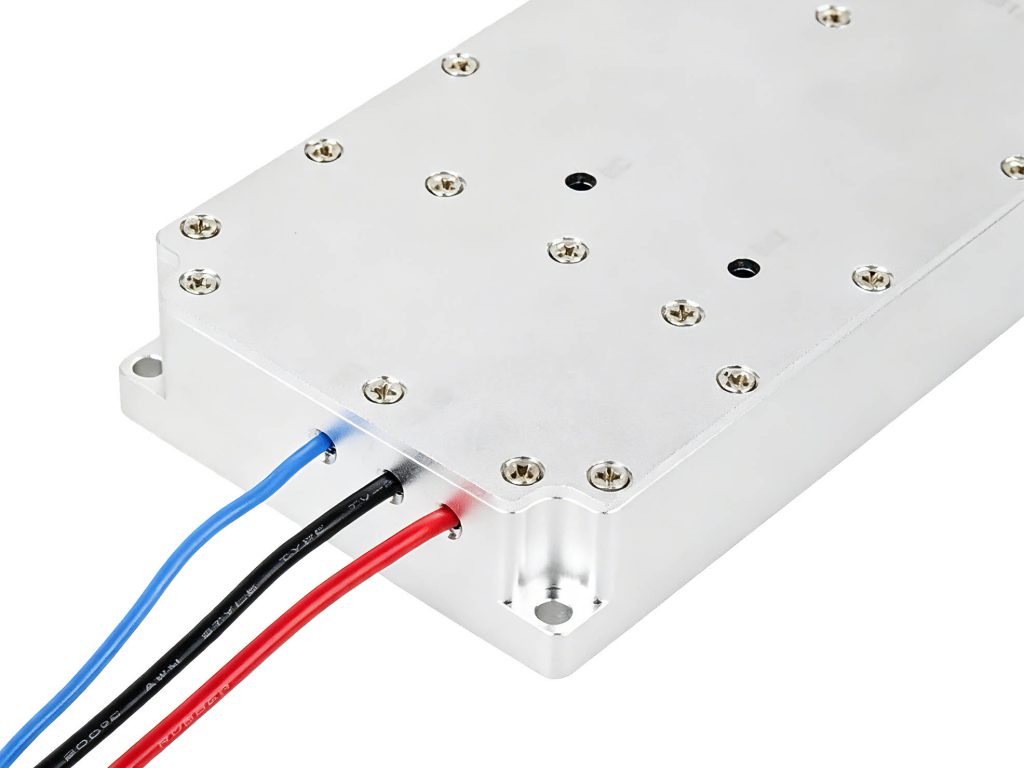
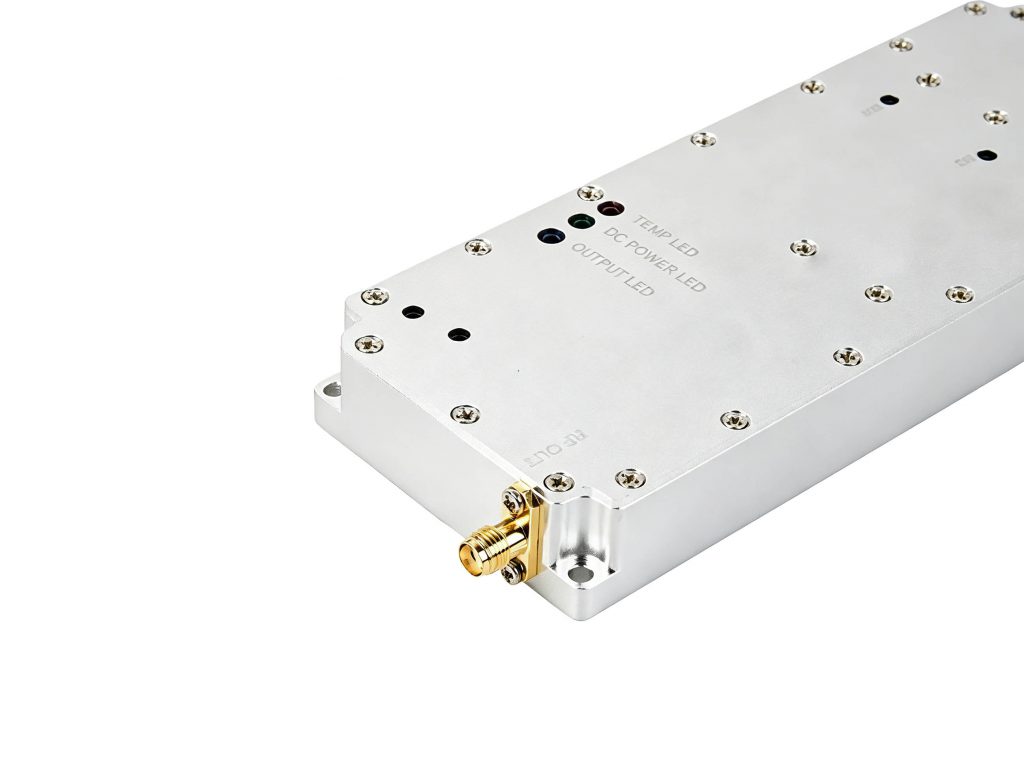
Technical Specifications
| Parameter | Specification | Notes |
| Frequency range | 870 – 960 MHz | Covers common drone command and video links |
| Output power | 20 W (43 dBm) typ. | P1dB, CW |
| Supply voltage | 24 – 29 V DC | Nominal 28 V for best efficiency |
| Current draw | ≤ 2.5 A | At 28 V, full output |
| Modulation source | Internal high-speed analog sweep generator | Built-in VCO, no external synth required |
| Analog scan speed | Adjustable, typ. 10–100 MHz/ms | Preset or voltage-controlled |
| Input / output impedance | 50 Ω nominal | SMA female on output, internal 50-ohm traces |
| Protection LEDs | Power (Green), RF On (Red), VSWR Alarm (Amber) | Monitors DC, RF, antenna mismatch |
| Operating temperature | -20 to +65 °C | Extended range with moderate airflow |
| Dimensions (L×W×H) | 115.5 × 46.5 × 21 mm | Compact extruded/machined enclosure |
| Weight | 0.21 kg | Lightweight aluminum design |
| Base material | Aluminum alloy with chemical conversion coating | Corrosion-resistant, integrated heat sink |
Product Details
Compact High-Power Core for Counter-Drone Systems
Modern counter-UAS operations require building blocks that marry high RF output with plug-and-play simplicity. The 20W drone jammer module delivers exactly that: a 20 W, 870–960 MHz source packed into a 115.5 × 46.5 × 21 mm envelope. Whether you are developing a man-portable backpack unit, a vehicle-mounted dome, or a fixed-site perimeter system, this module eliminates the need to source, match, and tune separate amplifier and signal generator stages.
LDMOS Power Stage: Efficiency Meets Robustness
At the heart of the 20W drone jammer module lies an advanced LDMOS transistor operated in a class AB push-pull configuration. This topology achieves power-added efficiency above 40 % while keeping harmonics low enough that external filtering is rarely needed for wideband jamming. Unlike fragile GaN-on-SiC alternatives, the LDMOS device withstands antenna mismatch up to VSWR 3:1 indefinitely, and the on-board protection monitors reflected power, instantly folding back drive if a dangerous condition persists. Input and output matching networks are integrated on the substrate, contributing to the module’s 21 mm height. A temperature-compensated bias circuit ensures stable gain from -20 °C cold starts to +65 °C ambient operation.
Onboard Agile Sweep: No External Synthesizer
A common bottleneck in jamming system design is the signal source. The 20W drone jammer module removes this hurdle by embedding a high-speed VCO and ramp generator that directly drives the LDMOS stage. Analog scan speed is user-adjustable through a control voltage or fixed preset, spanning 10 MHz/ms to over 100 MHz/ms. Because the sweep covers the entire 870–960 MHz range in a continuous sawtooth pattern, it creates a dense interference spectrum that disrupts frequency-hopping spread-spectrum links without needing to identify the exact channel. For systems that require external modulation, the module can also accept a CW or modulated input through the SMA port, but in stand-alone mode it works right out of the box — just supply DC power and an enable signal.
Straightforward Control and Visual Feedback
Engaging the jammer is a single logic-level action. Driving the enable pin to +5 V or leaving it floating turns on the RF output; pulling it to ground silences the unit. This makes integration with microcontrollers, drone detectors, or manual override switches trivial. Three LEDs on the board report real-time status: a green LED confirms DC supply, a red LED indicates that RF power is present at the output, and an amber LED lights up when reflected power exceeds a safe VSWR threshold. Additional internal protections guard against reverse polarity, over-temperature, and over-current, so the 20W drone jammer module survives the kinds of mishaps common in prototype and field environments.
Thermal and Mechanical Design
The baseplate is CNC-machined from 6061 aluminum alloy and coated with a chemical conversion finish that resists corrosion in outdoor and marine environments. Integrated fins on the bottom surface increase surface area, allowing the module to dissipate 60 W of heat with just moderate airflow or conduction to a cold plate. At 0.21 kg, the 20W drone jammer module adds negligible weight to drone-mounted payloads or manpack systems. Four M3 mounting holes simplify mechanical integration, and the SMA female output connector aligns with standard coaxial cabling. Operating temperature range -20 to +65 °C is verified through thermal cycling tests.
Performance and Integration Summary
Supply voltage is flexible from 24 to 29 V DC, with 28 V recommended for optimal efficiency. Current draw stays below 2.5 A even at full 20 W output. Output VSWR ≤2.0 keeps reflected energy manageable, and the amber warning LED provides immediate feedback if an antenna fault occurs. Because all active circuitry — VCO, driver, LDMOS final, and protection — resides on a single board, system BOM and wiring complexity drop significantly. Engineers using the module in counter-UAS projects report straightforward integration with radar and optical tracking systems, where the fast analog sweep masks the drone’s receiver without requiring precise frequency alignment.
Frequently Asked Questions
Case Studies
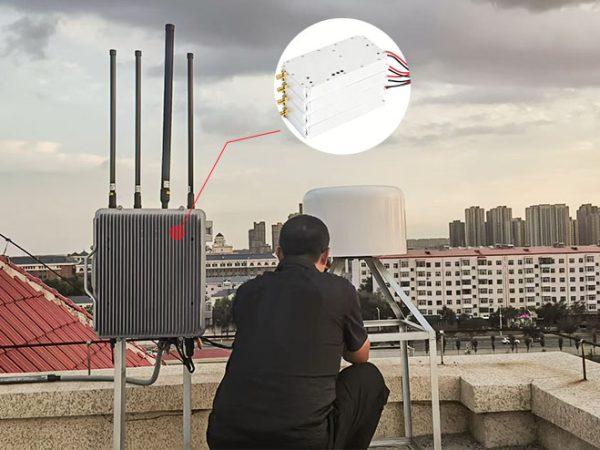
Heilongjiang Weather Center Completes Anti-Drone System Upgrade with Three High-Power Drone Jammer Modules

Tangshan Chem Plant Sealed Drone Gaps With 3 GaN Wideband Modules

How a National Prison Integrated Our Drone Jamming Module Into Their Fixed Counter-Drone System

Integrating Core RF Power: OEM Drone Jamming Module for Oil Refinery Security | Case Study
Send Us a Message
Related Products
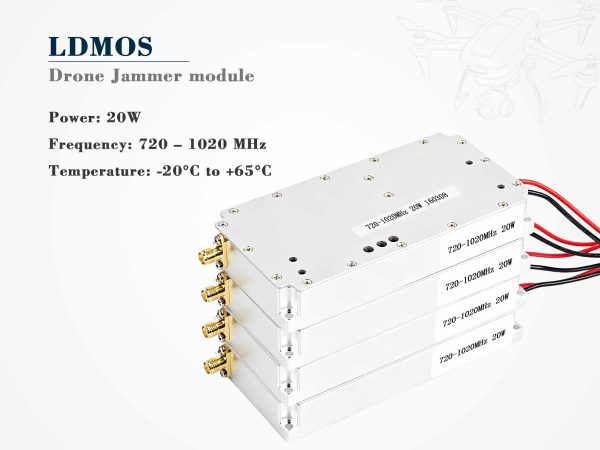
20W 720–1020MHz UAV Jammer Module | LDMOS Analog
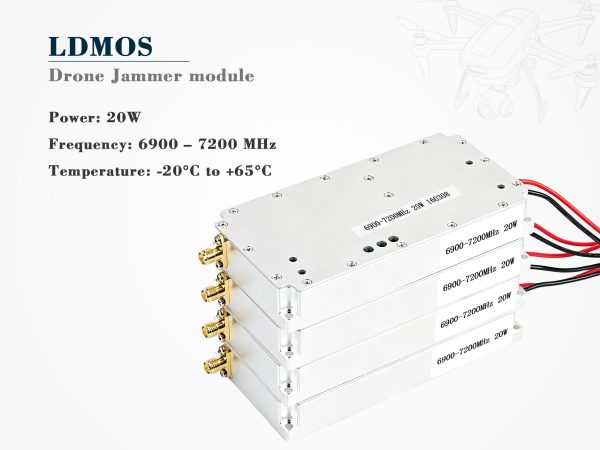
Powerful 20W LDMOS Drone Jammer Module for 6.9–7.2 GHz
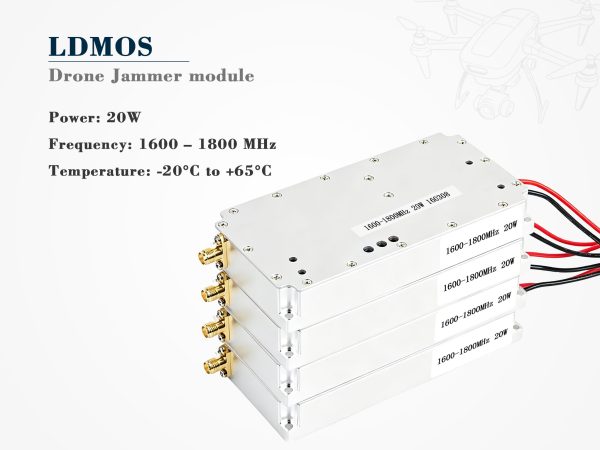
Powerful 20W Anti Drone Module 1600–1800MHz