
100W GaN Broadband Amplifier Module 1–3 GHz
100W GaN Broadband Amplifier Module covering 1000-3000MHz with 50dB gain and 100W output. High efficiency and rugged design.
It operates as the final stage in communication jammers, pushing broadband noise or complex modulated waveforms across L and S bands. In radar and EW simulators, the instantaneous 2000 MHz bandwidth handles fast chirps and frequency hops with zero retuning delay. Test and measurement labs rely on it as a general-purpose driver for antenna and component characterization.

Technical Specifications
| Parameter | Specification |
| Operating Frequency | 1000 – 3000 MHz |
| Instantaneous Bandwidth | 2000 MHz |
| Peak Output Power @CW | 100 W |
| Input Power for Rated Output | -2±3 dBm |
| Power Gain @0dBm | 50±3 dB |
| Gain Flatness | ±3 dB Max |
| Efficiency | 32% (better at lower band) |
| Harmonics @100W | ≥10 dBc |
| Spurious Level | ≥60 dBc |
| Input VSWR | ≤2:1 |
| Output VSWR | ≤2:1 |
| Operating Voltage | 28 – 32 V DC |
| Current Consumption @100W | 10 A |
| Dimensions (L×W×H) | 168.5 x 82.8 x 26.5 mm |
| Mass | 0.75 kg |
Product Details
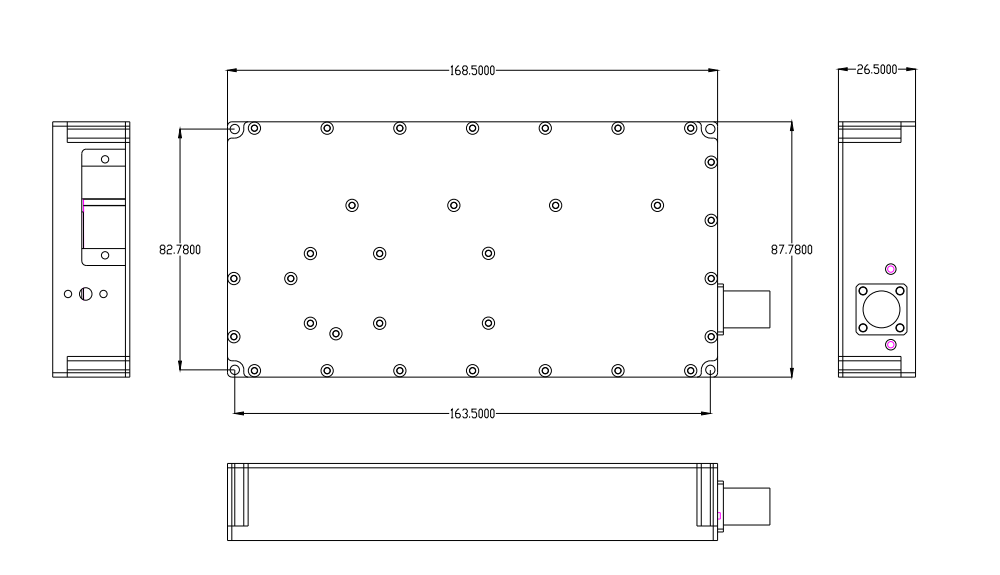
Uncompromised Wideband Power from 1 to 3 GHz
When your system demands raw RF power across multiple octaves without efficiency collapse, narrow-band solutions fall short. The 100W GaN Broadband Amplifier Module answers that challenge with a clean 100 W CW across the full 1000–3000 MHz range. It leverages a Gallium Nitride on Silicon Carbide transistor to deliver an instantaneous bandwidth of 2000 MHz, removing any need for mechanical tuning or band switching. Its Class AB design balances linearity and power-added efficiency, achieving 32% typical and climbing higher at the lower end of the band.
Why GaN-on-SiC Makes a Difference
Gallium Nitride technology has rewritten the rules for power density. Next to older LDMOS or GaAs approaches, GaN-on-SiC offers a higher breakdown voltage, superior thermal conductivity, and far greater power density per die area. Inside the 100W GaN Broadband Amplifier Module, the transistor is bonded to a copper sub-carrier and paired with a patented heat-spreading architecture. This pulls heat out of the junction quickly enough to sustain full rated power at a case temperature of 50°C without exotic cooling. Ruggedness is a given: the input stage easily handles accidental overdrive up to +5 dBm, so real-world operating margins stay comfortable.
Simple Integration and Consistent Performance
With a 50 Ω input and output impedance across the whole band, the module drops into standard 50-ohm chains with almost no matching drama. Input VSWR holds ≤2:1, and output VSWR likewise stays ≤2:1, keeping power delivery predictable sweep to sweep. A nominal 0 dBm drive delivers 50±3 dB of power gain, meaning you reach 100 W output with an input level of just -2±3 dBm. Gain flatness is maintained within ±3 dB maximum across the instantaneous bandwidth, which reduces amplitude correction overhead in wideband tests. Spurious content is well controlled: harmonics at 100 W are ≥10 dBc, and non-harmonic spurs stay below -60 dBc.
Compact, Lightweight, and Field-Ready
Footprint and weight often decide where a power amplifier can be deployed. At 168.5 x 82.8 x 26.5 mm and only 0.75 kg, this 100W GaN Broadband Amplifier Module slides into airborne payloads, shipboard consoles, and portable cases without dominating the enclosure. It draws approximately 10 A from a 28–32 V DC supply, so battery banks or vehicle power are both practical. Small size does not translate to fragile behavior—the GaN-on-SiC device and advanced assembly techniques keep it solid under vibration, shock, and wide temperature excursions.
Applications Where It Excels
Engineers repeatedly choose the 100W GaN Broadband Amplifier Module for roles that punish narrower amplifiers. It operates as the final stage in communication jammers, pushing broadband noise or complex modulated waveforms across L and S bands. In radar and EW simulators, the instantaneous 2000 MHz bandwidth handles fast chirps and frequency hops with zero retuning delay. Test and measurement labs rely on it as a general-purpose driver for antenna and component characterization. It also fits neatly into software-defined radio transmitters, where wide instantaneous bandwidth and respectable efficiency are not optional—they are mandatory.
Performance at a Glance
While full specs live in the table below, a handful of numbers define the amplifier’s personality. CW output power is a solid 100 W typical at a 50°C baseplate. Efficiency holds at 32% typical, improving toward lower band edges. Harmonics sit at least 10 dB under the carrier, and wideband spurious products are suppressed by 60 dBc or more. The RF input survives up to +5 dBm without damage, giving you one less thing to worry about during integration.
Frequently Asked Questions
Case Studies
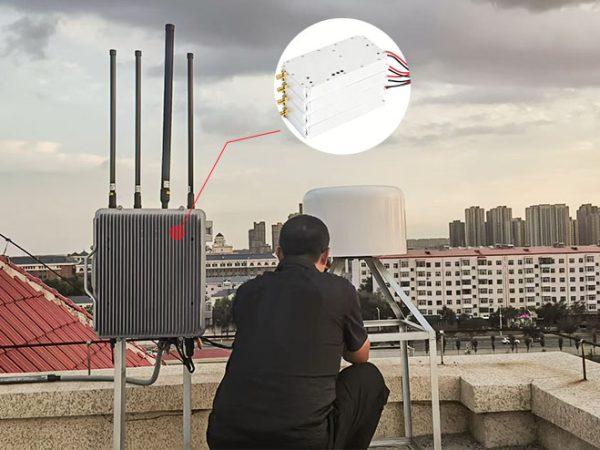
Heilongjiang Weather Center Completes Anti-Drone System Upgrade with Three High-Power Drone Jammer Modules

Tangshan Chem Plant Sealed Drone Gaps With 3 GaN Wideband Modules

How a National Prison Integrated Our Drone Jamming Module Into Their Fixed Counter-Drone System

Integrating Core RF Power: OEM Drone Jamming Module for Oil Refinery Security | Case Study
Send Us a Message
Related Products

High-Power 100W GaN Broadband Amplifier Module 3-5 GHz

100W Broadband Amp Module – 20 to 600 MHz Wideband Power for HF/VHF/UHF

100W Broadband Amplifier Module – 6 to 8 GHz Wideband Power