
100W GaN Wideband Module 300-1500MHz
100W GaN amp, 0.3–1.5GHz, 50dB gain, 30% eff, ≤2:1 VSWR, MCX/N, 28–32V, 0.75kg. For VHF/UHF/L-band, comms, radar & jamming.
Tactical and software‑defined radios
GPS/GNSS ground stations
Air‑traffic control (ATC) transponders and DME
Cellular base station boosters and repeaters
Electronic warfare jammers and test simulators
Broadband laboratory amplifiers

Technical Specifications
| Parameter | Condition | Min | Typ | Max |
| Operating frequency | CW | 300 MHz | – | 1500 MHz |
| Instantaneous bandwidth | – | – | 1200 MHz | – |
| Peak output power (P<sub>SAT</sub>) | CW | – | 100 W | – |
| Input power for rated output | – | – | –2 ±3 dBm | – |
| Max input (no damage) | – | – | – | 5 dBm |
| Power gain (@ 0 dBm input) | – | – | 50 ±3 dB | – |
| Gain flatness (@ 0 dBm input) | – | – | – | ±3 dB |
| Efficiency (@ 100 W out) | – | – | 30% | – |
| Harmonics (1st–Nth) | @ 100 W out | 10 dBc | – | – |
| Spurious level | – | 60 dBc | – | – |
| Input / Output VSWR | – | – | – | 2:1 |
| Operating voltage | DC | 28 V | 28–30 V | 32 V |
| Current consumption | @ 100 W out | – | 10 A | – |
Product Details
The lower end of the microwave spectrum – from 300 MHz all the way up to 1500 MHz – is a busy neighbourhood. It hosts VHF/UHF tactical radios, L‑band navigation (GPS/Galileo), air‑traffic control transponders, cellular infrastructure, and a growing number of IoT backhaul links. The challenge? No single narrowband amplifier can cover this entire stretch without a lot of switching and retuning. Enter the AMF3001500‑100W wideband module – a single GaN‑on‑SiC unit that delivers 100 watts of solid, reliable power across 300 to 1500 MHz, instantly, with zero tuning. It’s the kind of part that simplifies racks, reduces spares, and makes system integration feel almost too easy.
What Makes This Wideband Module Tick
The core story here is bandwidth – a full 1200 MHz of instantaneous coverage. That means you can sweep from 300 MHz to 1.5 GHz without hitting any dead zones, and without external matching networks. The Class AB GaN design provides the linearity you need for modern modulated waveforms (QAM, OFDM, or legacy FM/AM) while keeping efficiency at a comfortable 30%. The patented thermal management, featuring a copper sub‑carrier directly under the GaN die, ensures that the heat generated at 100‑W output gets pulled away quickly and evenly – so you can run long CW tests or continuous transmission without performance drift.
The 50‑ohm ports are genuinely broadband; input and output VSWR stay at or below 2:1 across the entire range, so you don’t waste time on impedance matching. On‑board monitoring – temperature output (0.75 V at 25°C, 0.01 V/°C slope), current sense, and an RS‑485 interface – turns this amplifier into a smart, observable sub‑system. You can poll its health, set thermal thresholds, and even gate the output via the PA_EN pin.
Electrical Performance at a Glance
All figures are guaranteed at 30 V DC, 50°C case temperature, and 50‑ohm reference. The table later in this page summarises the key numbers, but a few callouts deserve attention. Gain is a healthy 50 dB (typical), with flatness within ±3 dB – meaning you won’t need equalisation for most swept or broadband signals. Spurious rejection (≥60 dBc) and harmonic suppression (≥10 dBc) are both excellent, keeping your output clean even when operating near sensitive receivers. The current draw sits at 10 A typical – very reasonable for a 100‑W device at these frequencies.
One detail that stands out: the operating voltage range is 28–32 V (with ±2% accuracy), which is slightly wider than some higher‑frequency siblings. That gives you extra flexibility when working with unregulated or battery‑derived supplies. The HPA enable voltage is listed as 28 V – a fixed level for easy on/off control.
Built for the Field
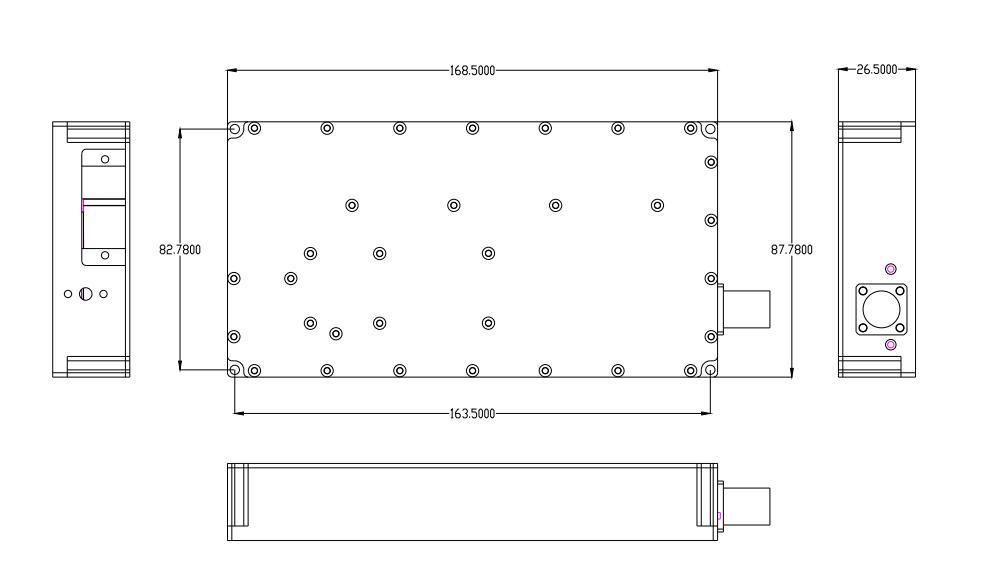
The environmental ratings match the rest of the family: case temperature –20°C to +85°C, storage –40°C to +105°C, and 95% RH non‑condensing. That makes it suitable for mobile shelters, mast‑mounted enclosures, or even unpressurised aircraft bays. Mechanically, it shares the same compact footprint – 168.5 × 82.8 × 26.5 mm (without connectors) and a lightweight 0.75 kg. RF connections are MCX female for input (saving panel space) and N‑type female for output (robust and low‑loss). DC power enters through a feed‑through capacitor with a male pin, and the 8‑pin header brings out PA_EN, RS‑485 (A/B), two external TTL pins (3 and 5), current monitor, and the temperature monitor.
Don’t overlook the cooling requirement – an external heatsink is mandatory. At 100 W output, the wideband module dissipates roughly 70–80 W, so proper thermal management is non‑negotiable for reliable, long‑life operation.
Where This Wideband Module Excels
The 300–1500 MHz range is incredibly versatile, and this amplifier fits right into:
-
Tactical and software‑defined radios – covers VHF/UHF and L‑band frequencies used by military and public‑safety comms.
-
GPS/GNSS ground stations – L‑band (1.1–1.5 GHz) is covered with plenty of margin for uplink or repeater applications.
-
Air‑traffic control (ATC) transponders and DME – the 1030/1090 MHz bands are right in the middle; this module provides the pulse power with excellent stability.
-
Cellular base station boosters and repeaters – many 700–900 MHz and 1.4–1.5 GHz bands fall within this range.
-
Electronic warfare jammers and test simulators – instantaneous bandwidth means you can hop across the entire band without retuning delays.
-
Broadband laboratory amplifiers – one unit replaces several narrowband amps, saving rack space and calibration effort.
The 2:1 VSWR tolerance gives you margin when driving antennas with varying impedance, and the ±3‑dB gain flatness ensures predictable performance across frequency sweeps.
Practical Integration Notes
The temperature monitor output is a practical tool: with a slope of 0.01 V/°C, you can easily read it with an ADC and set a shutdown threshold – for example, 85°C gives 1.35 V, which you can use to pull PA_EN low. The current monitor lets you detect abnormal consumption – a jump from the typical 10 A could indicate a load fault or impending device stress. The RS‑485 interface (pins 4 and 7) supports remote status polling, and the PA_EN pin accepts TTL‑level signals for pulsed operation or safety interlocks. The two external TTL pins (3 and 5) are available for custom logic – refer to the full datasheet for their exact behaviour.
The HPA enable voltage is specified as 28 V – this is not a TTL input; it’s a separate supply line for the high‑power amplifier stage, so ensure you provide the correct voltage to that pin.
Frequently Asked Questions
Case Studies

Drone Jammer Module Integration for Tianjin Binhai Military C-UAS

Tangshan Chem Plant Sealed Drone Gaps With 3 GaN Wideband Modules

How a Military Unit in Xi’an Upgraded Its Entire Anti-Drone Fleet With Our OEM Jamming Modules

How a National Prison Integrated Our Drone Jamming Module Into Their Fixed Counter-Drone System
Send Us a Message
Related Products

100W GaN Wideband Module – 4.0–6.0 GHz Band

100W GaN Wideband Module – 2.5–4.0 GHz Coverage