When you crack open a piece of RF test equipment, a software-defined radio, or even a portable drone jammer, there’s a good chance a tiny board is doing the heavy lifting — the signal source module. It’s the component that actually generates the clean sine waves, chirps, or modulated carriers that make the whole system tick. These modules have quietly moved from benchtop instruments into the heart of real-world electronic warfare, industrial heating, and even medical devices. Let’s break down where they show up and what specs actually matter when you’re picking one.

What a Signal Source Module Actually Does
At its core, a signal source module is a frequency synthesizer on a compact PCB. It locks a voltage-controlled oscillator (VCO) to a stable reference — usually a TCXO or OCXO — using a phase-locked loop (PLL). The output is a precise RF tone that can be swept, modulated, or stepped across a wide range. Most modern modules cover anywhere from 10 MHz up to 6 GHz or higher, with output power hovering around +10 dBm. Some integrate amplifiers to push past +20 dBm, but raw power isn’t always the goal — spectral purity often matters more.
Real-World Deployments You Might Not Expect
The signal source module is the invisible workhorse behind dozens of systems. Here’s a snapshot of where they’re being used right now:
| Application Field | Typical Use Cases | Frequency Highlights |
|---|---|---|
| RF Test & Measurement | Tracking generators, VNA sources, spectrum analyzer calibration | 9 kHz to 6 GHz |
| Counter-UAV / Electronic Warfare | Exciter for drone jamming modules, GPS spoofing, protocol-aware disruption | 433 MHz, 915 MHz, 2.4 GHz, 5.8 GHz, 1.57 GHz |
| Communications Infrastructure | Local oscillators for base station transceivers, backhaul links | 700 MHz to 3.8 GHz |
| Industrial Processing | RF plasma generation, induction heating, dielectric welding | 13.56 MHz, 27.12 MHz, 40.68 MHz |
| Medical Equipment | MRI excitation pulses, RF ablation generators | 64 MHz, 128 MHz |
| Scientific Research | Quantum computing qubit drive, atomic clock interrogation | Custom VHF to X-band |
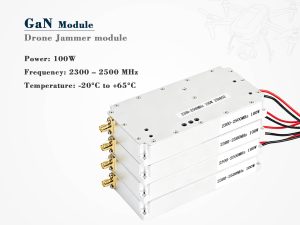
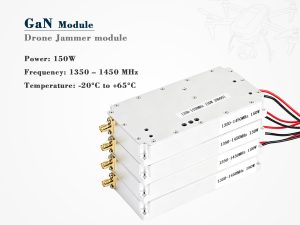
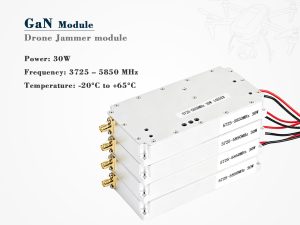
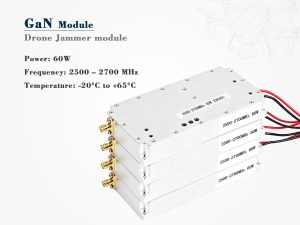
In the counter-drone world, a signal source module is the brain of the jammer. It generates the precise waveform that gets amplified and blasted out to break the drone’s link. Without a clean, fast-switching source, even a 100W amplifier won’t be effective — you’d just be broadcasting noise in the wrong place at the wrong time.
The Specs That Separate the Good from the Great
When you’re comparing modules, don’t just glance at the frequency range. These are the parameters that make or break a design.
Phase Noise:
This is the single most overlooked spec. A high phase noise floor means your signal bleeds into adjacent channels. In a test setup, that kills measurement accuracy. In a jammer, it wastes power and causes unintended interference. Look for a module that specifies phase noise in dBc/Hz at 1 kHz and 10 kHz offsets — anything below -90 dBc/Hz at 10 kHz offset is solid for most applications.
Frequency Resolution and Switching Speed:
If you need to hop frequencies fast — say, to track a frequency-agile drone — sub-millisecond switching time is non-negotiable. The PLL’s loop filter bandwidth and the VCO’s tuning sensitivity dictate this. A module with a 10 Hz resolution might sound impressive, but if it takes 5 milliseconds to settle, you’ll miss fast signals. Check the datasheet for tuning step size and lock time.
Modulation Capabilities:
Modern modules often include internal modulation support — AM, FM, pulse, and even arbitrary I/Q via a built-in DAC. If you’re building a smart jammer that needs to mimic protocol behaviors, integrated I/Q modulation is a huge plus. It keeps your BOM lean and your timing tight.
Power Flatness and Harmonics:
A signal source that varies ±3 dB across its band will give you headaches when you try to calibrate an antenna or run a swept jammer. Look for modules with power leveling or at least well-characterized output flatness. Harmonics should be below -30 dBc; if not, you’ll need external filtering, which adds cost and size.
Interface and Integration:
Most modules are controlled via SPI or UART, with some adding USB for direct PC control. If you’re embedding the module into a larger system, check that the command set allows you to change frequency, power, and modulation on the fly without rebooting. A well-documented API with Python or C libraries saves weeks of integration effort.
Keep It Real
The signal source module you choose anchors the performance of your entire system. A sub-$50 wideband synthesizer might be fine for a hobbyist spectrum analyzer, but for a military jammer or precision medical device, spend the extra money on phase noise and switching speed. The difference shows up in the field — not on a glossy spec sheet, but in whether your system actually works when it counts.