
100W GaN Wideband Module – 2.5–4.0 GHz Coverage
100W GaN wideband module, 2.5–4.0GHz, 50dB gain, 30% eff, ≤2:1 VSWR, MCX/N, 28V, 0.75kg. For 5G, radar, SATCOM & EW.
5G NR infrastructure
Weather and surveillance radar
Satellite communications (SATCOM)
Electronic warfare test beds
Multi‑band test systems

Technical Specifications
| Parameter | Condition | Min | Typ | Max |
| Operating frequency | CW | 2500 MHz | – | 4000 MHz |
| Instantaneous bandwidth | – | – | 3250 MHz | – |
| Peak output power (P<sub>SAT</sub>) | CW | – | 100 W | – |
| Input power for rated output | – | – | –2 ±3 dBm | – |
| Max input (no damage) | – | – | – | 5 dBm |
| Power gain (@ 0 dBm input) | – | – | 50 ±3 dB | – |
| Gain flatness (@ 0 dBm input) | – | – | – | ±3 dB |
| Efficiency (@ 100 W out) | – | – | 30% | – |
| Harmonics (1st–Nth) | @ 100 W out | 10 dBc | – | – |
| Spurious level | – | 60 dBc | – | – |
| Input / Output VSWR | – | – | – | 2:1 |
| Operating voltage | DC | 28 V | 28–30 V | – |
| Current consumption | @ 100 W out | – | 10 A | – |
Product Details
If your RF system lives in the 2.5 to 4.0 GHz range – a sweet spot that covers 5G mid‑bands, tactical radar, satellite downlinks, and electronic warfare – you know the struggle of juggling multiple narrowband amplifiers. The AMP25004000‑100W wideband module cuts through that complexity with a single, broadband GaN‑on‑SiC solution that delivers a full 100 watts of clean power across the entire band, instantly, without tuning. It’s the kind of component that makes system designers breathe easier: one part, one bias setting, one thermal design, and you’re done.
What Sets This Module Apart
The headline is the 3250 MHz of instantaneous bandwidth – that’s not a typo. From 2500 to 4000 MHz, the module maintains its gain, power, and match without any external adjustments. The Class AB GaN architecture gives you the linearity needed for modulated signals (think 5G NR or QAM) while keeping efficiency at a respectable 30%. And the patented thermal management – using a copper sub‑carrier directly under the GaN die – ensures that the 100‑W output doesn’t come with a side of overheating. You get consistent performance even after long CW runs, which is critical for production testing or continuous jamming scenarios.
The 50‑ohm input and output are truly broadband; the VSWR stays at or below 2:1 across the full range, so you won’t waste time with matching networks. And the monitoring features – temperature output (0.75 V at 25°C, 0.01 V/°C slope), current sense, and RS‑485 – turn this amplifier into a smart, observable part of your system, not just a dumb gain block.
Environmental and Mechanical Sturdiness
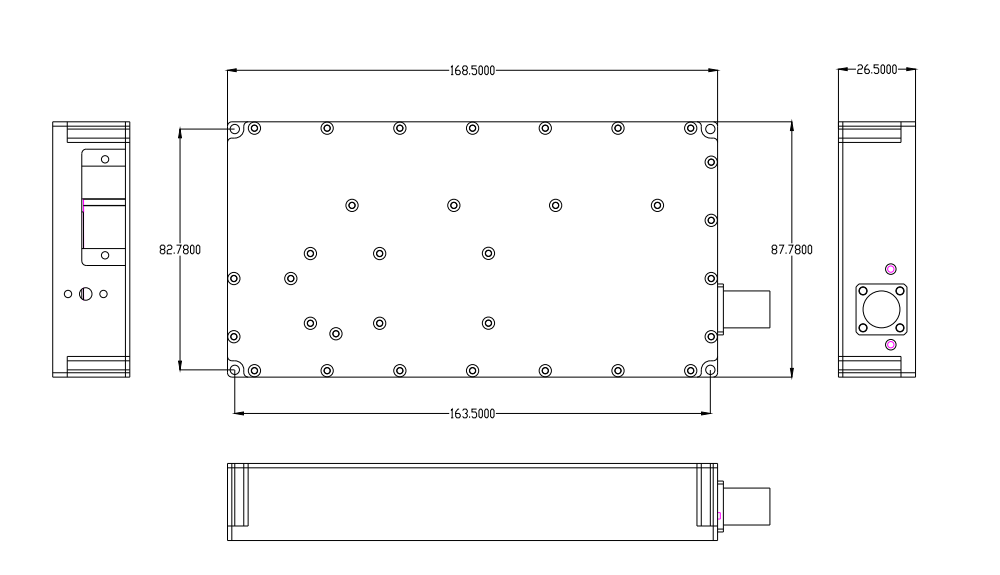
This module is built to survive harsh conditions. It operates from –20°C to +85°C case temperature and can be stored from –40°C to +105°C. Non‑condensing humidity up to 95% RH is within spec, so it’s fine for outdoor enclosures or unheated lab spaces. The mechanical footprint is the same compact size as its lower‑frequency sibling: 168.5 × 82.8 × 26.5 mm (without connectors) and just 0.75 kg. RF connections are MCX female for input (saving board space) and N‑type female for output (robust and low‑loss). DC power comes through a feed‑through capacitor with a male pin, and the 8‑pin header gives you PA_EN, RS‑485 (A/B), external TTL, current monitor, and the temperature monitor.
Don’t forget – an external heatsink is mandatory. At 100 W output, the module dissipates roughly 70–80 W, so adequate cooling is non‑negotiable for sustained operation.
Where This Module Excels
With its coverage from 2.5 to 4.0 GHz, this amplifier is a natural fit for:
-
5G NR infrastructure – covers n41 (2.5 GHz), n77 (3.3–4.2 GHz), and other mid‑band allocations, making it ideal for base station transmitters or repeater systems.
-
Weather and surveillance radar – the 2.7–3.5 GHz bands are heavily used in radar; this module provides the pulse power without needing different amps for each band.
-
Satellite communications (SATCOM) – many military and commercial downlinks fall in this range, and the high spurious rejection helps meet strict out‑of‑band emission limits.
-
Electronic warfare test beds – fast‑hopping threats require amplifiers that can follow; the instantaneous bandwidth ensures no lag.
-
Multi‑band test systems – one module replaces two or three narrowband amplifiers, reducing rack space and calibration complexity.
The 2:1 VSWR tolerance gives you a comfortable margin when driving slightly mismatched antennas or switching networks.
Practical Integration Notes
The temperature monitor is a gift for system integrators: with a slope of 0.01 V/°C, you can easily read it with a standard ADC and set a trip threshold – for example, 85°C gives 1.35 V, which you can use to shut down the PA_EN line. The current monitor lets you detect abnormal draw – a sudden rise from the typical 10 A could indicate a load fault or impending device stress. The RS‑485 interface allows you to poll the module’s status remotely, and the PA_EN pin supports TTL‑level gating for pulse‑on‑demand operation. Also note the external TTL pins (3 and 5) – they can be used for custom control logic if you need additional flexibility.
Whether you’re upgrading a legacy radar front‑end or designing a next‑generation 5G remote radio head, the AMP25004000‑100W wideband module offers a proven, drop‑in solution for 100 watts across 2.5–4.0 GHz. Its GaN efficiency, instantaneous bandwidth, and comprehensive monitoring make it a versatile building block that reduces part count and simplifies system integration. For thermal simulation files, connector torque specs, or custom mounting brackets, our applications engineers are ready to help. Try this module in your next design – and discover what true wideband performance feels like without the usual band‑switching headaches.
Frequently Asked Questions
Case Studies
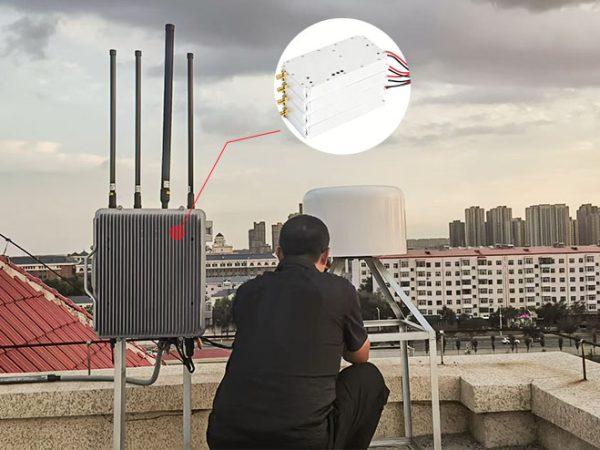
Heilongjiang Weather Center Completes Anti-Drone System Upgrade with Three High-Power Drone Jammer Modules

Tangshan Chem Plant Sealed Drone Gaps With 3 GaN Wideband Modules

How a National Prison Integrated Our Drone Jamming Module Into Their Fixed Counter-Drone System

Integrating Core RF Power: OEM Drone Jamming Module for Oil Refinery Security | Case Study
Send Us a Message
Related Products

High-Power 100W GaN Broadband Amplifier Module 3-5 GHz

100W GaN Broadband Amplifier Module 1–3 GHz

100W Broadband Amp Module – 20 to 600 MHz Wideband Power for HF/VHF/UHF