
100W GaN Wideband Module – 4.0–6.0 GHz Band
100W GaN wideband module, 4–6GHz, 50dB gain, 30% eff, ≤2:1 VSWR, MCX/N, 28V, 0.75kg. For C-band radar, SATCOM, 5G & test.
C‑band satellite ground stations
Weather and air‑traffic control radar
5G NR bands
Electronic warfare (EW) jammers and simulators
Automated test equipment (ATE)

Technical Specifications
| Parameter | Condition | Min | Typ | Max |
| Operating frequency | CW | 4000 MHz | – | 6000 MHz |
| Instantaneous bandwidth | – | – | 5000 MHz | – |
| Peak output power (P<sub>SAT</sub>) | CW | – | 100 W | – |
| Input power for rated output | – | – | –2 ±3 dBm | – |
| Max input (no damage) | – | – | – | 5 dBm |
| Power gain (@ 0 dBm input) | – | – | 50 ±3 dB | – |
| Gain flatness (@ 0 dBm input) | – | – | – | ±3 dB |
| Efficiency (@ 100 W out) | – | – | 30% | – |
| Harmonics (1st–Nth) | @ 100 W out | 10 dBc | – | – |
| Spurious level | – | 60 dBc | – | – |
| Input / Output VSWR | – | – | – | 2:1 |
| Operating voltage | DC | 28 V | 28–30 V | – |
| Current consumption | @ 100 W out | – | 11 A | – |
Product Details
The C-band – spanning 4.0 to 6.0 GHz – is one of the most crowded and critical slices of the microwave spectrum. It carries satellite TV, weather radar, 5G backhaul, military comms, and countless test applications. Traditionally, covering this whole range meant a rack full of band‑specific amplifiers, each with its own bias, cooling, and switching logic. The AMP40006000‑100W wideband module changes that equation entirely. With a single GaN‑on‑SiC amplifier that delivers 100 watts of clean, stable power across the full 2 GHz band – instantly, without tuning – you can retire the switching circus and focus on what really matters: your system performance.
Why This Module Stands Out
The headline feature is the 5000 MHz of instantaneous bandwidth – that’s the entire 4‑to‑6 GHz range with no gaps, no dipoles, no external matching. The Class AB GaN design gives you the headroom for both CW and modulated signals, with efficiency hovering around 30% – impressive for a wideband device at these frequencies. The patented thermal management, using a copper sub‑carrier directly beneath the GaN die, pulls heat away fast enough to maintain full rated power even during extended CW runs. That matters when you’re running burn‑in tests, jamming scenarios, or long‑duration satellite link simulations.
The 50‑ohm ports are genuinely broadband; input and output VSWR stay ≤2:1 across the entire range without any external matching components. And the built‑in monitoring suite – temperature sense (0.75 V at 25°C, 0.01 V/°C slope), current monitor, and RS‑485 interface – turns this amplifier into a smart, controllable element of your system, not just a passive gain block.
Built Tough for Real‑World Deployment
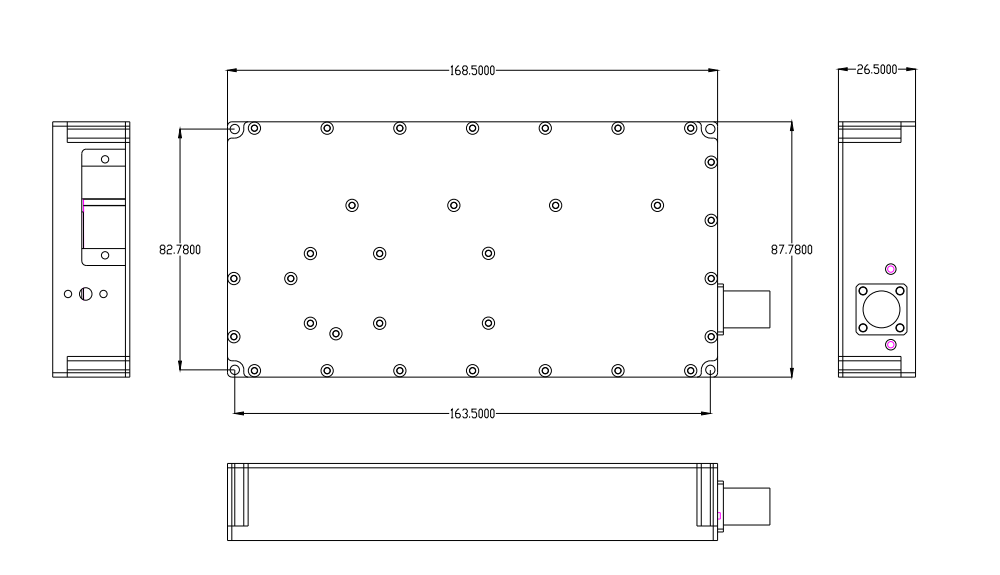
The environmental ratings are identical to the rest of the family: case temperature from –20°C to +85°C, storage from –40°C to +105°C, and 95% RH non‑condensing. That makes it suitable for outdoor antenna masts, unpressurised aircraft bays, or tropical test facilities. Mechanically, it shares the same compact footprint – 168.5 × 82.8 × 26.5 mm (without connectors) and just 0.75 kg. The RF interface uses an MCX female input (space‑efficient) and an N‑type female output (robust and low‑loss at these frequencies). DC power enters through a feed‑through capacitor with a male pin, and the 8‑pin header provides PA_EN, RS‑485 (A/B), external TTL (pins 3 and 5), current monitor, and the temperature monitor.
Remember: an external heatsink is absolutely required. At 100 W output, the module dissipates around 70–80 W, so thermal management is not optional – it’s essential for reliable operation.
Where This Module Shines
The 4–6 GHz band is incredibly versatile, and so is this amplifier. Typical applications include:
-
C‑band satellite ground stations – both transmit and receive chains benefit from the high gain and low spurious output, reducing the need for extra filtering.
-
Weather and air‑traffic control radar – the 5.4–5.9 GHz band is heavily used for terminal Doppler and surveillance radars; this module provides the pulse power with excellent pulse‑to‑pulse stability.
-
5G NR bands – n79 (4.4–5.0 GHz) and other mid‑band allocations are covered, making it useful for small‑cell and repeater designs.
-
Electronic warfare (EW) jammers and simulators – fast‑hopping threats need instantaneous response; this module doesn’t lag.
-
Automated test equipment (ATE) – one amplifier replaces multiple narrowband units, simplifying calibration and reducing rack space.
The 2:1 VSWR tolerance gives you margin when driving slightly mismatched loads, and the gain flatness of ±3 dB ensures that swept measurements don’t require external equalisation.
Integration Tips from the Lab
The temperature monitor is a hidden gem: with 0.01 V per °C, you can digitise it with any ADC and set a software alarm. For instance, 85°C gives 1.35 V – you can use that to pull the PA_EN line low and protect the module. The current monitor gives you a real‑time window into the module’s health – a sudden increase above 11 A might indicate a load fault or imminent failure. The RS‑485 interface allows you to poll the module’s status remotely, and the PA_EN pin accepts TTL logic for pulse‑on‑demand or safety interlock. The two external TTL pins (3 and 5) are available for custom control logic if needed – check the full datasheet for their exact function.
Whether you’re designing a next‑generation satellite uplink, upgrading an aging radar front‑end, or building a flexible test station for C‑band devices, the AMP40006000‑100W wideband module offers a compact, reliable, and high‑performance solution. Its GaN efficiency, instant bandwidth, and smart monitoring features reduce design complexity and accelerate time‑to‑market. For thermal simulation models, connector torque values, or custom mounting kits, our application engineering team is ready to assist. Put this module to work in your system – and experience the freedom of true wideband operation without the usual band‑switching headaches.
Frequently Asked Questions
Case Studies
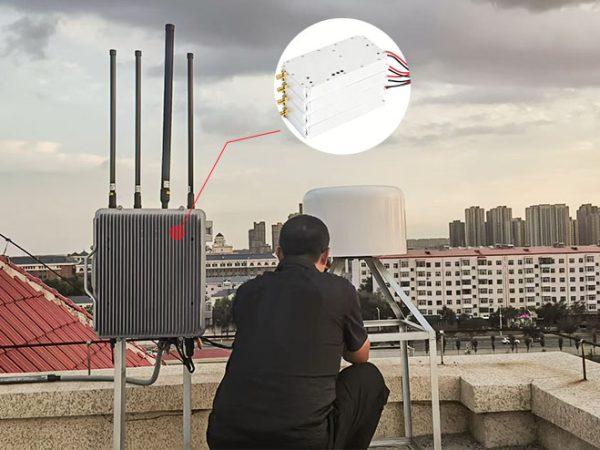
Heilongjiang Weather Center Completes Anti-Drone System Upgrade with Three High-Power Drone Jammer Modules

Tangshan Chem Plant Sealed Drone Gaps With 3 GaN Wideband Modules

How a National Prison Integrated Our Drone Jamming Module Into Their Fixed Counter-Drone System

Integrating Core RF Power: OEM Drone Jamming Module for Oil Refinery Security | Case Study
Send Us a Message
Related Products

High-Power 100W GaN Broadband Amplifier Module 3-5 GHz

100W GaN Broadband Amplifier Module 1–3 GHz

100W Broadband Amp Module – 20 to 600 MHz Wideband Power for HF/VHF/UHF