One Near-Miss Too Many

The Tangshan facility had been on the security integrator’s books for years. It’s the kind of place where safety protocols are written in triplicate: ethylene oxide storage, solvent recovery units, and a maze of high-pressure lines that don’t react well to unexpected objects falling out of the sky.
For a while, the existing counter-drone rack on the admin building roof did its job. It detected and jammed the usual consumer stuff — 2.4 GHz and 5.8 GHz — and the security team logged a few nuisance flights a year, mostly teenagers flying camera drones too close to the fence. Then, late last year, a drone they couldn’t touch spent six minutes mapping the tank farm at 1.6 GHz. The system logged the RF signal. It classified it as a drone. And it did absolutely nothing because the jamming amplifiers in the rack didn’t cover that band.
A week later, a second incursion happened, this time with a drone hopping between 3.5 and 3.7 GHz. Again, detected, classified, zero response. The plant’s HSE manager sent a two-word email to the integrator: “Fix it.”
The Mandate
The integrator called us on a Thursday. The plant’s demand was straightforward: they wanted continuous jamming coverage from 1.5 GHz to 6.0 GHz, at power levels that would actually force a drone into fail-safe mode at range, not just annoy it. But they also had a hard constraint: the rack enclosure, the DC power infrastructure, the antenna cabling, the control system — all of that had to stay. The plant had just passed a costly recertification of its roof-mounted equipment and wasn’t about to open a new permitting process.
We proposed three GaN wideband modules that, together, form an unbroken wall from 1.5 GHz up to 6.0 GHz. No gaps. No interleaving tricks. Just continuous, high-duty-cycle coverage.
The integrator placed an order for:
| Module | Band | Power | Qty |
|---|---|---|---|
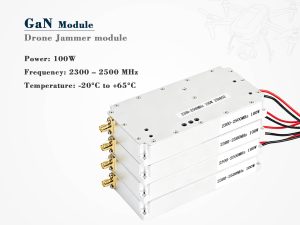
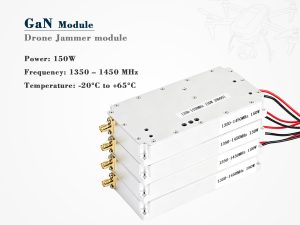
| 100W GaN Wideband Module | 1500–2500 MHz ① | 100 W | 1 |
| 100W GaN Wideband Module | 2500–4000 MHz ② | 100 W | 1 |
| 100W GaN Wideband Module | 4000–6000 MHz ③ | 100 W | 1 |
Each module was delivered in a flange-mount aluminum chassis, conduction-cooled, with an RS-485 control interface and a 48 V DC input. The control protocol was the same ASCII command set they already used — ARM, DISARM, STATUS — so the integrator’s central controller didn’t need a single line of code changed.
Making Three GaN Wideband Modules Fit Where Two Used to Sit
The old rack had two narrowband amplifier drawers, each about 2U tall. The integrator’s mechanical guy sketched up a single 3U replacement drawer that would hold all three of our modules on a shared heatsink plate. Our modules came with pre-drilled mounting flanges, so they bolted straight in. The existing roof antennas — a mix of wideband panel types — had enough bandwidth to handle the extended range, which saved a lot of hassle. The only thing they replaced inside the rack were the internal coax jumpers, swapping in shorter, lower-loss cables to keep the signal path clean.
Power was a slight concern at first. Three 100W modules pulling simultaneously from a 48 V DC bus meant the rack’s total draw would nearly triple. The integrator checked the original power supply specs, found enough headroom, and added a small inrush current limiter at the DC input just to be safe. No external wiring changed. No new conduits. The whole physical swap took two technicians about five hours on a Saturday morning.
The Tests
The plant’s security team wanted to see every drone they could get their hands on thrown at the new setup. They borrowed a few, brought in a contractor with a custom FPV build, and ran flights at different times of day over two weekends.
-
Seven different drone types were flown in 22 total sorties, covering frequencies from 1.5 GHz up to 5.8 GHz, including one hybrid that used 1.6 GHz for C2 and 3.5 GHz for video.
-
All 22 sorties ended with the drone losing control link and executing a pre-programmed return-to-home or auto-landing in the designated catch zone — a fenced gravel area near the maintenance shed.
-
The jamming range, measured by the drone’s onboard GPS logs, stretched to about 2 km with the existing antenna setup, more than double what the old amplifiers could manage.
-
The security director made a point of testing the 3.5 GHz and 1.6 GHz bands repeatedly because those were the ones that had failed before. This time, the drones never even got close to the tank farm.
A week after testing wrapped, the integrator forwarded us a short note from the plant’s HSE manager. It read: “We no longer have blind spots. That was the goal. It’s met.”
What Other Industrial Sites Can Take From This
We’ve seen a fair number of chemical plants and refineries in a similar spot. They invested in counter-drone gear three or four years ago when the threat was mostly Wi-Fi-based consumer drones. Now the threat has shifted, but the racks, the power, the cabling, the monitoring software — that stuff is still perfectly good. Replacing the entire system is expensive, slow, and often triggers a chain of compliance reviews nobody wants.
Three modules, three bands, one morning of integration. That’s what this project boiled down to. The GaN design means the modules aren’t stressed at 100W, so they’ll run cool and last. The wideband coverage means when some new drone pops up on 2.3 GHz or 3.1 GHz next year, the plant is already covered. No firmware update needed. No site visit. It’s a hardware-defined shield that doesn’t care what frequency the next drone hops to, as long as it falls between 1.5 and 6.0 GHz.