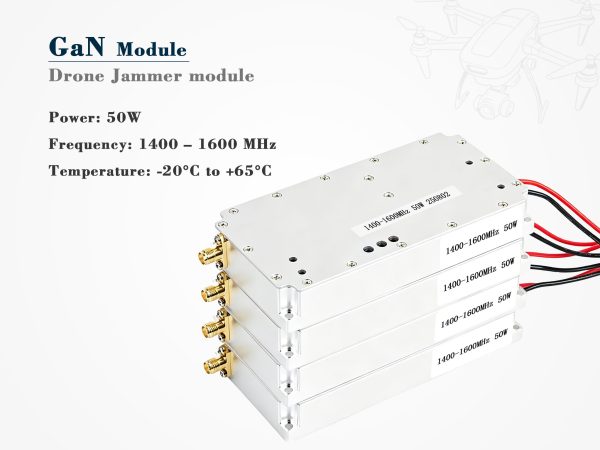
50W LDMOS Drone Jamming Module 600-700MHz
50W LDMOS drone jamming module, 600-700MHz, built-in noise modulation, 28V, 50W, SMA, 117x58x18mm.
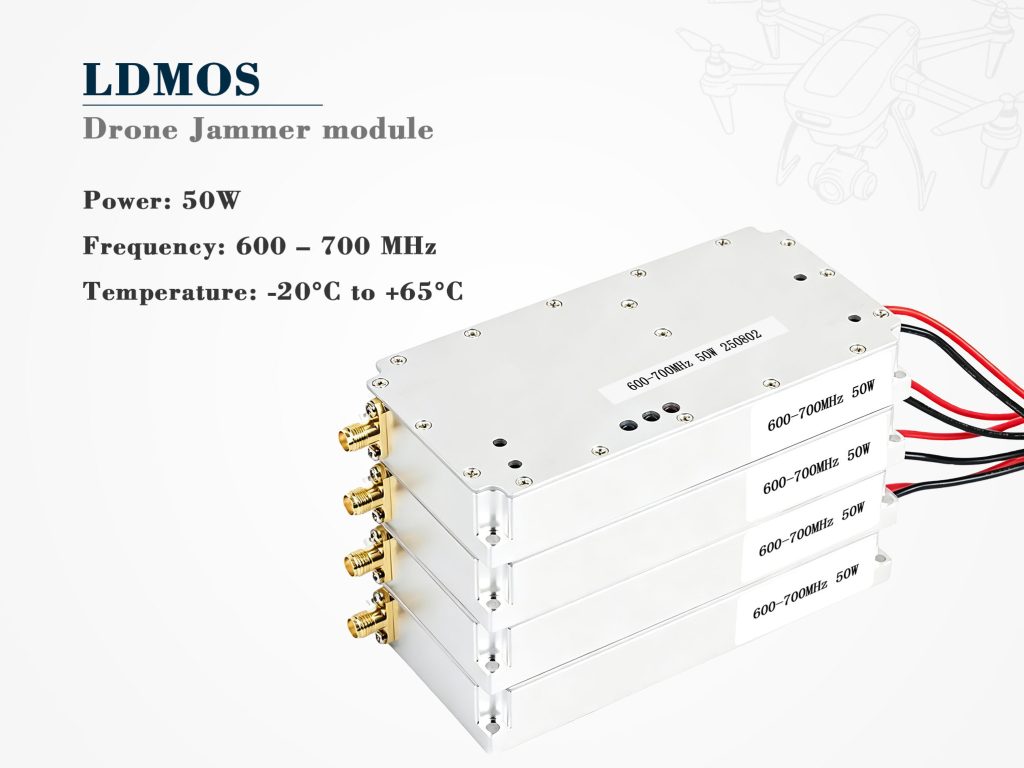
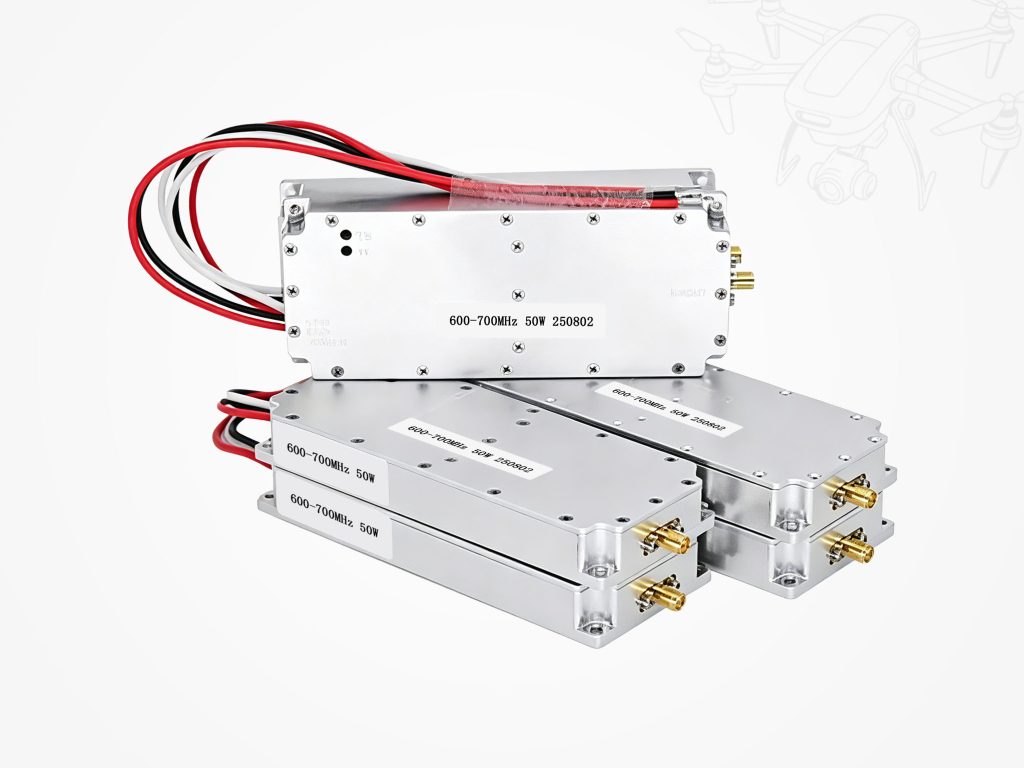
Technical Specifications
| Parameter | Specification | Notes |
| Frequency range | 600–700 MHz | Covers common drone command links |
| Output power | 47±1 dBm (50 W) | LDMOS final stage |
| Supply voltage | 24–28 V DC | 28 V nominal for rated power |
| Current draw | ≤3.2–4.5 A (at 50W) | Depends on VSWR and temperature |
| Modulation source | Built-in high-speed noise | Customizable: VCO, DDS, SDR |
| Analog scan speed | 270 kHz (default) | Configurable 100–500 kHz |
| Input / output impedance | 50 Ω | SMA female connector |
| Protection LEDs | Green: power; Red: over-voltage/overtemp | Auto-shutdown protection |
| Operating temperature | -20~+65 °C | Baseplate temperature |
| Dimensions (L×W×H) | 117 × 58 × 18 mm | Custom sizes available |
| Weight | 300 g | Aluminum enclosure |
| Base material | Anodized aluminum alloy | Excellent thermal properties |
Product Details
Targeting the 600–700 MHz Threat Band
If you’ve worked with counter-drone systems, you know that not all UAVs rely on 2.4 GHz or 5.8 GHz. Many commercial and industrial drones still use the 600–700 MHz range for remote control or telemetry downlinks. This is where the 50W drone jamming module comes in. It delivers 50 watts of continuous RF power across that entire band, driven by a rugged LDMOS transistor. With an output of 47±1 dBm, this module drowns out the drone’s receiver with aggressive noise. The integrated design means you don’t need to mess with external signal generators or complex cabling—just supply DC power and the 50W drone jamming module starts doing its job.
Noise Modulation: The Key to Disruption
A single-tone jammer is easy for modern drones to filter out. What makes this 50W drone jamming module effective is its built-in high-speed noise modulation source. Instead of a clean sine wave, it radiates a dense, rapidly changing noise waveform across the 600–700 MHz spectrum. This overwhelms the drone’s receiver front-end, making it nearly impossible for any digital filtering algorithm to recover the control signal. The default modulation is optimized for maximum disruption, but if your mission demands something different—like a VCO sweep, direct digital synthesis, or an SDR-based arbitrary waveform—the module can be customized at the factory. That flexibility keeps this 50W drone jamming module relevant as drone technology evolves.
DC Power Requirements and Thermal Design
Getting clean, stable power to your jammer is critical. This module operates from 24 to 28 V DC, drawing between 3.2 and 4.5 A depending on load and temperature. Use a regulated DC supply with minimal ripple to maintain spectral cleanliness and avoid spurious emissions. At a nominal 28 V, a 50 W RF output is consistently achieved. The LDMOS amplifier is efficient enough that the 117 x 58 x 18 mm aluminum body acts as a sufficient heatsink for most duty cycles. Still, for extended continuous use, mounting it to a larger metal surface is recommended to keep junction temperatures in check. The 50W drone jamming module is protected by over-voltage and over-temperature circuits that shut down the amplifier if thresholds are exceeded, preventing damage.
Frequency Sweep Speed and Source Options
While the core function is noise jamming, the analog sweep speed is set to 270 kHz by default. This can be tailored anywhere from 100 kHz to 500 kHz upon request. A faster sweep broadens the instantaneous bandwidth slightly, while a slower one concentrates more energy per channel. Additionally, the internal modulation source can be swapped for a VCO, DDS, or SDR input. This gives system integrators the freedom to implement more complex jamming patterns or synchronize multiple units for phased-array setups. Even in its default configuration, the 50W drone jamming module covers a wide threat spectrum without any external input.
Simple Controls and On-Board Diagnostics
Operation is straightforward: supply DC to the 50W drone jamming module, and a green LED confirms power. If over-voltage or over-temperature is detected, a red LED lights up and the amplifier shuts down automatically. The SMA female output connects directly to your antenna or filter chain. Remote on/off is as simple as switching the DC input—no dedicated TTL pin needed, though one can be added on request.
Compact Footprint for Field Integration
Weighing just 300 g and measuring 117×58×18 mm, the module fits tight installations like drone guns or backpack jammers. The anodized aluminum base dissipates heat and resists corrosion. Stack multiple units to cover different bands without exceeding space limits. The 50W drone jamming module serves as a reliable building block for integrated counter-UAS platforms.
Built to Last in Harsh Conditions
The -20 to +65°C operating temperature range means this module can be deployed in desert heat or freezing winters without performance degradation. The solid-state LDMOS design has no moving parts, so vibration and shock don’t affect it. All components are sealed against dust and moisture on the PCB, though the module itself isn’t IP-rated for immersion. With proper mounting and a good antenna, this 50W module will provide years of consistent service. It’s been tested extensively with mismatched loads up to 2:1 VSWR and passed.
Summary
In short, this 50W module combines high-power noise jamming, LDMOS durability, and a compact form factor ideal for counter-drone missions in the 600–700 MHz band.
Frequently Asked Questions
Case Studies
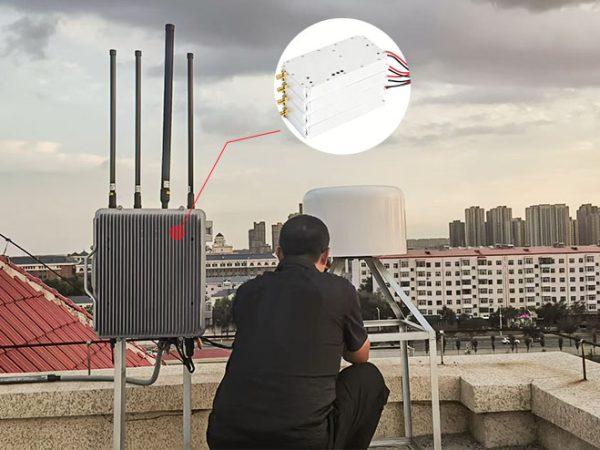
Heilongjiang Weather Center Completes Anti-Drone System Upgrade with Three High-Power Drone Jammer Modules

Tangshan Chem Plant Sealed Drone Gaps With 3 GaN Wideband Modules

How a National Prison Integrated Our Drone Jamming Module Into Their Fixed Counter-Drone System

Integrating Core RF Power: OEM Drone Jamming Module for Oil Refinery Security | Case Study
Send Us a Message
Related Products
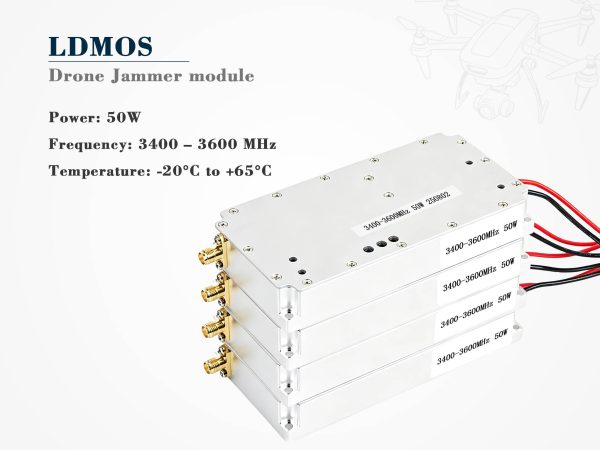
3400–3600 MHz 50W Drone Countermeasure Module
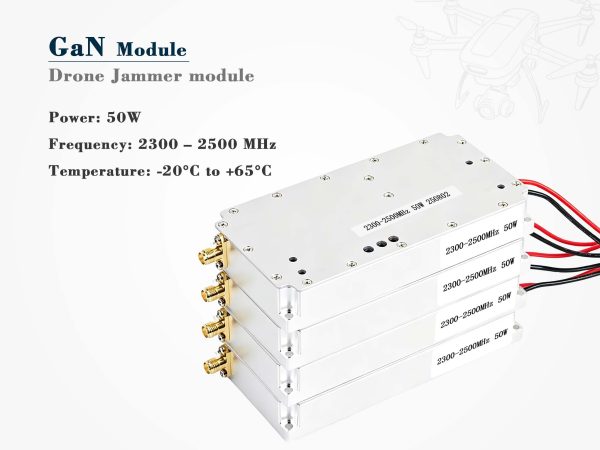
2300–2500MHz 50W GaN Module for Drone Countermeasure and Signal Shielding
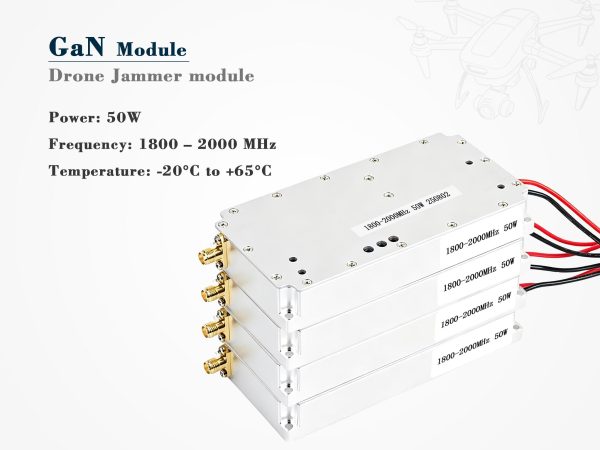
Powerful 50W GaN Jammer Module 1800-2000MHz