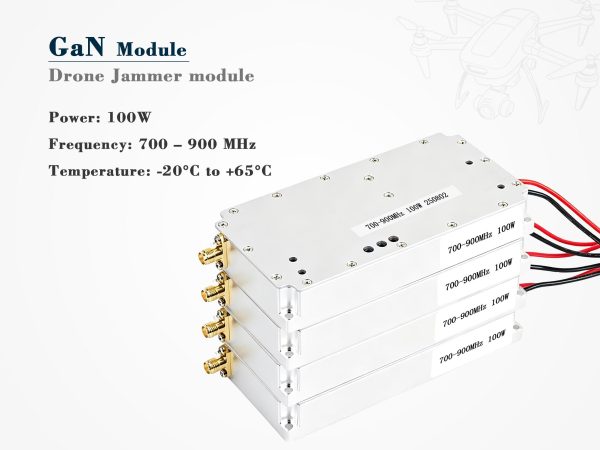
100W LDMOS Drone Jammer Module 2500-2700MHz
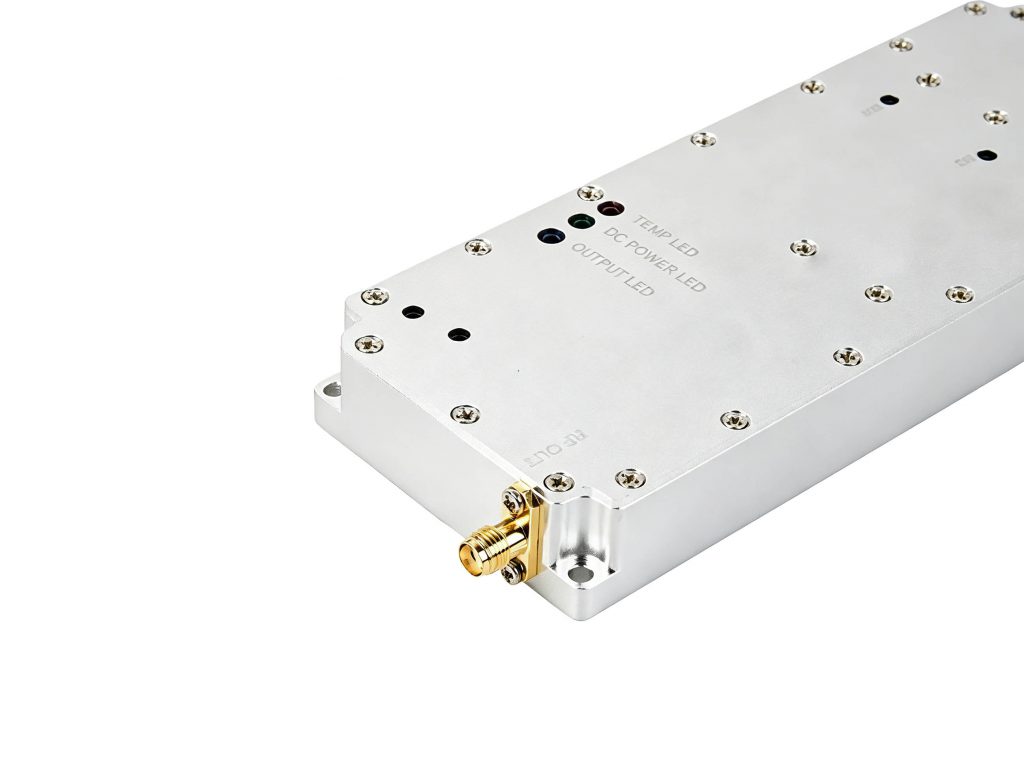
100W drone jammer module, 2500-2700MHz, LDMOS, built-in sweep source, 24-29V DC, 100W, SMA, 168.5x84.5x23mm.
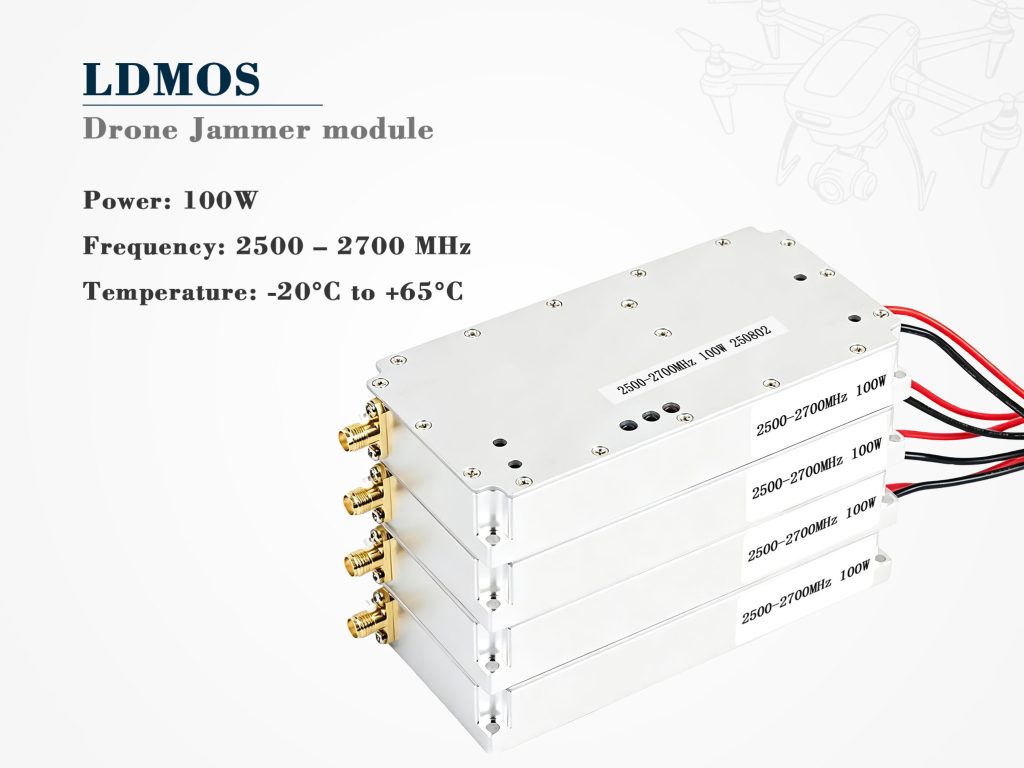
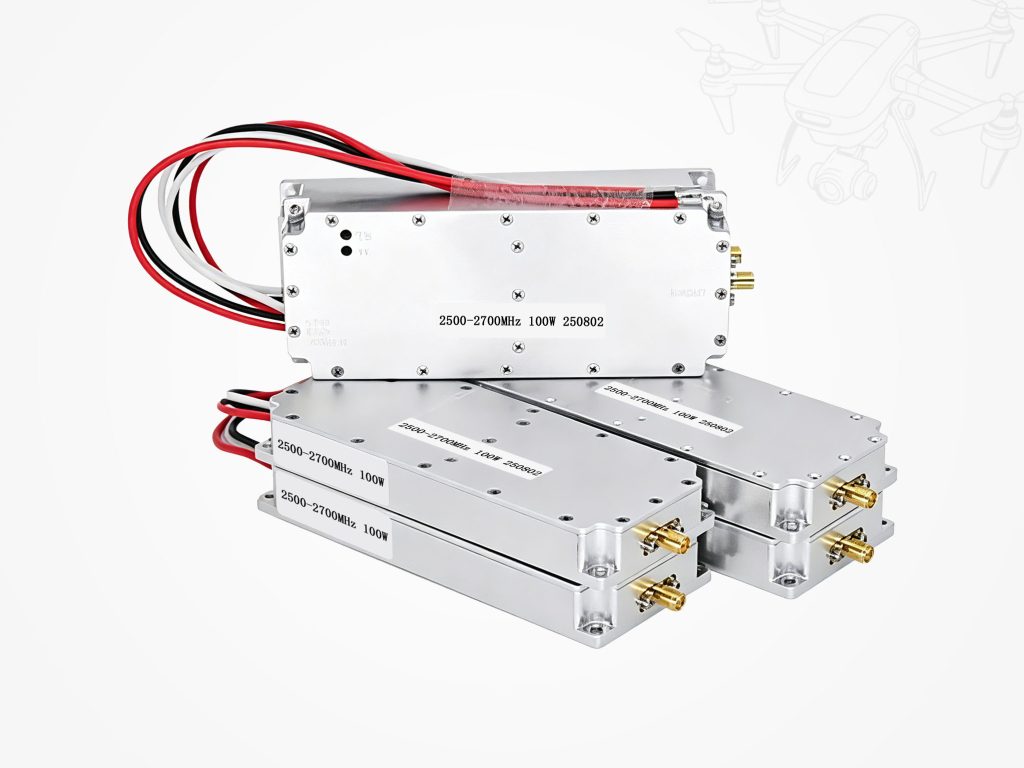
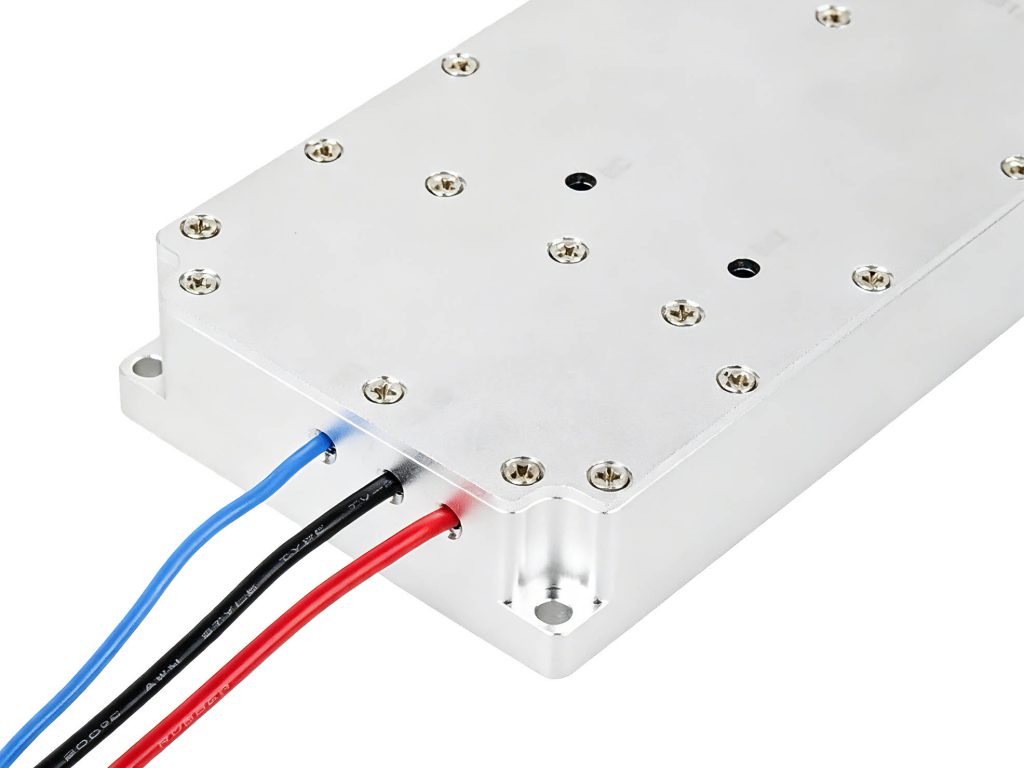
Technical Specifications
| Parameter | Specification | Notes |
| Frequency range | 2500~2700 MHz | Covers UAV video downlinks and command links |
| Output power | 100 W (50 dBm) | LDMOS final stage, VSWR ≤2.0 tolerant |
| Supply voltage | 24~29 V DC | 28 V nominal for rated 100 W output |
| Current draw | ≤12 A at 100 W | Depends on VSWR and temperature |
| Modulation source | Built-in high-speed analog sweep | Factory configurable; no external generator needed |
| Analog scan speed | Configurable high-speed | Typical range provided upon request |
| Input / output impedance | 50 Ω | SMA female connector |
| Protection LEDs | Green: Power/Enable; Red: VSWR/Over-temp | Absorptive VSWR protection included |
| Operating temperature | -20~+65 °C | Baseplate temperature |
| Dimensions (L×W×H) | 168.5 × 84.5 × 23 mm | Compact for a 100W module |
| Weight | 0.55 kg | Aluminum alloy enclosure |
| Base material | Anodized aluminum alloy | Excellent thermal dissipation |
Product Details
Power That Silences Drones in the 2.5–2.7 GHz Band
When drone operators switch to less congested frequencies like 2500–2700 MHz for video transmission or command links, countermeasures must respond with overwhelming force. The 100W LDMOS drone jammer module delivers a formidable 100 watts of RF output — enough to saturate receivers at ranges where lower-power modules simply fail. This band covers critical UAV communication channels, and with 100W, you’re not just creating noise; you’re seizing full spectral dominance. Many off-the-shelf drones rely on this spectrum for long-range HD video, making the module a vital asset in fixed and mobile counter-drone setups.
Why LDMOS Makes the 100W Difference
Achieving 100 watts across a 200 MHz-wide band is no trivial task. The module’s LDMOS transistor stage provides the necessary combination of gain, efficiency, and thermal resilience. Efficiency exceeds 40%, which means less DC power is wasted as heat and more is converted into effective jamming energy. The 100W LDMOS drone jammer module also tolerates high VSWR conditions (≤2.0) without catastrophic failure — a critical trait when antennas get damaged or misaligned in the field. This ruggedness keeps your counter-UAS system operational when it matters most. When you’re counting on consistent jamming in all conditions, that robustness is non-negotiable.
High-Speed Sweep and Absorptive VSWR Protection
Many jamming modules pump out a single tone that drones can easily dodge. That’s why the 100W LDMOS drone jammer module integrates a high-speed analog sweep source directly on board. It rapidly shifts the carrier across 2500–2700 MHz, creating a moving interference barrier. Moreover, the module includes built-in absorptive VSWR protection — not just a reflective limiter. If an antenna mismatch occurs, excess reflected energy is safely dissipated rather than sent back to the LDMOS transistor, adding another layer of durability that competing modules often lack.
Power Supply: What You Need to Run 100W
Output power of this magnitude demands a serious DC source. The 100W LDMOS drone jammer module runs on 24–29 V DC and can draw up to 12 A at full power. A high-quality regulated supply with low ripple is mandatory to maintain spectral purity and avoid spurious emissions. At 28 V, the module comfortably delivers the rated 100W while staying within its current limits. Given the 40% efficiency, the remaining 60% becomes heat — so careful thermal planning is essential. A 28V supply with at least 15A headroom is recommended to handle startup surges reliably.
Simple Control and Status Indication
Activation follows the same no-nonsense logic as other professional jammer modules: apply +5V or leave the control pin floating to enable, ground it to disable. The module shows its status via LEDs — green when powered and active, red if over-temperature or VSWR fault is detected. This immediate visual feedback simplifies field diagnostics. The SMA female output connects to any standard 50-ohm antenna or external filter. No software, no configuration files; just DC and a trigger.
Compact Design with Industrial-Grade Build
Despite pushing 100 watts, the module measures just 168.5 × 84.5 × 23 mm and weighs 0.55 kg. The aluminum alloy base with black anodized finish provides excellent thermal conductivity and corrosion resistance. Mount it to a larger metal surface for sustained full-power operation. The 100W LDMOS drone jammer module easily integrates into vehicle-mounted arrays, fixed-site jamming systems, or transportable deployment kits. When every cubic centimeter counts, this power-to-size ratio is hard to beat.
Thermal Considerations and Reliability
Operating ambient from -20°C to +65°C means this unit can be deployed from arctic winters to desert summers. The solid-state LDMOS design eliminates mechanical wear points, and the absorptive VSWR protection prevents thermal runaway caused by antenna faults. For continuous 100W operation in high ambient temperatures, forced-air cooling is recommended, but at typical duty cycles, the heatsink body handles the load. The module is built to survive real-world abuse without degradation.
Summary
For counter-drone missions requiring maximum power density in the 2.5–2.7 GHz range, this 100W LDMOS module delivers reliable, high-efficiency jamming with integrated sweep and robust protection. It’s a straightforward, battle-tested building block for serious RF denial.
Frequently Asked Questions
Case Studies
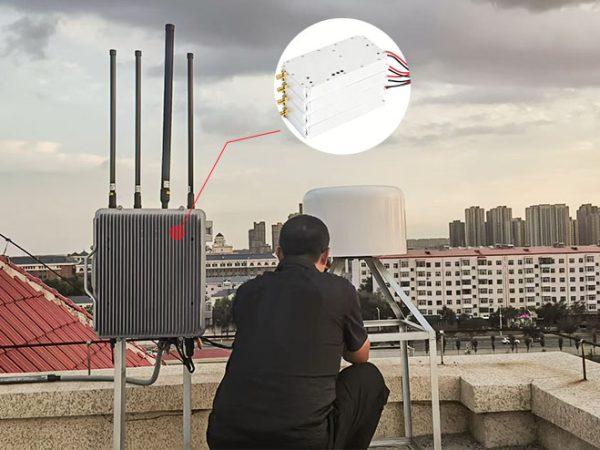
Heilongjiang Weather Center Completes Anti-Drone System Upgrade with Three High-Power Drone Jammer Modules

Tangshan Chem Plant Sealed Drone Gaps With 3 GaN Wideband Modules

How a National Prison Integrated Our Drone Jamming Module Into Their Fixed Counter-Drone System

Integrating Core RF Power: OEM Drone Jamming Module for Oil Refinery Security | Case Study
Send Us a Message
Related Products
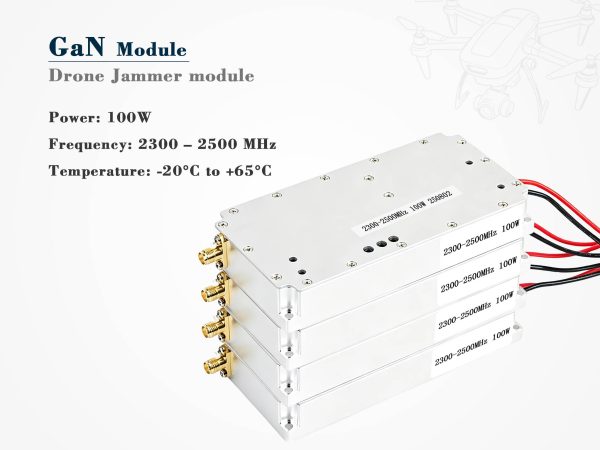
2300–2500 MHz 100W GaN Counter-UAV Module
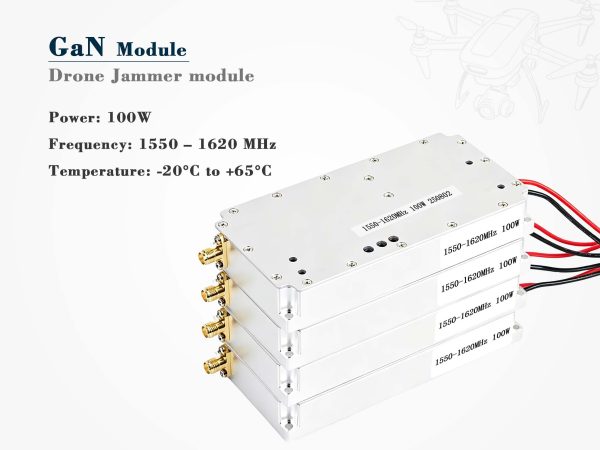
100W GaN Drone Jamming Module 1550–1620MHz
100W 2000–2200MHz GaN Analog Drone Interference Module