
100W GaN Wideband Module 1500-2500MHz
100W GaN wideband amp, 1500–2500MHz, 50dB gain, 30% efficiency, ≤2:1 VSWR, MCX/N connectors, 28V, 0.75kg. For test, EW, radar & comms.
Automated test equipment (ATE)
Electronic countermeasures (ECM)
Radar front‑ends
Satellite communication ground stations
General‑purpose RF labs

Technical Specifications
| Parameter | Condition | Value |
| Operating frequency | CW | 1500 – 2500 MHz |
| Instantaneous bandwidth | – | 2000 MHz (typ.) |
| Peak output power (P<sub>SAT</sub>) | CW, 100W | 100 W (typ.) |
| Input power for rated output | – | –2 ± 3 dBm |
| Maximum safe input (no damage) | – | 5 dBm max |
| Power gain (at 0 dBm input) | – | 50 ± 3 dB |
| Gain flatness (at 0 dBm input) | – | ±3 dB max |
| Efficiency (at 100W out) | – | 30% (typ.) |
| Harmonics (1st–Nth) | at 100W out | ≥ 10 dBc |
| Spurious level | – | ≥ 60 dBc |
| Input / Output VSWR | – | ≤ 2:1 |
| Operating voltage | DC | 28 – 30 V (±2% accuracy) |
| Current consumption | at 100W out | 10 A (typ.) |
Product Details
When your RF chain demands instant coverage across 1500 to 2500 MHz without swapping hardware, the AMP15002500‑100W wideband module steps in as a straightforward, no‑compromise solution. Designed around Gallium Nitride on Silicon Carbide (GaN‑on‑SiC) technology and housed in a compact copper sub‑carrier, this unit delivers a solid 100 watts of peak output power with a typical gain of 50 dB – all while keeping efficiency around 30%. Whether you are building test equipment, jamming systems, or broadband communication links, this module handles the heavy lifting with minimal fuss.
What makes this wideband module different?
The first thing you notice is the instantaneous bandwidth – no tuning, no band‑switching relays, just a flat 2000 MHz of usable spectrum from a single RF port. The Class AB GaN design strikes a practical balance between linearity and power consumption, and the patented thermal management keeps the junction cool even during prolonged CW operation. With 50‑ohm input and output impedance, integration into existing 50‑ohm systems is essentially plug‑and‑play. The module also includes built‑in monitoring features: a temperature monitor output (0.75 V at 25°C, scaling 0.01 V/°C), a current monitor pin, and an HPA enable line for remote on/off control.
Environmental and mechanical toughness
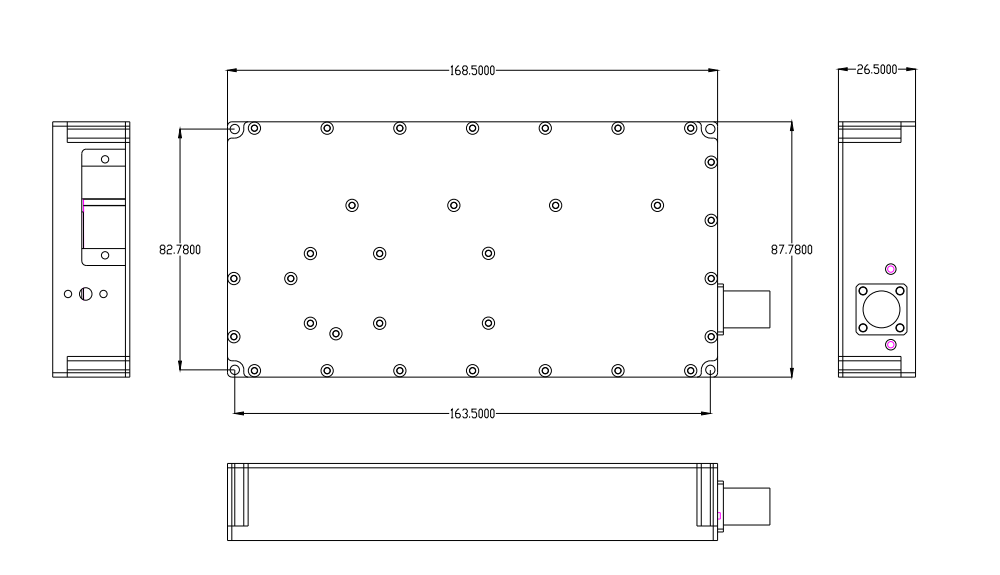
This module is built for real‑world conditions. It operates over a case temperature range of –20°C to +85°C and can be stored between –40°C and +105°C. Non‑condensing humidity up to 95% RH is tolerated, making it suitable for outdoor enclosures or lab environments with variable climate. The mechanical envelope is surprisingly compact: 168.5 × 82.8 × 26.5 mm (without connectors) and weighs only 0.75 kg. RF connections use an MCX female input and a rugged N‑type female output – a combination that gives you a small‑footprint input side and a robust, low‑loss output interface. DC power feeds through a feed‑through capacitor with a male supply pin, and the 8‑pin header provides access to enable, RS‑485 (A/B), external TTL lines, and monitoring outputs. Remember that an external heatsink is mandatory – the module dissipates significant heat at full power, so proper thermal management is not optional.
Where does this module shine?
Given its wide, uninterrupted bandwidth and 100‑W capability, we see this module used in:
-
Broadband test stations – one amplifier replaces multiple narrowband units for swept measurements.
-
Electronic warfare (EW) simulators – fast frequency hopping requires instantaneous response, and this module delivers without retuning.
-
Military and aerospace communication – the GaN‑on‑SiC technology offers high ruggedness against load mismatches and overdrive.
-
Radar pulse amplification – the Class AB bias supports both CW and pulsed modes with good linearity.
-
General‑purpose laboratory amplification – when you need a reliable, predictable gain block that covers S‑band.
The ±3 dB gain flatness across the entire band means you won’t waste time equalising your test setup, and the 2:1 VSWR limit ensures safe operation even with imperfect antenna loads.
Design details that matter
The copper sub‑carrier and patented heat‑spreading architecture allow the GaN die to run cooler than many competing designs. That directly translates to longer MTBF and stable performance over hours of operation. The temperature monitor output (0.75 V at 25°C, with 0.01 V per °C slope) gives you real‑time die temperature feedback – you can implement a software shut‑off or fan control loop without adding extra sensors. Similarly, the current monitor pin lets you detect abnormal consumption, which is a handy diagnostic for preventive maintenance. The RS‑485 interface (pins 4 and 7) offers remote supervision and control, while the PA_EN pin (pin 6) allows you to gate the amplifier with an external TTL signal – useful for pulsed applications or safety interlocks.
Whether you are upgrading an existing test rack or designing a new multi‑band transmitter, the AMP15002500‑100W wideband module offers a proven, off‑the‑shelf answer to the 1.5‑2.5 GHz challenge. Its combination of GaN efficiency, wide instantaneous bandwidth, and comprehensive monitoring makes it a workhorse that engineers can trust. For customised heatsink designs or integration support, reach out to our application team – we are happy to share thermal modelling data and layout recommendations. Get your hands on this module and experience what true wideband power feels like.
Frequently Asked Questions
Case Studies
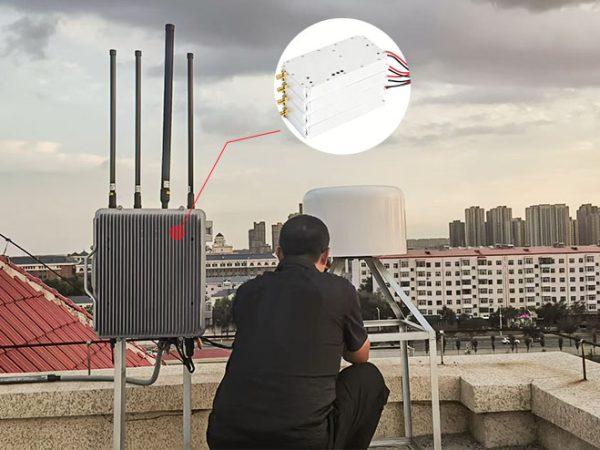
Heilongjiang Weather Center Completes Anti-Drone System Upgrade with Three High-Power Drone Jammer Modules

Tangshan Chem Plant Sealed Drone Gaps With 3 GaN Wideband Modules

How a National Prison Integrated Our Drone Jamming Module Into Their Fixed Counter-Drone System

Integrating Core RF Power: OEM Drone Jamming Module for Oil Refinery Security | Case Study
Send Us a Message
Related Products

High-Power 100W GaN Broadband Amplifier Module 3-5 GHz

100W GaN Broadband Amplifier Module 1–3 GHz

100W Broadband Amp Module – 20 to 600 MHz Wideband Power for HF/VHF/UHF