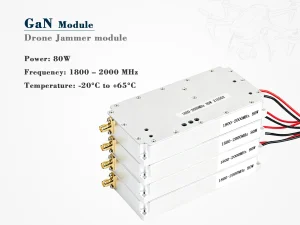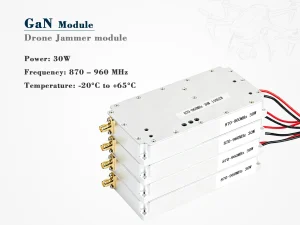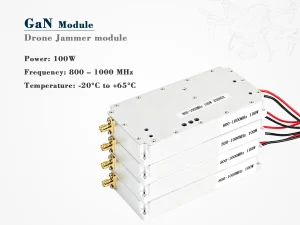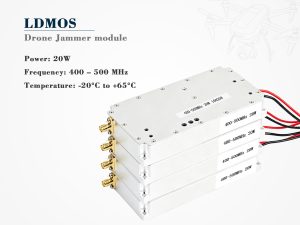
Procurement teams are shifting from “power first” to “proof first” as sub-GHz links become a larger part of counter-UAS planning.
Sub-GHz LoRa FPV jammer modules occupy a narrow but growing niche. They are discussed in authorized counter-drone programs, test ranges, and defense research, where LoRa-based control and telemetry links may operate below 1 GHz. The buying conversation, however, is often distorted by exaggerated wattage claims and vague band coverage. This guide outlines what serious buyers should verify before shortlisting a sub-GHz LoRa FPV jammer module.
Regulatory Filter Comes Before RF Filter
In most countries, transmitting jamming signals is illegal unless specifically authorized by a government body. A sub-GHz LoRa FPV jammer module cannot be treated like an ordinary radio accessory. Procurement must start with legal review: Who is allowed to operate it? In what area? Under what power and frequency limits? What documentation is required for audits?
If a vendor cannot answer these questions, the product should be disqualified. Compliance is not a paperwork formality; it defines whether the module can be used at all.
What “Sub-GHz” Actually Covers
“Sub-GHz” is a broad label. It can refer to different ISM allocations depending on region, including bands used by LoRa, remote controls, telemetry, and industrial sensors. A module marketed as sub-GHz may cover one narrow slice or several ranges. Buyers should demand a band-by-band breakdown, not a single frequency range.
| Spec area | What to verify | Common gap |
|---|---|---|
| Band coverage | Exact frequency ranges and regional variants | “Sub-GHz” without a band list |
| Bandwidth | Per-channel and total bandwidth | Peak numbers with no context |
| Filtering | Preselector and harmonic suppression data | No spectrum plots |
| ERP | Conducted power, antenna gain, cable loss | Wattage-only claims |
| Tuning | Step size, settling time, channel control | Manual tuning only |
| Regional compliance | Certifications for target country | Generic global claim |
RF Performance: Look Beyond Output Power
Output power is easy to advertise and hard to interpret. A 20 W amplifier feeding a poorly matched antenna may deliver less effective radiated power than a 10 W module with better filtering and antenna design. Sub-GHz propagation also behaves differently from higher bands: obstacles, terrain, and antenna height can matter more than a few watts.
Buyers should request measured ERP, VSWR, spurious emissions, and harmonic suppression. In authorized testing, these figures should be confirmed with calibrated equipment. A module that produces strong out-of-band emissions may interfere with licensed services and create legal exposure.
Thermal and Power Realities
Sub-GHz RF amplifiers generate heat. Many modules are rated at peak power for short bursts, but real deployments may require longer duty cycles. The datasheet should state continuous and intermittent ratings, ambient temperature limits, and cooling requirements. Without that information, field failure is likely.
Power quality is another differentiator. Mobile and remote installations often see voltage swings, inrush current, and electrical noise. Look for wide input range, transient protection, reverse-polarity protection, and documented peak current. A module that resets under load is not ready for operational use.
Integration and Control Checklist
| Integration item | Preferred evidence | Why it matters |
|---|---|---|
| Control interface | Ethernet, RS-485, GPIO, API docs | Fast command and automation |
| Latency | Measured trigger-to-transmit time | Supports time-sensitive response |
| Fail-safe state | Documented behavior on link loss | Prevents unintended transmission |
| Firmware | Signed updates and version policy | Security and lifecycle support |
| Logging | Event and fault logs | Supports audits and troubleshooting |
| Power protection | Tested transient and reverse-polarity specs | Protects hardware in the field |
Procurement Questions That Separate Vendors
-
Which sub-GHz bands are covered, and which are explicitly filtered?
-
What is the measured ERP under the recommended antenna setup?
-
What duty cycle is supported at full rated power?
-
Can you provide spurious emission and thermal test reports?
-
How does the module behave when the control link fails?
-
What legal authorizations or certifications apply in our jurisdiction?
-
What firmware update and warranty terms are offered?
Red Flags in the Market
| Red flag | Why it is a problem |
|---|---|
| “No license required” | Jamming is rarely legal without authorization. |
| Unnamed frequency bands | Prevents proper legal and RF review. |
| Peak power only | Hides thermal and duty-cycle limits. |
| No test data | Makes compliance and performance impossible to verify. |
| Closed control protocol | Slows integration and limits auditing. |
| No regional variants | Suggests a one-size-fits-all design. |
The Bottom Line
A sub-GHz LoRa FPV jammer module should be selected like any other regulated RF system: start with legal authority, verify RF filtering and ERP, demand thermal and power data, and test integration under realistic conditions. The strongest vendor is not the one with the biggest wattage claim. It is the one that can document performance, support compliance, and survive the field.