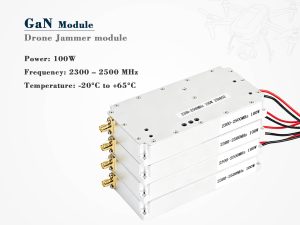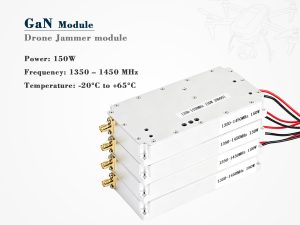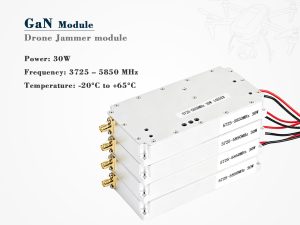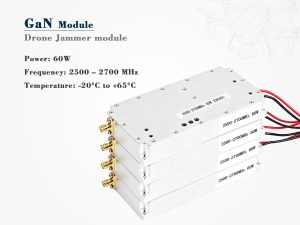

When a military research institute located in Tianjin’s Binhai area revisited its counter-drone posture, it wasn’t because the existing equipment had stopped working — it was because the drone threat had quietly outgrown the hardware. Small commercial drones had moved to frequency-hopping protocols, started leveraging the 5.8 GHz and 3.5 GHz bands more aggressively, and were showing up in coordinated swarms that could overwhelm narrowband jammers. The institute’s fixed installations, anti-drone guns, and backpack jammers still had solid chassis, battery systems, and antenna arrays. What they lacked were RF power modules that could deliver wide instantaneous bandwidth, higher output power, and enough linearity to handle complex modulation jamming waveforms without distortion.
The institute’s engineering team decided against a wholesale replacement. Instead, they chose a modular RF upgrade, pulling in a set of GaN and LDMOS power amplifier modules that could be integrated into the very same platforms they already maintained and trained on.
Procurement scope at a glance
The bill of materials was straightforward but purpose-built:
-
5 units of 100W GaN Wideband Module – 4.0–6.0 GHz Band
-
20 units of 50W LDMOS Drone Jammer Module 5725-5850 MHz
-
20 units of 20W Drone Jammer Module 3400-3600 MHz
These four module types weren’t selected to cover every imaginable frequency. They were selected to cover the bands that had become operationally painful: the 2.4 GHz and 5.8 GHz ISM bands where most COTS drones operate, the 3.4–3.6 GHz range increasingly seen in higher-end consumer and commercial UAVs, and a wide GaN-backed swath from 2.5 to 6.0 GHz for broad-spectrum denial when the exact threat frequency wasn’t known in advance.
Integration without reinvention
The integration philosophy was clean. The 100W GaN modules, with their 2.5–4.0 GHz and 4.0–6.0 GHz splits, went into the fixed-site counter-UAS racks and a few vehicle-mounted units that guard the institute’s perimeter. Their role was to generate high-power jamming and spoofing signals across the entire common drone telemetry and video downlink spectrum. Because they run on a 28V supply and offer a compact mechanical footprint, they dropped into the existing amplifier slots with minimal mechanical rework — mostly just updated thermal interface material and a revised bias sequencing cable.
The 50W LDMOS modules, covering 5725-5850 MHz, were the workhorse upgrade for the man-portable anti-drone guns and backpack jammers. Why 50 watts at 5.8 GHz? The institute’s field tests had shown that 5.8 GHz video downlinks, especially those using digital modulation with forward error correction, demand higher effective isotropic radiated power at the jammer antenna to sever the link at tactically useful distances. The LDMOS devices brought the required power density while keeping DC power consumption within the battery budget of a dismounted operator carrying a backpack system.
The 20W modules at 3400-3600 MHz, meanwhile, found their way into the lighter handheld jammers and as auxiliary modules in some backpack configurations. They added the 3.5 GHz band denial capability that was completely absent before — a gap that had been exploited by at least two drone models observed in unauthorized overflights near the installation.
What the field data said
Post-integration testing was conducted under the institute’s standard evaluation protocol: fixed-site systems tested against a DJI Matrice 600, a homebrew 5.8 GHz FPV quad, and a 3.5 GHz commercial inspection drone; portable guns and backpacks tested in urban mock-up environments with deliberate multipath.
The fixed-site 100W GaN system achieved complete video downlink break and failsafe return-to-home trigger at 2.8 km on the 2.4 GHz band and 2.3 km on the 5.8 GHz band, both roughly a 40% improvement over the legacy LDMOS-only chain. When the 4.0–6.0 GHz GaN module was driven with a swept jamming waveform covering 5.725–5.850 GHz, the effective jamming range stayed above 2 km even with the drone at full transmission power.
On the portable side, a single 50W LDMOS gun module with a 12 dBi panel antenna forced a 5.8 GHz video dropout at 1.2 km line-of-sight. The 20W 3.5 GHz module, integrated into the same gun chassis via an RF switch matrix, successfully interrupted the control link of the 3.5 GHz test drone at 900 meters. In backpack configuration, the combination of a 50W 5.8 GHz and two 20W 3.5 GHz modules allowed a single operator to cover both bands simultaneously while walking a patrol route — a capability the institute’s security team had been asking for.
Equally important, the drone jammer modules showed no measurable degradation in output power after a continuous 30-minute key-down test at 40°C ambient, and harmonic levels stayed below -45 dBc without additional external filtering — a non-negotiable requirement when operating in a military electromagnetic environment.
Why it matters and where it goes next
The value here isn’t just that the institute can now jam more drones. It’s that they gained a fully modular RF backbone. When a new drone standard inevitably moves into the 6 GHz band or below 2.5 GHz, the same amplifier chassis, control interfaces, and antenna feeds can accept a different GaN or LDMOS module covering the new frequency — without tearing apart the whole system. That’s a budget multiplier in an era where defense procurement cycles can lag behind consumer drone innovation by years.
Extensibility is already being planned. The next phase under discussion involves adding a 20W L-band module (1.5–1.6 GHz) for GNSS denial in fixed installations, and possibly a C-band GaN variant that pushes past 6 GHz if threat analysis warrants it. Because the institute validated the module integration workflow — mechanical, thermal, RF chain, and firmware adaptation — on this project, future upgrades are expected to require half the integration time.
For the wider counter-UAS community, this case underlines a practical truth: the RF power amplifier is not a commodity bolt-on. The shift to GaN wideband devices and application-matched LDMOS modules directly translates into jamming range, waveform flexibility, and the ability to counter frequency-agile drones that would have slipped through just two years ago. When the modules are designed to be integrated rather than being locked inside a proprietary black box, a military user can upgrade their own systems on their own timeline. That’s precisely what the Tianjin Binhai institute did — and the results hold up in the numbers.