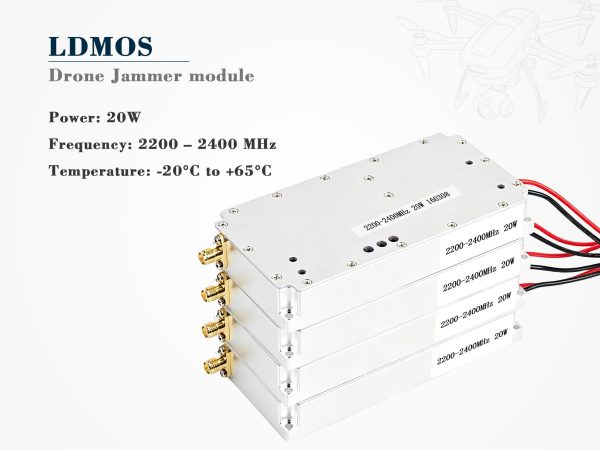
20W Anti-Drone Module | 1805–1920MHz LDMOS Analog Jammer
20W anti-drone module, 1805–1920MHz, LDMOS amplifier, ≥40% efficiency, built-in fast sweep source, SMA-F, DC24–29V, 115.5×46.5×21mm, 0.21kg. For UAV disruption and C-UAS integration.
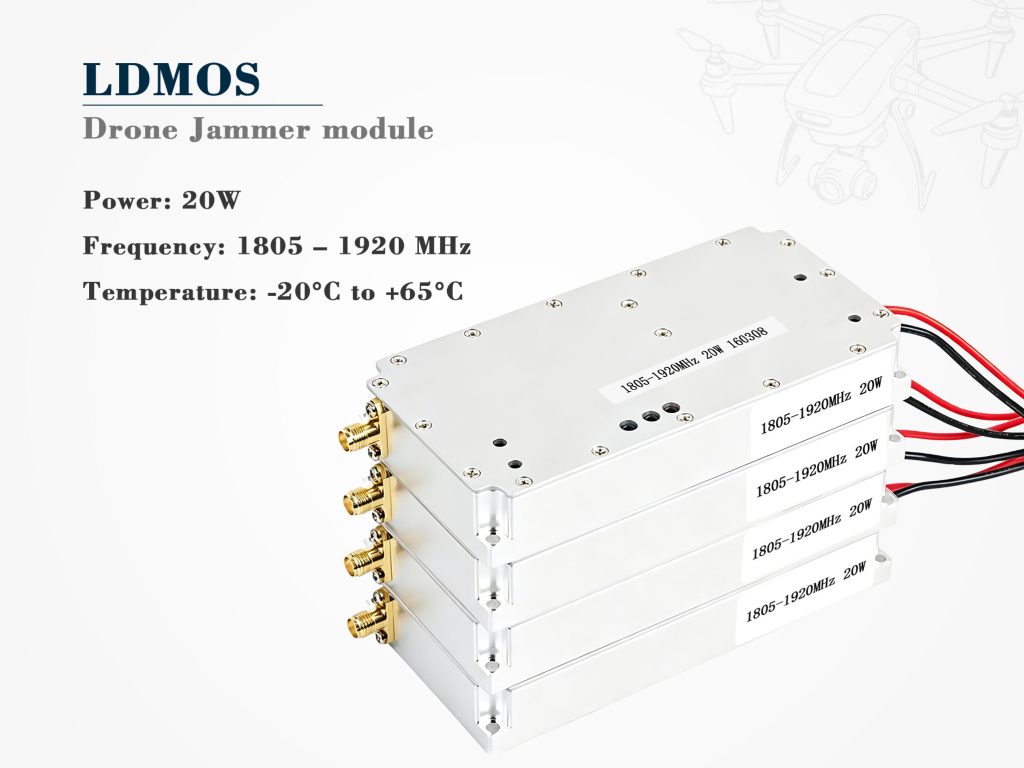
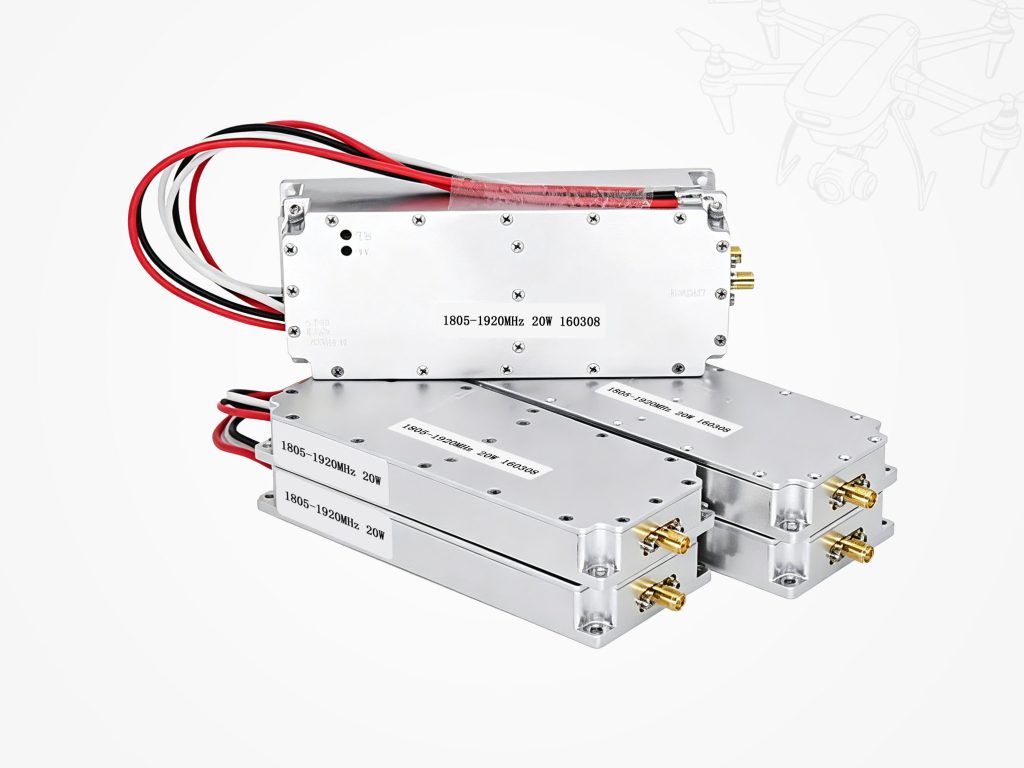
Technical Specifications
| Parameter | Specification | Notes |
| Frequency range | 1805–1920MHz | Fixed band, covers DCS/PHS downlink |
| Output power | 20W (minimum) | Measured at 28V, 25°C |
| Supply voltage | DC24V–29V | Nominal 28V recommended |
| Current draw | 2.5A max | At 20W output |
| Modulation source | Internal fast sweep | Analog, sweep rate factory-preset |
| Analog scan speed | ~180MHz/ms | Typical value |
| Input / output impedance | 50Ω | SMA-F output |
| Protection LEDs | Over-current indicator (red) | On-board LED |
| Operating temperature | -20°C to +65°C | Baseplate temperature |
| Dimensions (L×W×H) | 115.5×46.5×21mm | Excluding connector |
| Weight | 0.21kg | Net weight |
| Base material | Aluminium alloy | With Ni-plated finish |
Product Details
Purpose-Built for the 1805–1920MHz Band
This 20W anti-drone module targets a frequency range that matters. The 1805–1920MHz band covers DCS downlink and PHS communication channels, which are increasingly utilised by commercial UAVs for telemetry and control links. Unlike broadband modules that waste power across irrelevant frequencies, this unit focuses its 20W output precisely where it is needed most.
The module employs LDMOS (Laterally Diffused Metal Oxide Semiconductor) technology—a mature, rugged platform that delivers reliable performance in demanding RF environments–. LDMOS devices are well-suited for long-pulse and high-duty-cycle applications thanks to their very low thermal resistance per watt, which contributes to excellent VSWR-withstand characteristics. For system integrators who prioritise field-proven reliability over theoretical efficiency gains, this remains a compelling choice.
Analog Sweep – Simple, Effective, Immediate
The built-in fast-sweeping analog source generates continuous interference across the full 200MHz span without requiring external waveform generators or complex programming. This is jamming in its most straightforward form: power on, sweep starts, drones lose link.
Sweep jamming offers a practical advantage in real-world scenarios. When operating without prior knowledge of a drone’s exact frequency, barrage jamming covers all frequencies simultaneously but requires significantly higher power–. Sweep jamming, by contrast, achieves effective disruption with lower average power by continuously hopping through the band—making the most of every watt this 20W module delivers–. When paired with a detection system that identifies the target drone’s control channel, the 20W anti-drone module can also be used in a targeted manner, jamming only the frequencies where video, telemetry, and drone communication signals are detected.
LDMOS Performance in a Compact Enclosure
Rated at 20W output with ≥40% efficiency, this module runs sufficiently cool for extended operation. The aluminium alloy housing serves dual duty as both a heatsink and an EMI shield, keeping internal temperatures manageable even at full tilt. With a maximum current draw of just 2.5A at 24–29V DC, it integrates easily into battery-powered portable jammers and vehicle-mounted systems alike.
Output VSWR is rated at ≤2.0:1, providing a comfortable margin against antenna mismatch in field-deployed systems. The SMA female output connector mates with most standard antennas and cabling, minimising integration headaches.
Simple Control, Flexible Integration
The on/off interface could not be simpler: +5V or floating enables the output, while grounding disables it. This logic-level control ties directly into standard microcontroller GPIOs or manual toggle switches, removing the need for additional driver circuitry. The four mounting holes align with a 46.5mm pitch pattern, and the overall height of 21mm fits inside most handheld gimbal housings and compact enclosures.
Built for the Field
Rated for -20°C to +65°C ambient operation, this 20W anti-drone module withstands cold starts, direct sunlight, and engine bay heat. Protection circuitry includes over-current and reverse-polarity safeguards. For continuous high-power operation, we recommend attaching it to a metal chassis or a passive heatsink with thermal interface material.
Typical Applications
-
Handheld counter-UAV guns
-
Rooftop perimeter security
-
Convoy and VIP protection
-
Temporary event airspace control
-
Fixed-site C-UAS installations
Frequently Asked Questions
Case Studies
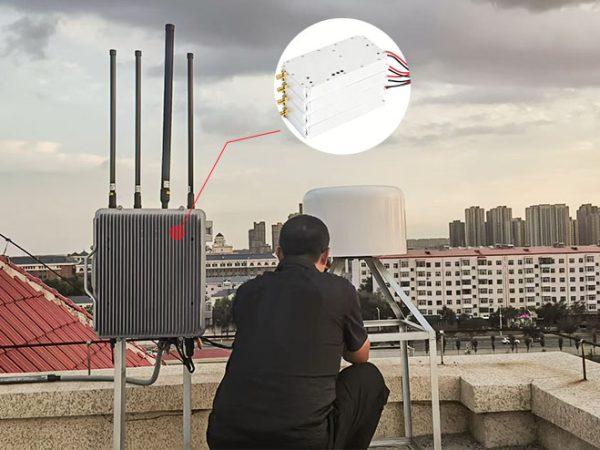
Heilongjiang Weather Center Completes Anti-Drone System Upgrade with Three High-Power Drone Jammer Modules

Tangshan Chem Plant Sealed Drone Gaps With 3 GaN Wideband Modules

How a National Prison Integrated Our Drone Jamming Module Into Their Fixed Counter-Drone System

Integrating Core RF Power: OEM Drone Jamming Module for Oil Refinery Security | Case Study
Send Us a Message
Related Products
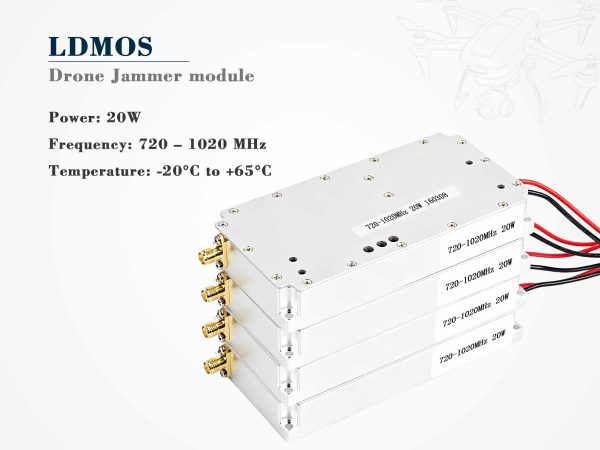
20W 720–1020MHz UAV Jammer Module | LDMOS Analog
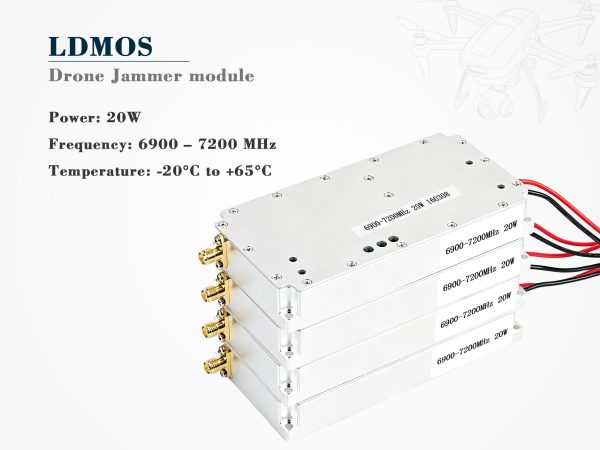
Powerful 20W LDMOS Drone Jammer Module for 6.9–7.2 GHz
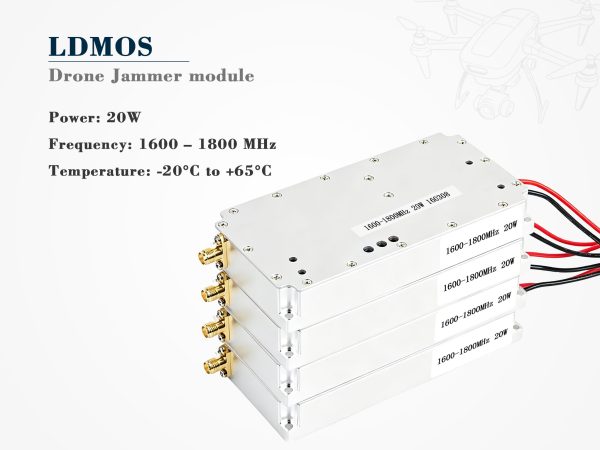
Powerful 20W Anti Drone Module 1600–1800MHz