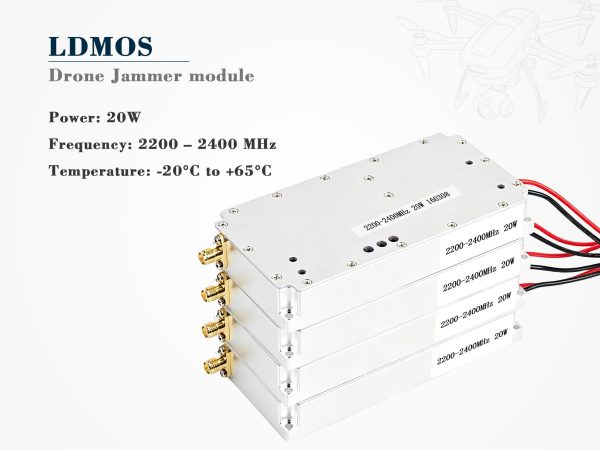
20W 4800–4960MHz Drone Jammer Module with Sweep
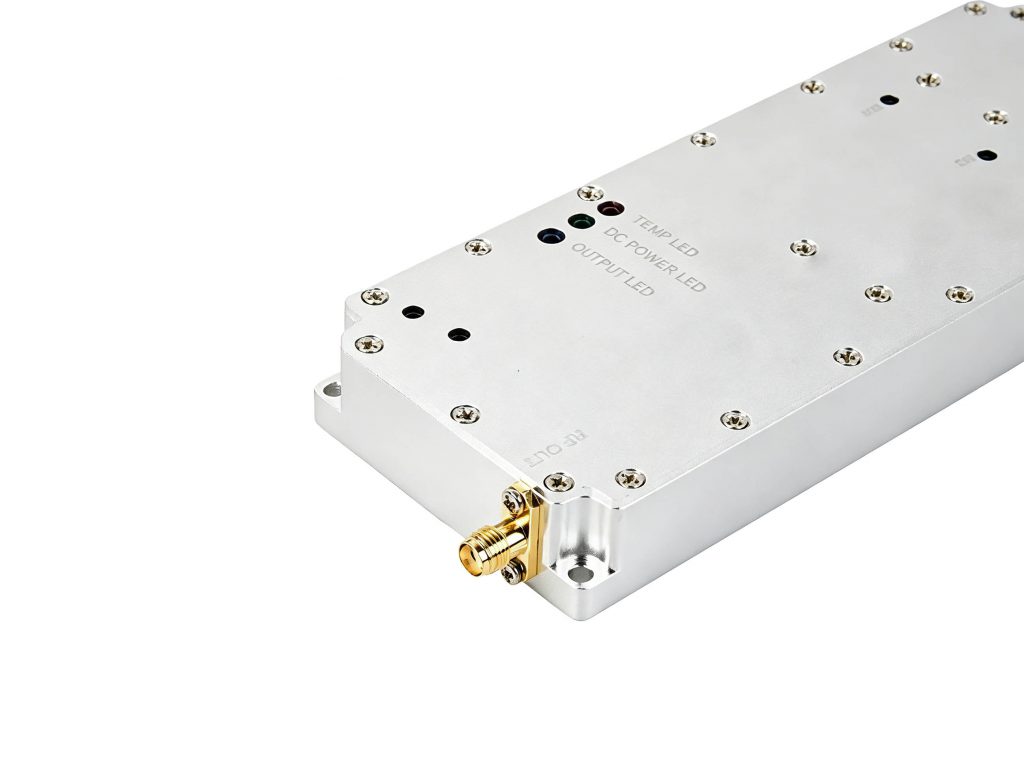
20W drone jammer module covering 4800–4960MHz with built‑in analog sweep source. DC 24–29V, 2.5A, SMA out, compact 115×46×21mm. For counter‑UAS systems.
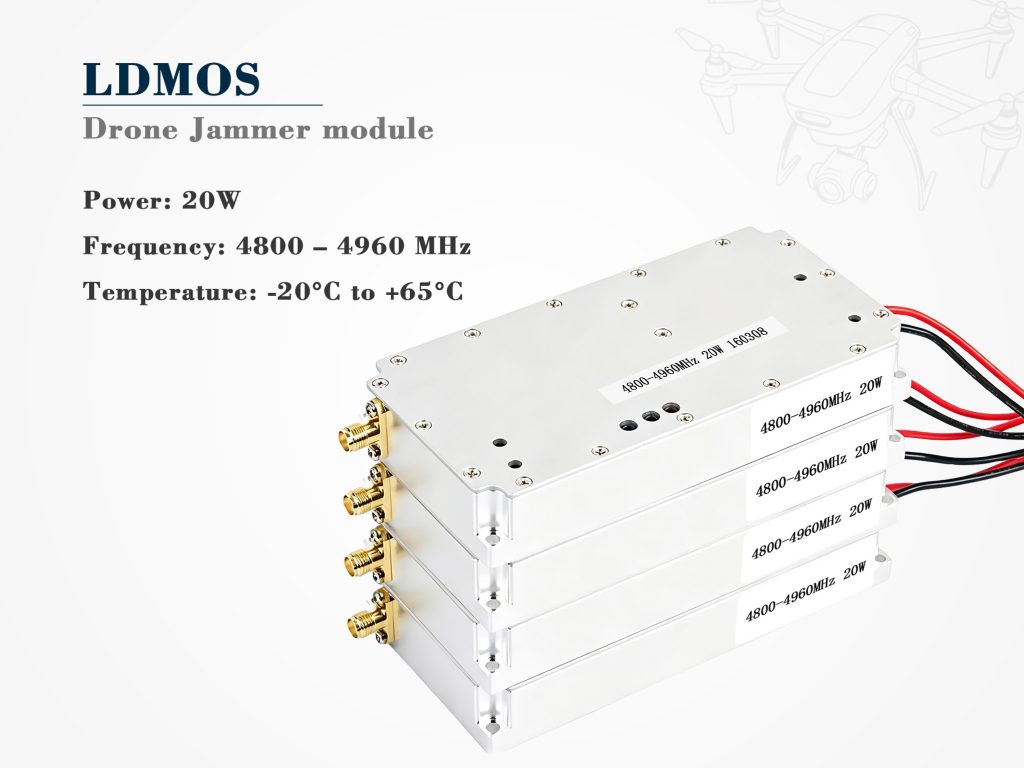
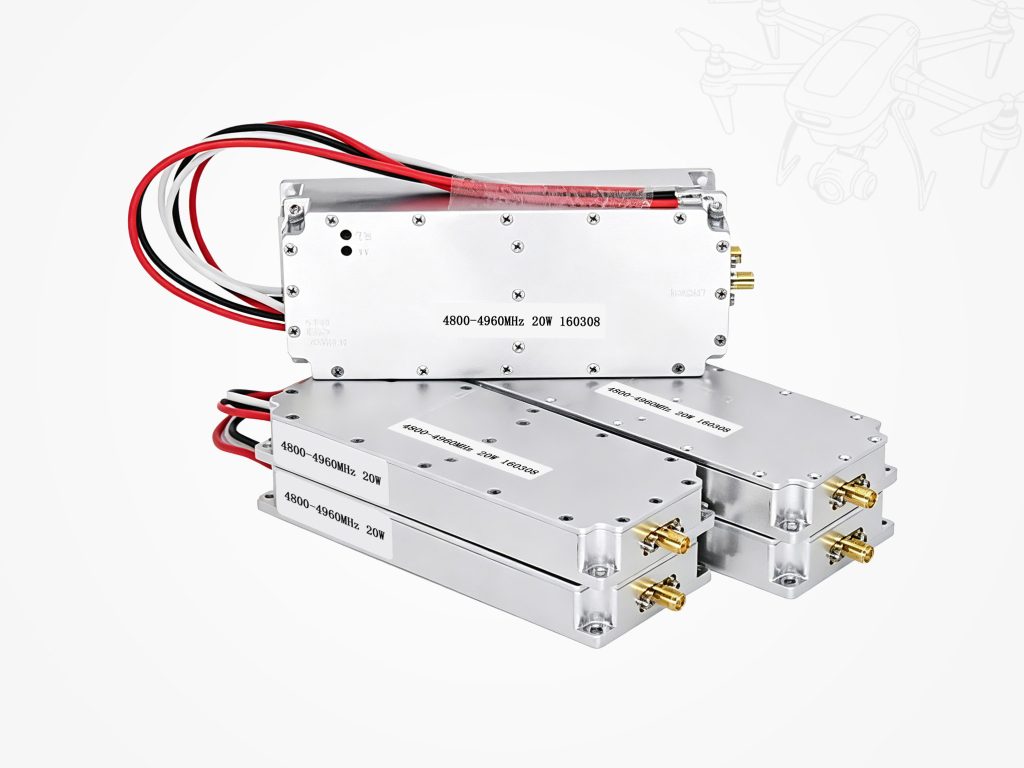
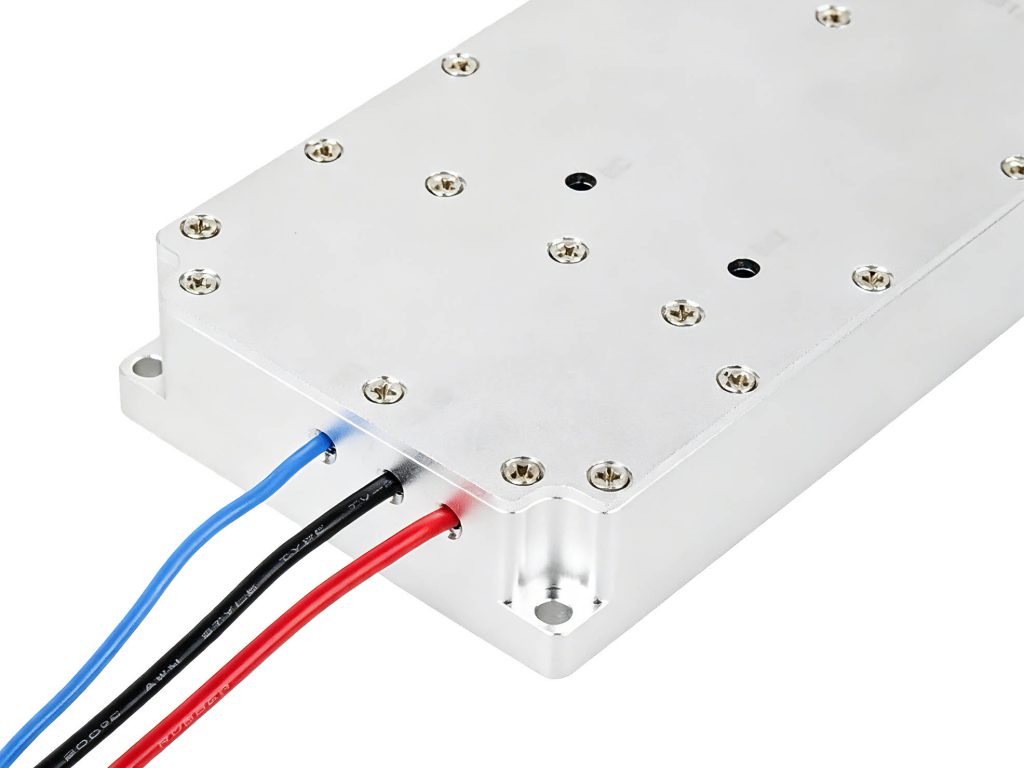
Technical Specifications
| Parameter | Specification | Notes |
| Frequency range | 4800 – 4960 MHz | Full band coverage, no gaps |
| Output power | 20W (typical) | Measured at 50Ω load, 26V supply |
| Supply voltage DC 24V – 29V | Recommended nominal 26V | |
| Current draw | ≤ 2.5A | At maximum output power |
| Modulation source | Built‑in high‑speed analog sweep | VCO‑based, no external generator needed |
| Analog scan speed | > 50 MHz/ms | Covers the entire band in < 4 ms |
| Input / output impedance | 50Ω (RF output) | Control input is high‑impedance TTL |
| Protection LEDs | Over‑temperature & over‑current (internal) | No external LED pins – protection is automatic |
| Operating temperature | -20°C to +60°C | Ambient, with adequate heatsinking |
| Dimensions (L×W×H) | 115.5 × 46.5 × 21 mm | Excluding connectors and mounting tabs |
| Weight | 0.21 kg | Approximately |
| Base material | Aluminium alloy (6061) | Provides structural strength and thermal spread |
Product Details
Why 4.9GHz Matters in Drone Defence
If you’ve been following the counter‑UAS space, you know that the 4.9GHz band is no longer a niche frequency. More and more drone manufacturers are moving their command links and high‑definition video downlinks into this range – especially for 5G‑based telemetry and beyond‑visual‑line‑of‑sight (BVLOS) operations. That means any serious drone jammer system needs to have this band locked in.
This module gives you exactly that – a dedicated, 20W powerhouse that covers the full 4800–4960MHz spectrum without gaps. No external signal generator, no complicated PLL programming. It comes with a built‑in high‑speed analog sweep source that just works. Apply power, toggle the enable line, and you’re putting out clean, swept interference across the entire band.
Power That Actually Stays Cool
20W of RF output sounds great on paper, but what really matters is how that power behaves in the real world. This module draws about 2.5A at nominal 26V – that’s roughly 65W of DC input. With an efficiency of at least 40%, you get over 20W out while keeping waste heat manageable. Of course, you’ll still want to bolt it to a decent heatsink if you plan to run it continuously, but the module’s aluminium housing does a solid job of spreading the thermal load.
The output VSWR is specified at ≤2.0, which is perfectly acceptable for a broadband amplifier in this power class. That gives you some breathing room when connecting to different antennas – whether you’re using a directional panel, an omnidirectional whip, or a custom array. The SMA female output is standard, so you won’t waste time hunting for oddball adapters.
Simple Control, No Fuss
One thing we’ve learned from talking to integrators is that they hate over‑engineered control interfaces. This module keeps it stupid‑simple: a +5V signal or floating input turns it on, and grounding the pin turns it off. That’s it. You can drive it directly from a GPIO pin on an Arduino, a STM32, or even a manual toggle switch. No serial commands, no I²C, no firmware headaches.
The module runs on a DC supply between 24V and 29V – a very common range for battery packs and industrial power bricks. If you’re building a portable handheld jammer, you can easily pair it with a 6‑cell Li‑ion or Li‑Po pack. For fixed installations, a 24V DIN‑rail supply works perfectly.
Built for Integration, Not Just Bench Testing
At 115.5 × 46.5 × 21mm and a featherweight 0.21kg, this module is surprisingly compact for its output power. It fits inside a standard 50mm diameter tube (common for handheld drone guns) and leaves plenty of room for batteries, cooling fans, and control electronics. The mounting holes are conveniently placed – though the datasheet doesn’t call them out explicitly, the mechanical layout is designed for easy screw‑down attachment.
We’ve seen customers use these modules in vehicle‑mounted jammers, tripod‑based portable systems, and even fixed site protection units around sensitive facilities. The 4.9GHz band is particularly relevant for jamming consumer drones that use 5.8GHz or 2.4GHz – but some newer models are switching to 4.9GHz for better penetration and less congestion, so having this option in your arsenal gives you a tactical advantage.
What About Duty Cycle and Heat?
Let’s address the elephant in the room – 20W RF amplifiers get hot. This module is rated for continuous operation given adequate heatsinking and airflow. Without a heatsink, we recommend limiting duty cycle to around 30–40% (e.g., 3 seconds on, 5 seconds off) to keep junction temperatures within safe limits. With a fan‑cooled heatsink, you can run it indefinitely at full power. The internal protection circuitry includes over‑temperature shutdown, so you won’t fry it if you push too hard – but it’s always better to design for proper thermal management upfront.
The sweep source inside is an analog VCO‑based generator that scans the entire 4800‑4960MHz range at a fast rate (typically better than 50MHz/ms). That ensures that any narrow‑band or frequency‑hopping drone link gets effectively blanked within milliseconds. It’s not a cheap DDS chip – it’s a proven analog design that delivers consistent spurious performance and low phase noise, which matters when you need to jam without interfering with adjacent bands.
Who Should Buy This Drone Jammer Module?
If you’re a system integrator, a defence contractor, or an R&D lab building next‑generation counter‑UAS equipment, this module saves you months of RF design work. You don’t need to wrestle with power amplifier matching, sweep linearity, or thermal compensation – it’s all baked in. Just focus on your antenna design, power management, and user interface, and leave the RF heavy lifting to this little brick.
We’ve also seen hobbyists and security enthusiasts use these for testing and demonstration purposes – but remember, jamming is regulated in most countries, so always check your local laws before deploying.
Final Thought
This drone jammer module isn’t the cheapest on the market, but it’s built to deliver consistent, repeatable performance where it counts. The combination of 20W output, built‑in sweep, compact size, and simple control makes it a go‑to choice for professionals who need reliable jamming in the 4.9GHz band. Whether you’re protecting a border, a stadium, or a VIP convoy, having this module in your toolkit gives you one less thing to worry about.
Frequently Asked Questions
Case Studies
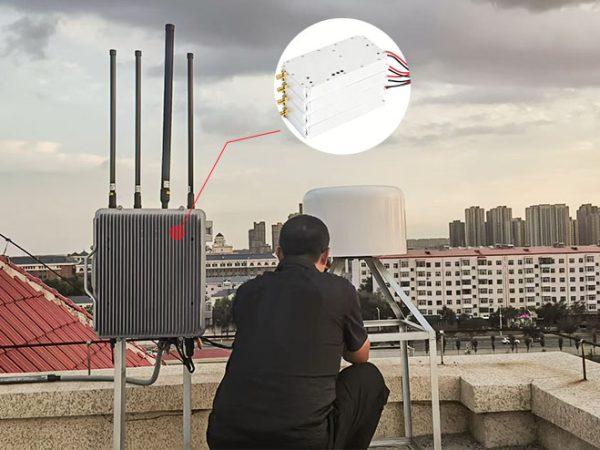
Heilongjiang Weather Center Completes Anti-Drone System Upgrade with Three High-Power Drone Jammer Modules

Tangshan Chem Plant Sealed Drone Gaps With 3 GaN Wideband Modules

How a National Prison Integrated Our Drone Jamming Module Into Their Fixed Counter-Drone System

Integrating Core RF Power: OEM Drone Jamming Module for Oil Refinery Security | Case Study
Send Us a Message
Related Products
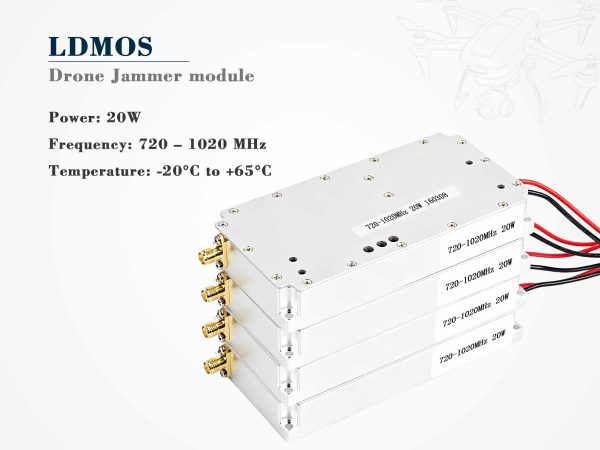
20W 720–1020MHz UAV Jammer Module | LDMOS Analog
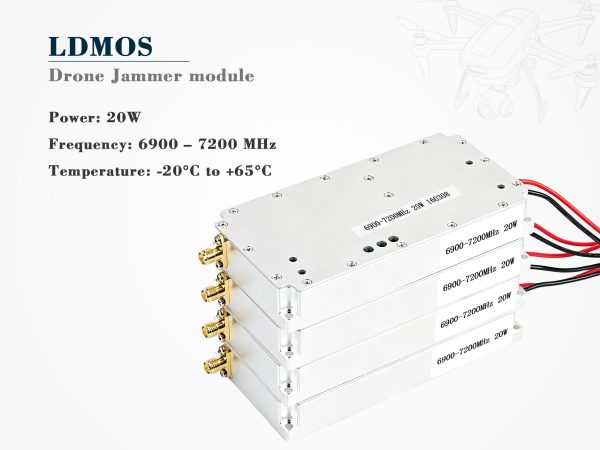
Powerful 20W LDMOS Drone Jammer Module for 6.9–7.2 GHz
Powerful 20W Anti Drone Module 1600–1800MHz