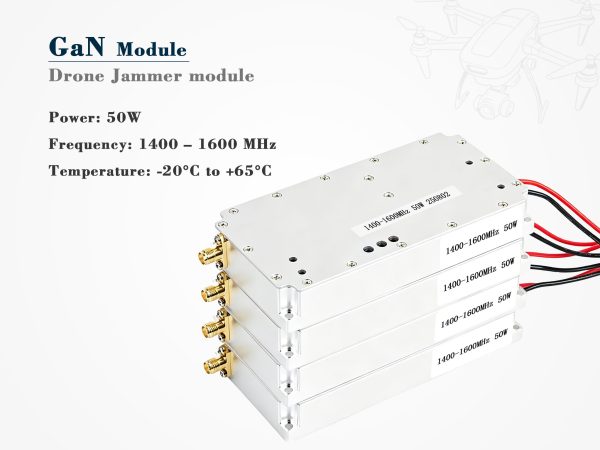
50W Anti-Drone Jamming Module 2000-2400MHz: Compact LDMOS Powerhouse
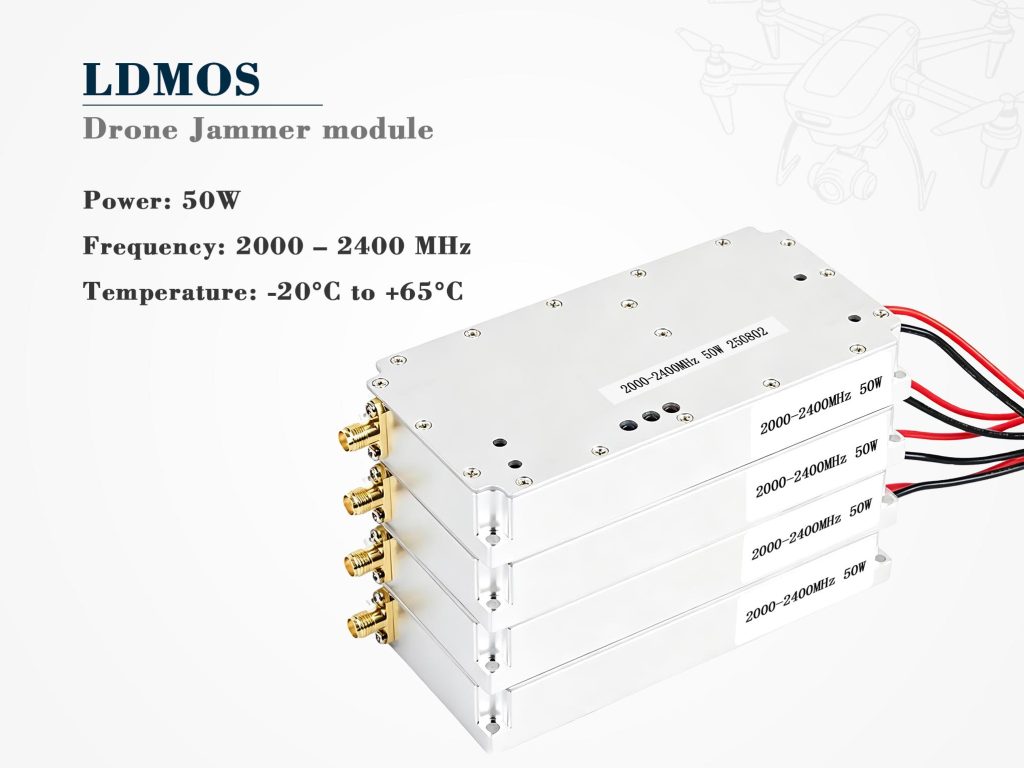
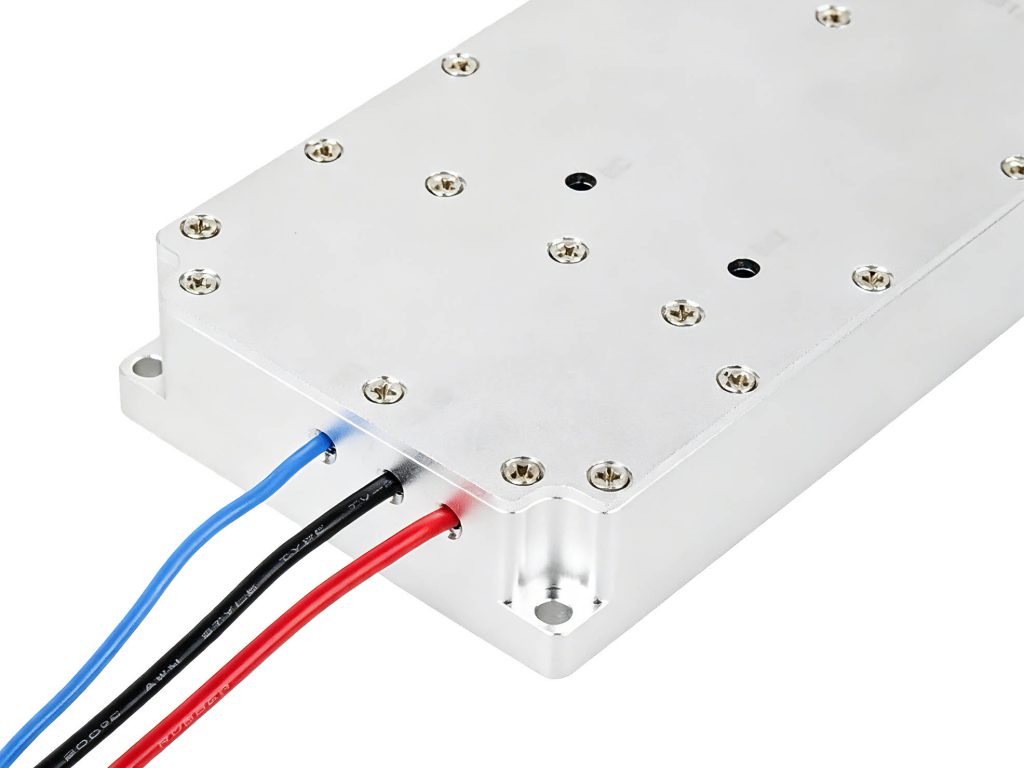
50W Anti-Drone Jamming Module: 50W output, 2000-2400MHz, built-in noise source, 28V, 117x58x18mm. Blocks drone video and control links.
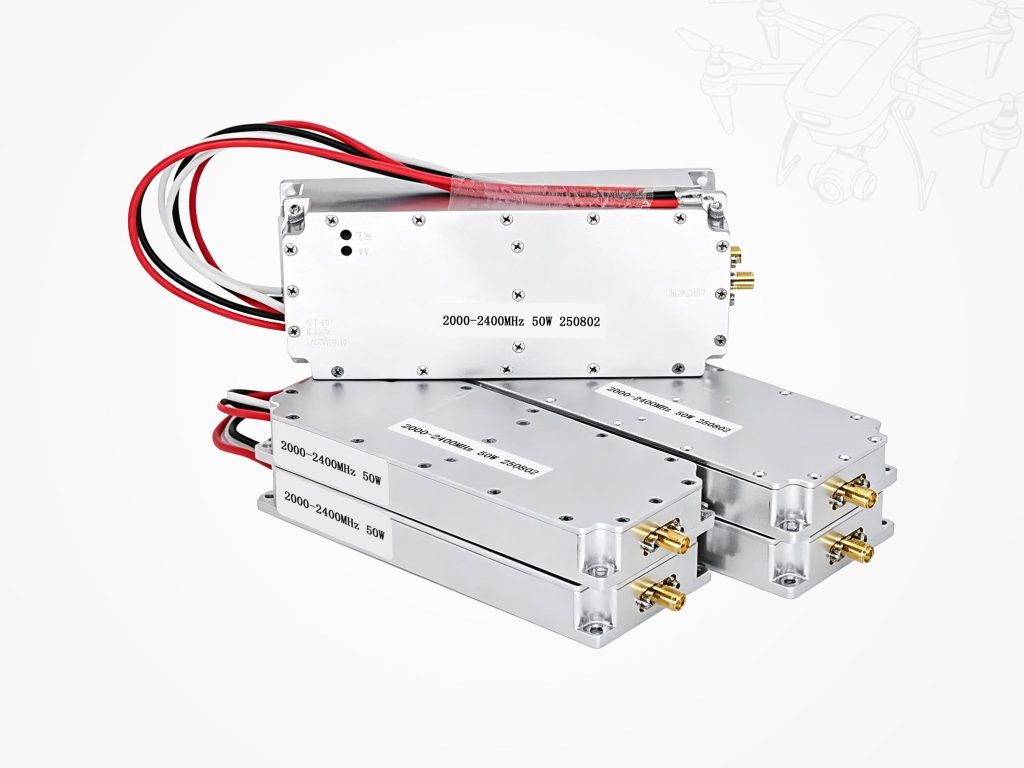
Technical Specifications
| Parameter | Specification | Notes |
| Frequency range | 2000 – 2400 MHz | Covers drone FPV video, control, and ISM traffic |
| Output power | 50 W (47 dBm) | Measured at SMA female port |
| Supply voltage | 28 V DC (24 – 28 V) | Regulated supply recommended |
| Current draw | ≤ 4.5 A at 50 W output | Typical range 3.2 – 4.5 A |
| Modulation source | Built-in high-speed noise modulated source | Optional VCO, DDS, SDR |
| Analog scan speed | 270 kHz (default) | Custom 100 – 500 kHz available |
| Input / output impedance | 50 Ω | SMA female output connector |
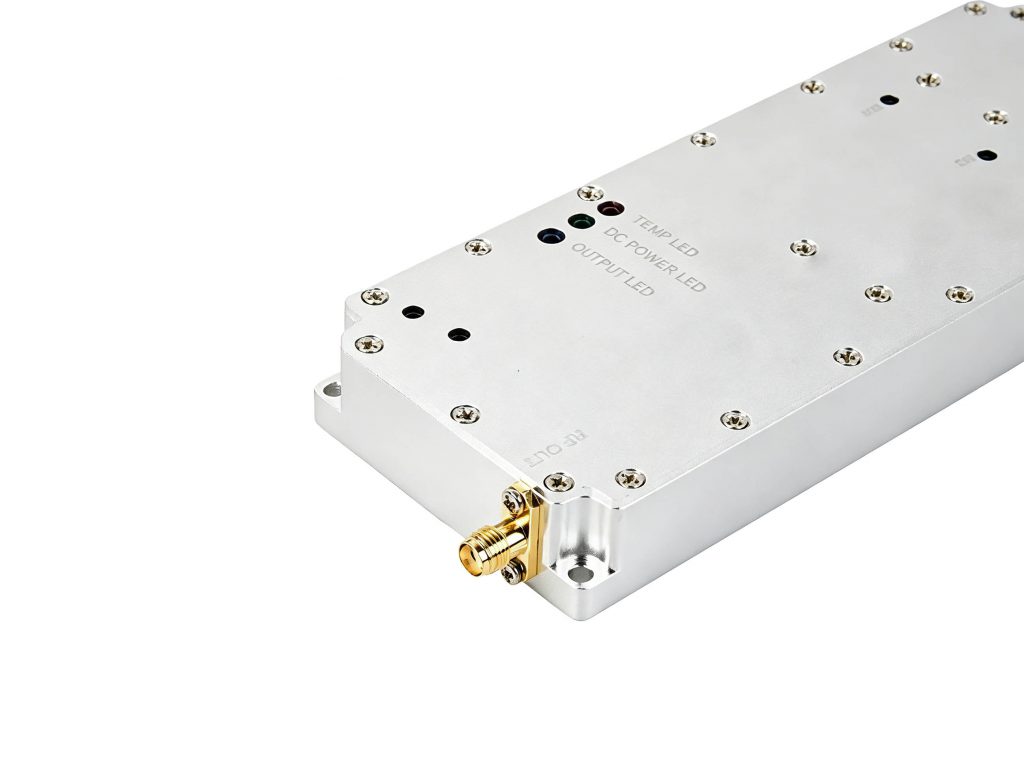
| Protection LEDs | Power On (green), Over-voltage (red), Over-temp (red) | Real-time fault indicators |
| Operating temperature | -20 °C to +65 °C | Ambient operating range |
| Dimensions (L×W×H) | 117 × 58 × 18 mm | Custom dimensions available |
| Weight | 300 g | Module only, antenna not included |
| Base material | LDMOS silicon die, copper carrier | High thermal conductivity base |
Product Details
The 50W Anti-Drone Jamming Module delivers a clean 50-watt barrage across the 2000–2400 MHz band, a frequency window swarming with drone FPV video feeds, control telemetry, and ISM traffic. At just 117×58×18 mm and 300 grams, it slots into portable kits, fixed-site cabinets, and custom counter-UAS arrays without adding bulk. Security teams pick this module when they need reliable denial power that doesn’t demand exotic GaN supplies or massive heatsinks.
LDMOS: Proven Power in a Slim Footprint
While GaN often grabs headlines, silicon LDMOS remains a workhorse for rugged jamming applications. The 50W Anti-Drone Jamming Module uses a mature LDMOS final stage that offers excellent linearity and forgiving load tolerance. Efficiency is tuned for continuous sweep operation, and the die is bonded to a thermally optimized carrier that spreads heat evenly across the module base. For teams that prefer a known, battle-tested technology with decades of field data, LDMOS makes sense. It also simplifies supply chains—28 V DC rails are standard in security and defense vehicles, so you can wire the module directly into existing power buses without custom DC-DC converters.
Built-in Noise Source and Sweep Tuning
No external function generator is required. The board carries a built-in high-speed noise modulation source that blankets the 2.0–2.4 GHz range with a moving interference barrier. The default analog sweep rate sits at 270 kHz, a sweet spot that catches frequency-hopping spread spectrum drones. If your target protocol demands a different profile, the 50W Anti-Drone Jamming Module can be factory-customized for sweep speeds between 100 kHz and 500 kHz. The modulation core is also upgradeable to VCO, DDS, or SDR architectures—giving OEMs the flexibility to craft mission-specific waveforms. The RF output exits via a 50-ohm SMA female port, ready to connect directly to a high-gain panel or omni antenna.
Power, Control, and Onboard Protection
A single 28 V DC supply (24–28 V window) runs the entire module, drawing between 3.2 A and 4.5 A at the 50 W ceiling. Integration couldn’t be simpler: apply a TTL high or leave the enable pin floating to start jamming, pull it low to stop. Three onboard LEDs—green for power, red for over-voltage, and red for over-temperature—give instant health status. The 50W Anti-Drone Jamming Module also monitors output VSWR internally and will throttle back if a damaged antenna or open load threatens the output stage. This self-protection loop keeps the LDMOS transistor safe during field mishaps, reducing maintenance and replacement costs.
Deployment Scenarios and OEM Customization
Because the 2000–2400 MHz range is dense with drone video and remote-control links, the 50W Anti-Drone Jamming Module often serves as the primary jammer in multi-band systems. It can be stacked with lower-frequency modules (like our 700–840 MHz GaN blocker) to create a full-spectrum denial wall. The compact chassis—customizable in size upon request—fits into vehicle-mounted racks, pelican-case kits, and man-portable backpacks. Operating temperature spans -20°C to +65°C, so outdoor towers and desert deployments are well within limits. If your project demands custom connector types, sweep rates, or modulation engines, the module is offered with flexible OEM configuration. Always consult local RF regulations before radiating, and consider pairing the jammer with drone detection sensors for a reactive, energy-efficient security architecture.
Frequently Asked Questions
Case Studies
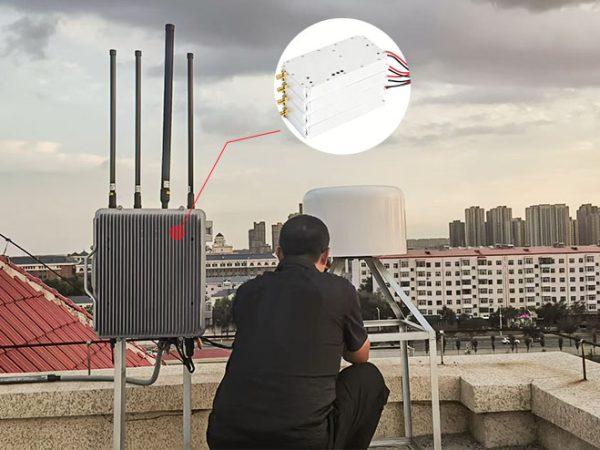
Heilongjiang Weather Center Completes Anti-Drone System Upgrade with Three High-Power Drone Jammer Modules

Tangshan Chem Plant Sealed Drone Gaps With 3 GaN Wideband Modules

How a National Prison Integrated Our Drone Jamming Module Into Their Fixed Counter-Drone System

Integrating Core RF Power: OEM Drone Jamming Module for Oil Refinery Security | Case Study
Send Us a Message
Related Products
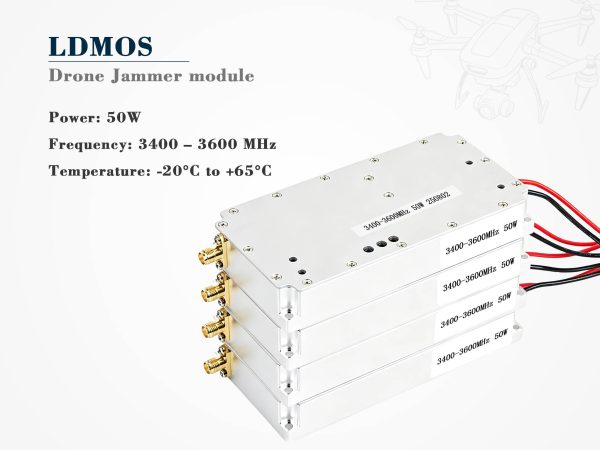
3400–3600 MHz 50W Drone Countermeasure Module
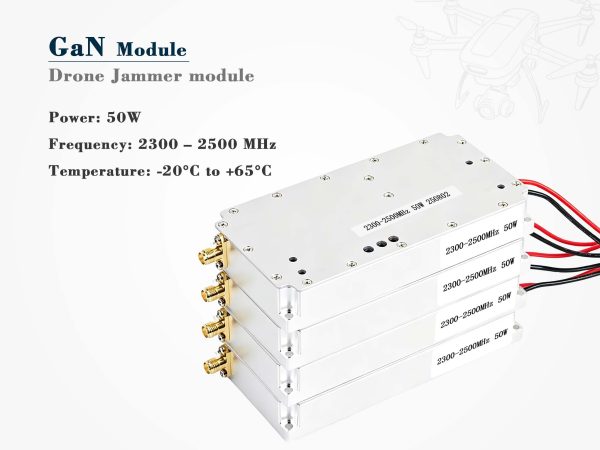
2300–2500MHz 50W GaN Module for Drone Countermeasure and Signal Shielding
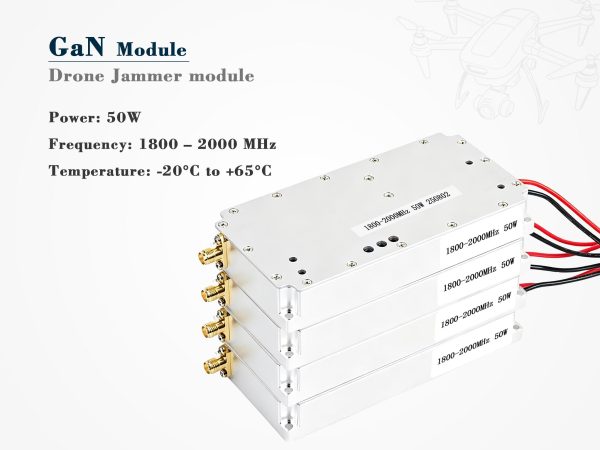
Powerful 50W GaN Jammer Module 1800-2000MHz