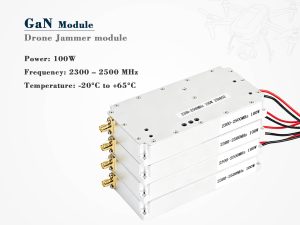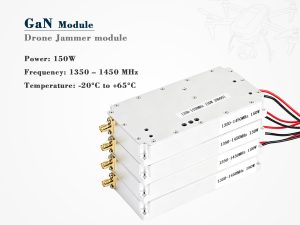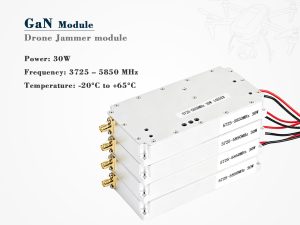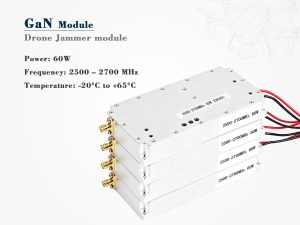
How does a drone jammer module work? It disrupts the radio links between a drone and its controller, video feed, or satellite navigation system. Rather than hacking the aircraft, the module transmits high-power noise or false signals on the same frequencies. This blocks command, telemetry, video, or GPS lock, so the drone may hover, land, or return home.

Core Principle
A typical module is an RF transmitter chain with a detection front end. First, it scans known drone bands. Then a signal generator creates noise, chirps, or spoofing waveforms. An amplifier boosts that signal, and an antenna radiates it toward the target. Timing and power control prevent overheating and wasted energy.
| Stage | Function | Common Example |
|---|---|---|
| Detection | Scans drone uplink/downlink bands | 2.4 GHz, 5.8 GHz, GNSS |
| Signal generation | Creates noise or false data | DDS, VCO, FPGA |
| Amplification | Raises output power | GaN SSPA |
| Antenna | Directs RF energy | Panel, sector, horn |
| Control | Manages bands and duty cycle | MCU or SDR |
Across RF Bands
Most consumer drones use 2.4 GHz for control and 5.8 GHz for video. GNSS receivers often use L1/E1 and L2/L5. A jammer module may cover several bands at once, because blocking only one link may not stop a drone. Frequency-hopping spread spectrum makes the task harder. The jammer must raise the noise floor enough across each hopping channel, or the drone link may survive. Effective jamming depends on jam-to-signal ratio, not just wattage.
Key Components and Directional Antennas
Directional antennas increase effective radiated power toward the drone and reduce interference elsewhere. A high-gain panel can focus energy, but it must track or cover the target area. Omni antennas are simpler, yet they waste power and can disrupt nearby Wi-Fi. For site protection, a drone detection system often cues the jammer module, so it transmits only when a threat appears. Regulators such as the FCC treat jamming as illegal in many civilian cases. Always check local law before testing.
Real Time
In real time, the process is a loop: detect, classify, select, transmit, and adjust. A detector identifies the drone protocol. The processor chooses the matching band and waveform. The amplifier sends a burst. Sensors monitor temperature and voltage. If the link persists, the module changes power, bandwidth, or antenna direction. Latency matters. A slow response gives the drone time to move or complete its mission.
7 Proven Facts and Legal Limits
-
Power alone is not enough; antenna gain and band matching matter.
-
2.4 GHz and 5.8 GHz are common drone control/video bands.
-
GNSS jamming can affect nearby navigation devices.
-
Heat is a major limit in compact modules.
-
Directional systems reduce collateral interference.
-
Civilian jamming is illegal in many countries.
-
Shielded rooms are the safest legal test environment.
External reference: ITU radio regulations.
FAQ
Q: Does it hack the drone?
No. It usually denies radio links; it does not decrypt or take over control.
Q: Can it stop autonomous drones?
Only if it blocks GNSS or other navigation signals, and results vary.
Q: Is it legal?
In many places, no. Government agencies may use it under strict rules.
How does a drone jammer module work? It is an RF denial tool that detects, generates, amplifies, and directs interference. Its success depends on frequency coverage, power, antennas, and timing.