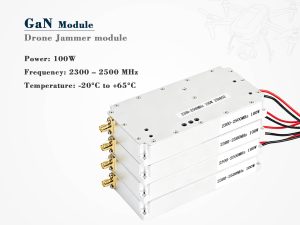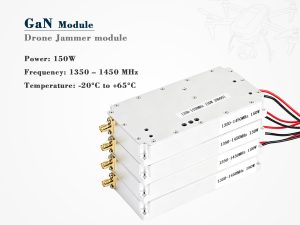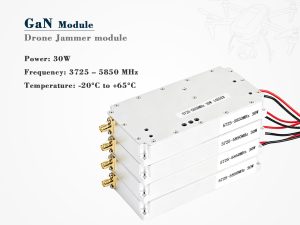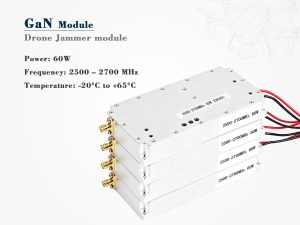
Choosing a drone jammer module is not a power contest. A 100 W module with poor filtering, weak cooling, or mismatched antennas can underperform a well-integrated 30 W design. For integrators building authorized counter-UAS systems, the goal is controlled, reliable RF disruption with minimal interference to nearby networks.
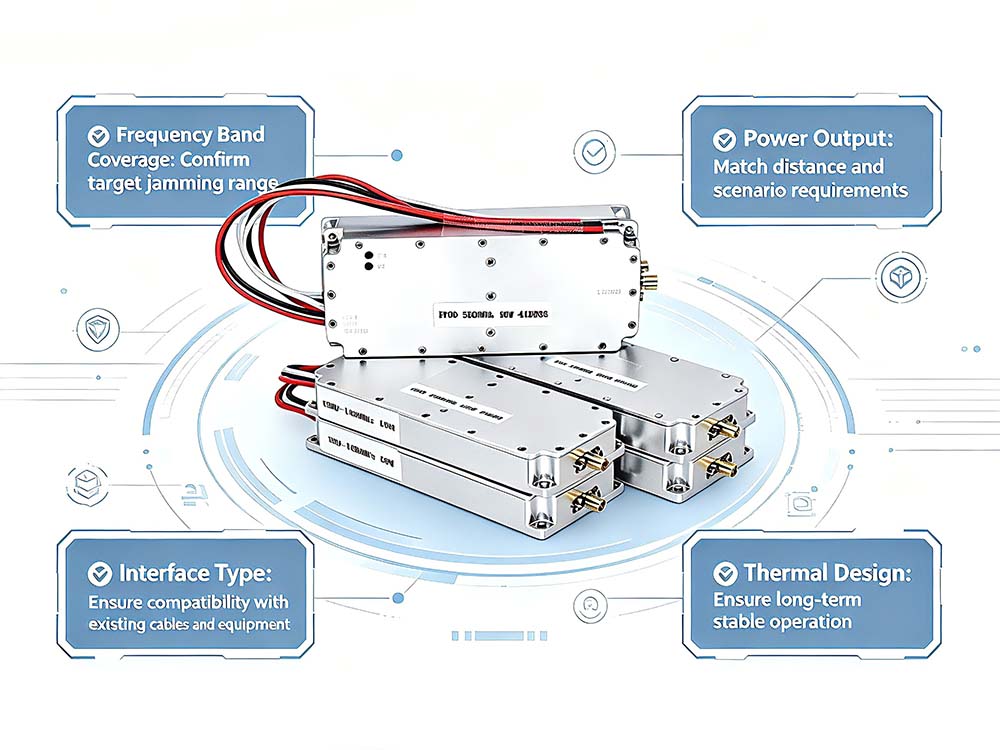
Define the Operational Envelope First
Begin with the threat, not the catalog. Which drone links must be addressed? Common targets include 433 MHz, 868/915 MHz, 1.2 GHz, 1.5 GHz, 2.4 GHz, 5.8 GHz, and GNSS bands. Each band requires different power, bandwidth, and antenna behavior. A module that covers 2.4 GHz and 5.8 GHz may be enough for consumer drones, while industrial or custom UAVs can use lower or higher frequencies.
Also define range, mounting, duty cycle, and input power. A portable unit may need 12–24 V DC and passive cooling. A vehicle-mounted system can support higher output but must handle vibration and alternator noise. Fixed sites often prioritize remote control, logging, and weatherproofing.
Core Specifications That Matter
| Parameter | Why it matters | Selection tip |
|---|---|---|
| Frequency coverage | Determines which control, video, and GNSS links can be targeted | Match bands to the actual threat list; avoid unnecessary wideband coverage |
| Output power | Affects range and jamming-to-signal ratio | Compare linearity and duty cycle, not just peak watts |
| Cooling | Heat shortens module life and causes power fold-back | Check thermal resistance, airflow, and heatsink size |
| SWaP | Size, weight, and power limit deployment options | Validate dimensions with antennas, filters, and cables installed |
| Control interface | Enables integration with detection and command software | Look for Ethernet, RS-485, CAN, or API support |
| Protection | Prevents damage from VSWR, over-voltage, and overheating | Require VSWR protection, temp sensors, and current limiting |
| Compliance | Keeps deployment lawful and reduces interference risk | Confirm authorized use, band limits, and power caps |
Power Is Not Range
Power is only one part of the link budget. Antenna gain, cable loss, polarization, terrain, and the drone’s receiver sensitivity determine real-world effect. A high-gain directional antenna can improve effective range more than doubling amplifier power, while poor cable loss can waste the same investment.
The table highlights a simple rule: electrical performance, thermal design, and legal limits must be reviewed together.
Module Types and Deployment Fit
Single-band modules are easier to certify, cool, and repair. Multi-band modules save space but create isolation challenges. If bands are poorly isolated, intermodulation products can reduce effective jamming and interfere with other receivers. Broadband amplifiers offer flexibility, but they often waste power on unused frequencies.
For portable teams, low-SWaP multi-band modules with efficient GaN amplifiers are attractive. For vehicle systems, ruggedized modules with wide DC input and CAN control are common. For fixed installations, rack-mounted modules with remote monitoring and directional antennas provide better coverage control.
Compliance and Risk Controls
Drone jamming is restricted in most countries. It should only be used by authorized government, military, law enforcement, or approved security operators under local law. Integrators should build in power limits, geographic restrictions, audit logs, and a hardware kill switch. Avoid GNSS disruption unless legally authorized, because it can affect civil aviation, timing, and emergency services.
Validation Checklist
Before purchasing, request:
-
Frequency response and spectral mask data.
-
VSWR and thermal test results.
-
Duty-cycle ratings at real ambient temperatures.
-
Interface documentation and firmware update policy.
-
Compliance statements and end-user requirements.
Then test antennas, filters, and power supplies as a complete RF chain. A module that performs well on a bench may fail in the field if cable loss or antenna mismatch is ignored.
Final Thought
The best drone jammer module is not the highest-power unit. It is the one that matches the mission, survives the environment, integrates cleanly, and stays within legal limits. Start with the threat and compliance, then compare RF performance and thermal design.