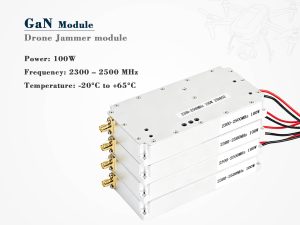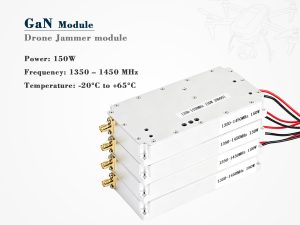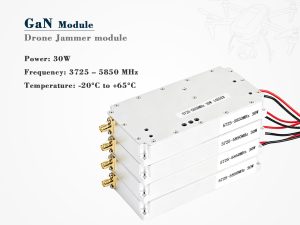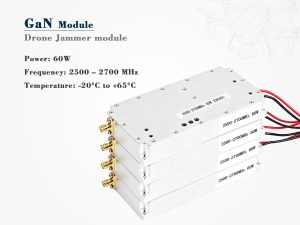
Drone jammer module for telemetry is not just an RF power block. It sits at the intersection of radio physics, protocol timing, thermal design, antenna behavior, and legal limits. A module that looks strong on a datasheet can still fail in the field if it misses the telemetry link’s hopping pattern, bandwidth, or duty cycle. This guide focuses on practical engineering and procurement decisions, not marketing claims.
Why a Drone Jammer Module for Telemetry Is Different
Telemetry links usually carry low data rate but critical control and status data. They may use frequency hopping, TDMA, LoRa, FHSS, or custom waveforms. A drone jammer module for telemetry must disrupt those packets without wasting power across the whole band. That is different from broadband video jamming, where raw coverage may matter more than packet timing.
In many counter-UAS systems, telemetry disruption is paired with detection.
How a Drone Jammer Module for Telemetry Works
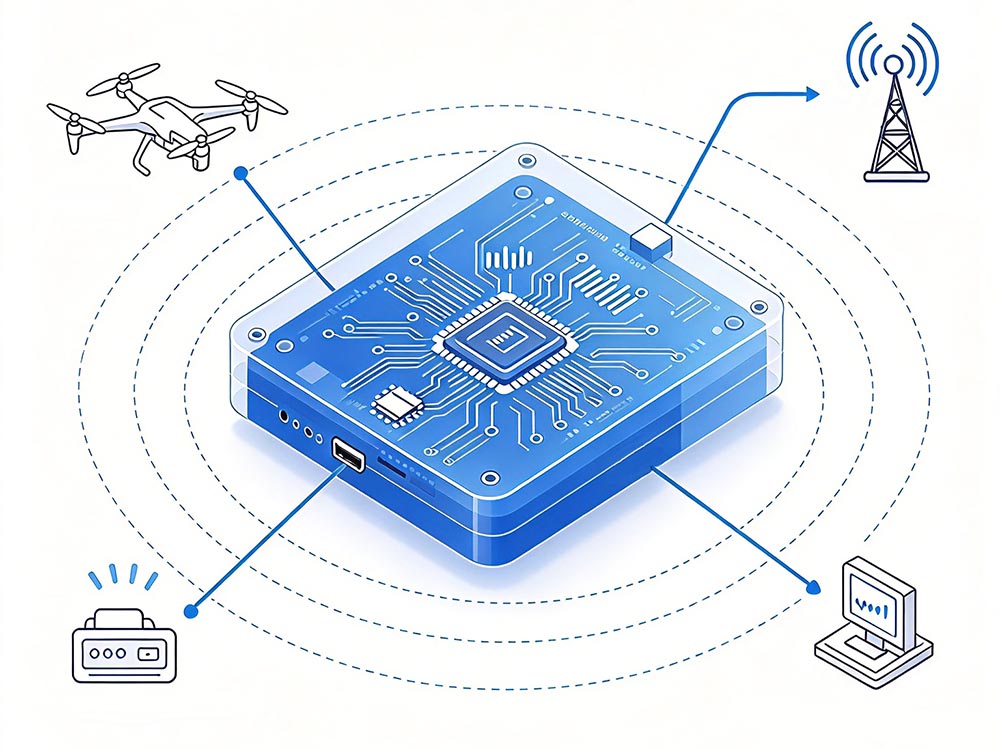
A typical module includes an SDR or waveform generator, RF upconversion, filtering, a power amplifier, a controller, and thermal management. The controller may follow a protocol library or use reactive jamming. Reactive modes listen first, then transmit only when a telemetry burst appears. This can reduce average power and heat, but it demands fast processing and accurate threshold settings.
Core Blocks in a Drone Jammer Module for Telemetry
| Block | Role | Design Note |
|---|---|---|
| SDR / waveform generator | Creates noise, chirps, or protocol-aware signals | Hopping speed matters |
| RF upconversion | Moves signal to target band | Image rejection is critical |
| Filtering | Limits out-of-band emissions | Low insertion loss |
| PA | Sets output power | Linearity affects efficiency |
| Controller | Timing, sensing, and API control | Must match protocol behavior |
| Thermal path | Removes heat | Duty cycle drives size |
| Antenna port | Delivers RF to air | VSWR protection is essential |
RF Bands and Telemetry Protocols a Drone Jammer Module for Telemetry May Target
Telemetry is not limited to one band. Small UAVs may use 433 MHz, 868/915 MHz, 2.4 GHz, or 5.8 GHz, depending on region and design. Some links combine RC and telemetry; others separate them. A drone jammer module for telemetry should therefore be specified by band, not just by total wattage.
| Band | Common Telemetry Use | Typical Waveforms | Jammer Consideration |
|---|---|---|---|
| 433 MHz | ISM telemetry | LoRa, FHSS | Narrowband, lower power |
| 868 / 915 MHz | Regional ISM | FHSS, LoRa | Region-specific rules |
| 2.4 GHz | RC and telemetry | FHSS, DSSS | Wideband, high duty cycle |
| 5.8 GHz | Video and some telemetry | OFDM, custom | Directional antennas help |
| GNSS L1/L2 | Navigation, not telemetry | Spread spectrum | High legal risk in many markets |
A common mistake is to treat GNSS jamming as telemetry jamming. They are different problems with different legal exposure. For radio standards, check ETSI radio standards and FCC engineering and technology pages.
Key Specs to Compare in a Drone Jammer Module for Telemetry
Datasheets often list one maximum power figure. That number can hide per-band performance. Ask for power per band, bandwidth per band, duty cycle, and thermal derating. A 50 W module may deliver only 10 W on the band you need, or it may overheat after two minutes.
| Spec | Why It Matters | Question to Ask |
|---|---|---|
| Output power | Affects range and link margin | Is it per band or total? |
| Bandwidth | Must cover hopping range | What is the 3 dB bandwidth? |
| Hopping speed | Tracks fast FHSS links | How fast can it follow? |
| Duty cycle | Drives thermal design | Continuous or intermittent? |
| VSWR protection | Protects PA | What mismatch can it survive? |
| Control interface | Integration with C2 | API, Ethernet, UART? |
| Power input | Platform fit | 12 V, 24 V, or 48 V? |
| Weight and size | Mobility | Can it fit the mount? |
Power, Duty Cycle, and Thermal Limits in a Drone Jammer Module for Telemetry
Thermal design is not a secondary issue. It is a primary performance limit. If a drone jammer module for telemetry runs at high duty cycle, the PA junction temperature rises, efficiency drops, and protection circuits may fold back power. In field use, that foldback can look like “random” range loss. Proper heatsinking, airflow, and duty-cycle management are part of the RF design.
Deployment Scenarios for a Drone Jammer Module for Telemetry
Fixed sites, mobile vehicles, convoys, and border posts each create different constraints. A fixed site can use directional antennas, larger heatsinks, and mains power. A vehicle needs vibration tolerance, wide input voltage, and compact cabling. A man-portable unit must balance weight, battery life, and output power.
Integration with Detection and C2
A drone jammer module rarely works alone. It needs detection data, rules of engagement, and a control interface. If the detection layer misclassifies a friendly link, the jammer may create interference without benefit. That is why protocol libraries and logging matter. Teams often test a drone jammer module for telemetry with recorded IQ files before live trials.
Compliance and Risk: Drone Jammer Module for Telemetry
Jamming is tightly regulated in most countries. Transmitting on protected bands, exceeding power limits, or causing harmful interference can lead to penalties. Compliance is not just a paperwork task; it affects product design. Filtering, shielding, and power control are technical controls that support legal use.
Before deployment, confirm authorization, band limits, and operational rules. For public guidance, review ITU-R spectrum resources and national regulator publications. In the United States, the FCC is a key reference. In Europe, <a href=”https://www.etsi.org/technologies/radio” rel=”dofollow”>ETSI</a> standards are commonly consulted.
Buying Checklist for a Drone Jammer Module for Telemetry
Use this checklist before requesting samples or quotes.
| # | Check | Why |
|---|---|---|
| 1 | Band plan | Match real telemetry links |
| 2 | Power per band | Avoid hidden derating |
| 3 | Protocol support | FHSS, LoRa, custom |
| 4 | Thermal test data | Confirm duty cycle |
| 5 | Control API | Integrate with C2 |
| 6 | Compliance evidence | Reduce legal risk |
| 7 | Field support | Tuning and training matter |
A drone jammer module for telemetry should be evaluated as part of a system, not as a standalone box. Ask for test reports, spectrum plots, and thermal curves. If a supplier cannot provide them, treat the specification as provisional.
FAQ About Drone Jammer Module for Telemetry
What is a drone jammer module for telemetry?
It is an RF module designed to disrupt or degrade telemetry links used by drones or remote systems. It may use noise, chirps, or protocol-aware waveforms.
Can it target only telemetry?
In principle, yes, if the band and waveform are matched. In practice, RC, video, and telemetry may share bands, so some overlap is common.
What power is needed?
Power depends on range, antenna gain, band, and link margin. More power is not always better because heat and legal limits rise quickly.
Is it legal?
Only with proper authorization. Rules vary by country and band. Always consult a qualified legal and RF compliance professional.
How should it be tested?
Start with conducted tests, then shielded room tests, then controlled field tests. Log power, duty cycle, temperature, and link behavior.
Final Take
A drone jammer module for telemetry is a focused RF tool, not a universal counter-UAS answer. The best results come from matching bands, protocols, power, thermal limits, and compliance from the start. Buy for the telemetry link you actually need to address, and test the module as part of a complete detection-to-effect chain.