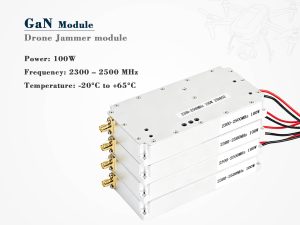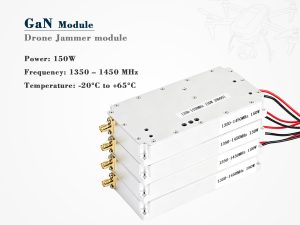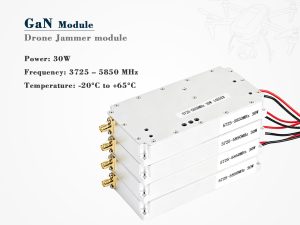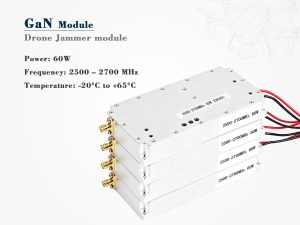
If you are budgeting for an authorized counter-drone project, “drone jammer module cost” is not a single number. A module can be a simple single-band RF board or a multi-channel, high-power subsystem with firmware, filtering, and compliance documentation. Prices in 2026 range from roughly $150 for low-power experimental units to more than $80,000 for customized rack-mounted modules. The final figure depends on output power, frequency bands, channel count, thermal design, software, certification, and order volume.
This article is intended for government agencies, system integrators, airports, correctional facilities, and critical infrastructure teams that are legally authorized to evaluate counter-drone equipment. It is not intended for personal or unauthorized use.
Quick price snapshot
The table below gives indicative unit prices for modules or subsystems. It excludes antennas, power supplies, installation, and system-level software. Actual quotes can vary widely by supplier, batch size, and compliance requirements.
| Module type | RF output | Bands / channels | Typical application | Indicative unit price (USD) |
|---|---|---|---|---|
| Single-band low-power module | 5–20 W | 1 band | Lab testing, integration proof of concept | $150–$600 |
| Multi-band medium-power module | 20–50 W | 2–4 bands | Vehicle-mounted or fixed-site integration | $800–$3,500 |
| Multi-channel high-power module | 50–150 W | 4–8 channels | Airports, prisons, critical sites | $5,000–$20,000 |
| Custom rack-mount module | 150–400 W+ | 6–12+ channels | Large system integration | $20,000–$80,000+ |
Low-cost modules can look attractive on a spreadsheet, but they often lack the thermal headroom, filtering, and documentation needed for continuous operation. For an authorized deployment, total cost of ownership matters more than the lowest board price.
What drives the price?
Several variables explain why two modules with the same nominal wattage can have very different prices.
| Cost driver | Why it matters | Impact on price |
|---|---|---|
| Frequency coverage | More bands require more RF chains and filters | Moderate to high |
| Output power | Higher power needs better amplifiers, cooling, and power supply | High |
| Channel count | Multiple channels increase control and filtering complexity | Moderate to high |
| Signal generation | Analog sweeping vs. digital modulation changes software and hardware | Moderate |
| Component grade | Industrial or military-grade parts cost more but improve reliability | Moderate to high |
| Thermal design | Heatsinks, fans, and enclosures affect continuous duty cycle | Moderate |
| Compliance and testing | Export, radio, and safety documentation adds cost | Moderate |
| Order volume and customization | Small custom runs cost more per unit | High |
In practice, the RF power amplifier is often the largest single cost item. It can account for 25% to 40% of the module price. Signal sources, filters, control boards, firmware, and thermal management make up most of the rest. Certification, testing, and traceable documentation can add another 5% to 15%, depending on the destination market.
Module cost vs. complete system cost
Buyers sometimes compare a module quote with a complete counter-drone system quote. That comparison is misleading. A module is only one part of a larger solution.
| Item | Module-level purchase | Complete system |
|---|---|---|
| RF components | Included | Included |
| Antennas and cables | Usually separate | Included |
| Detection and tracking | Not included | Included |
| Control software | Basic or separate | Integrated |
| Installation and training | Not included | Often included |
| Compliance documentation | Partially included | System-level documentation |
| Typical cost position | Lower | Significantly higher |
If your project requires detection, direction finding, camera tracking, or remote management, the module cost is only a fraction of the total budget.
Hidden costs to plan for
A realistic budget should include more than the module itself. Common additional costs include:
-
Antennas, mounts, and low-loss coaxial cables
-
Power supplies, UPS, and electrical protection
-
Cooling, ventilation, and weatherproof enclosures
-
Control hardware, laptops, or ruggedized tablets
-
Integration labor and site surveys
-
Spectrum monitoring or detection sensors
-
Spare parts, repairs, and extended warranty
-
Operator training and documentation
-
Certification, testing, and export license support
For fixed installations, installation and site preparation can easily exceed the module price. For mobile systems, vehicle integration and power management add further cost.
How to compare supplier quotes
When reviewing a drone jammer module price, ask for a line-item breakdown rather than a single total. A transparent quote should separate the RF module, power supply, control interface, cooling, testing, and documentation. It should also state the duty cycle, operating temperature range, and supported frequency bands.
Use this checklist before you buy:
-
Is the project legally authorized in your jurisdiction?
-
Can the supplier provide export-control and end-user documentation?
-
Are the frequency bands and output power clearly specified?
-
Is there test data for out-of-band emissions and filtering?
-
What is the continuous duty cycle at the stated power?
-
What is the warranty period and repair turnaround?
-
Are spare parts and technical support available?
-
Does the quote include antennas, cables, and power supplies?
-
Is training or integration support included?
-
Are there any restrictions on resale or transfer?
A lower quote that omits documentation, testing, or support can become more expensive after integration.
Compliance and sourcing note
Drone jamming and RF interference are tightly regulated in most countries. In many jurisdictions, individuals may not purchase, import, possess, or operate jamming equipment. Authorized government, law enforcement, and critical infrastructure programs may be permitted under specific conditions, but they still require proper licensing, frequency coordination, and end-user documentation.
For this reason, the lowest-priced module is rarely the safest choice. Suppliers that cannot provide traceable compliance paperwork may expose the buyer to legal, operational, and financial risk.
Bottom line
The cost of a drone jammer module in 2026 depends less on a single wattage rating and more on the full configuration. Expect to pay from a few hundred dollars for a basic low-power board to tens of thousands of dollars for a high-power, multi-channel, documented module. For authorized projects, the smartest approach is to define the mission first, then request a detailed quote that includes thermal performance, filtering, compliance files, and lifecycle support. That gives you a realistic drone jammer module cost—and a system you can actually deploy and maintain.