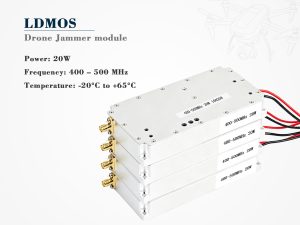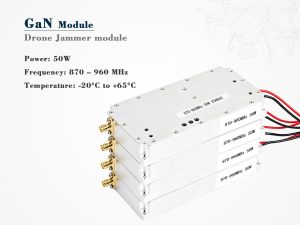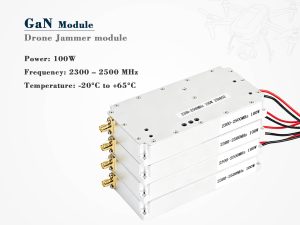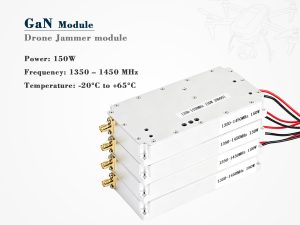
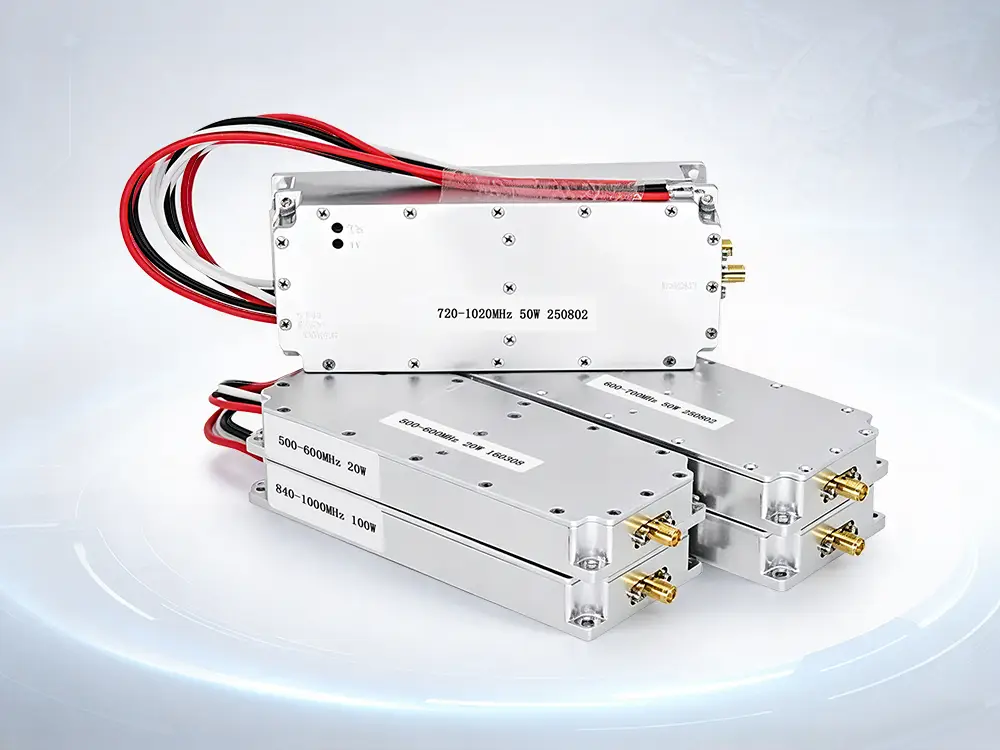
LoRa drone jammer modules are specialized RF components designed to disrupt LoRa-based communication links used by some drones, telemetry systems, and remote-control setups. They are not standalone “drone killers.” Instead, they are building blocks inside larger counter-drone or C-UAS systems that detect, identify, track, and then apply an authorized mitigation method.
The term is often misunderstood because LoRa is a long-range, low-power wireless protocol, while most consumer drones rely on Wi-Fi, proprietary 2.4 GHz/5.8 GHz links, or frequency-hopping control systems. A LoRa drone jammer module targets the narrower slice of drone operations that depend on LoRa or similar sub-GHz links. That distinction matters for engineers, procurement teams, and security integrators.
Quick Definition
| Question | Short Answer |
|---|---|
| What is it? | An RF module that can interfere with LoRa-based drone communication links. |
| Where does it fit? | As a mitigation subsystem in authorized C-UAS platforms. |
| What does it target? | LoRa control, telemetry, or sensor links in specific frequency bands. |
| Is it a complete product? | Usually no. It needs antennas, power, cooling, control logic, and legal authorization. |
| Can civilians use it? | In most countries, no. Jamming is tightly restricted or prohibited. |
| Main risk? | Unintended interference with LoRaWAN, IoT, utility, and public networks. |
Why LoRa Matters in Drone Operations
LoRa is attractive for drones because it can carry small data payloads over long distances with low power consumption. It is often used for telemetry, remote ID-adjacent links, sensor backhaul, and long-range command channels. However, it is not ideal for high-bandwidth video. That is why many drones use a mix of RF technologies: LoRa for low-rate control or telemetry, and higher-frequency links for video or high-speed data.
A LoRa drone jammer module therefore addresses a specific vulnerability. It does not automatically defeat a drone that uses encrypted frequency hopping, cellular, satellite, or autonomous flight. In practice, counter-drone effectiveness depends on detection accuracy, antenna placement, spectrum conditions, and the drone’s fallback behavior.
Core Building Blocks of a LoRa Drone Jammer Module
A module is more than a transmitter. It is an RF chain with thermal, power, and control constraints. The table below outlines the typical architecture at a high level.
| Block | Function | Why It Matters |
|---|---|---|
| RF front end | Generates and shapes the interference signal | Determines band coverage and spectral behavior |
| Power amplifier | Raises signal strength to the antenna | Affects range, heat, and power demand |
| Filtering | Limits out-of-band emissions | Reduces interference with nearby systems |
| Antenna interface | Connects to directional or omnidirectional antennas | Shapes coverage and polarization |
| Control interface | Accepts commands from a C-UAS controller | Enables timing, targeting, and safety interlocks |
| Power supply | Converts input power for RF stages | Influences portability and duty cycle |
| Thermal management | Removes heat from amplifiers | Prevents shutdown and component stress |
| Monitoring | Reports VSWR, temperature, and status | Supports reliable, repeatable operation |
Specs Buyers and Engineers Should Compare
Not all LoRa drone jammer modules are equal. A procurement team should ask for test data, not just headline numbers. The following table summarizes common evaluation points.
| Specification | What to Check | Why It Matters |
|---|---|---|
| Frequency coverage | Which LoRa bands are supported? | Regional bands differ: 433 MHz, 868 MHz, 915 MHz, and others |
| Bandwidth | How wide is the affected spectrum? | Wider coverage can increase interference risk |
| Output power | Is it adjustable and duty-cycle limited? | Higher power is not always better or legal |
| Modulation handling | Does it address LoRa chirp spread spectrum? | Generic noise may be inefficient |
| Cooling | Air, conduction, or liquid? | Thermal design limits real-world runtime |
| Control | API, serial, Ethernet, or proprietary? | Integration with C-UAS command systems |
| Protection | VSWR, over-temperature, over-current? | Prevents damage and unsafe emissions |
| Size and weight | Suitable for fixed, vehicle, or portable use? | Affects deployment and power needs |
| Compliance | Certifications and export classification? | Legal and supply-chain requirements |
Where These Modules Fit in Counter-Drone Systems
A counter-drone workflow usually follows a detect–track–identify–mitigate sequence. A LoRa drone jammer module belongs in the mitigation layer, but only after authorization and rules of engagement are clear.
| Stage | Typical Technology | Role of LoRa Jamming Module |
|---|---|---|
| Detect | RF sensors, radar, optical | None directly |
| Track | Radar, EO/IR, RF triangulation | None directly |
| Identify | RF fingerprinting, protocol analysis | Helps confirm LoRa link presence |
| Mitigate | RF disruption, spoofing, capture | May disrupt LoRa control or telemetry |
| Assess | Post-action reporting | Confirms whether link was affected |
This layered view prevents a common mistake: treating a jammer module as a complete solution. Without detection and identification, an operator may interfere with the wrong signal or disrupt legitimate LoRaWAN infrastructure.
Legal and Ethical Boundaries
Radio jamming is illegal in many jurisdictions unless performed by authorized government, military, or law enforcement agencies under strict conditions. Even then, spectrum regulators may require coordination, power limits, geographic restrictions, and logging. A LoRa drone jammer module can affect IoT networks, smart meters, industrial sensors, and emergency systems. That makes compliance and spectrum hygiene essential.
For commercial buyers, the safer path is often a licensed C-UAS service, a controlled test range, or a detection-only system. If a module is legally permitted, it should include safeguards such as directional antennas, power limits, time-bound operation, and audit trails.
Procurement Checklist
Before shortlisting a LoRa drone jammer module, confirm the following:
| Check | Yes/No | Notes |
|---|---|---|
| Is the use case legally authorized? | Consult local telecom and defense regulations | |
| Is the target link actually LoRa? | Do not assume all drone links are LoRa | |
| Are regional frequency bands covered? | 433/868/915 MHz vary by country | |
| Does the vendor provide test reports? | Look for spectral and thermal data | |
| Can output power be capped? | Reduces legal and interference risk | |
| Is integration documented? | API, power, cooling, and antenna specs | |
| Are export controls addressed? | Classification may affect shipping | |
| Is there a fail-safe shutdown? | Important for safety and compliance |
Final Take
LoRa drone jammer modules are niche RF tools for authorized counter-drone environments. They can play a role when a drone depends on LoRa communication, but they are not universal, plug-and-play, or legally simple. The best approach is to start with detection and identification, confirm the legal basis, and treat any jamming module as one controlled part of a larger, auditable C-UAS architecture.