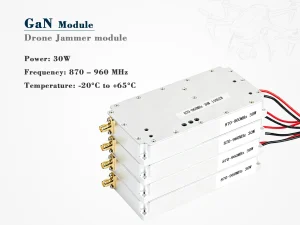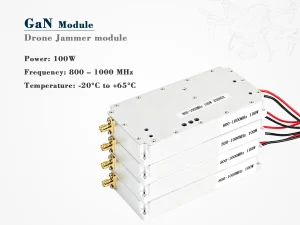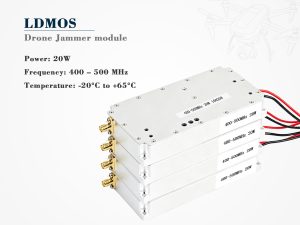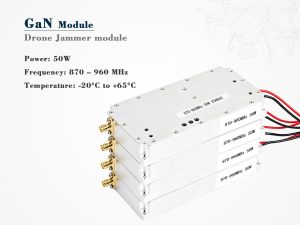
Compliance, RF discipline, and thermal endurance are replacing raw wattage as the main buying criteria.
As counter-UAS budgets grow, procurement teams face a crowded market of RF modules marketed for LoRa and FPV link disruption. The challenge is not finding a product; it is choosing a LoRa FPV jammer module that fits legal boundaries, mission frequency bands, and field conditions. In most jurisdictions, transmitting jamming signals without explicit authorization is illegal. That makes compliance the first filter, not an afterthought.
A Compliance-First Selection Matrix
| Checkpoint | Question to ask | Why it matters | Warning sign |
|---|---|---|---|
| Legal authorization | Is the module approved for your country, agency, and use case? | Jamming is tightly regulated; unauthorized operation can lead to penalties. | Vendor claims “no license needed.” |
| Frequency coverage | Does it target the exact LoRa and FPV bands in the threat profile? | Overbroad coverage can disrupt licensed networks and safety systems. | “All-band” claims with no filter data. |
| Output power / ERP | What are conducted power, antenna gain, cable loss, and ERP? | Higher wattage does not guarantee results and can increase risk. | Wattage-only marketing. |
| Filtering and spurious emissions | Are harmonics and spurious outputs documented? | Poor filtering can interfere with GPS, Wi-Fi, and cellular services. | No spectrum test report. |
| Thermal design | What duty cycle is supported at full power? | Modules often fail from heat before RF limits are reached. | No heatsink, fan, or temperature data. |
| Control interface | Does it offer Ethernet, RS-485, GPIO, or an API? | Integration speed and fail-safe behavior depend on control quality. | Closed firmware with no integration guide. |
| Power quality | What are voltage range, inrush current, and peak consumption? | Vehicle and edge deployments need stable, protected power. | Undocumented peak current. |
| Compliance documentation | Are test reports, declarations, and warranty terms available? | Audits and deployments require traceable evidence. | Refusal to share basic test data. |
Why Frequency Coverage Is Not a Numbers Game
A LoRa FPV jammer module may be advertised as covering multiple bands, but coverage alone says little about real performance. LoRa control links often operate in sub-GHz ISM bands, while FPV video can use 2.4 GHz, 5.8 GHz, or other frequencies depending on the drone platform. The module must match the actual threat profile, not a generic marketing list.
Overbroad coverage creates collateral interference. In authorized counter-UAS testing, engineers should verify frequency accuracy, bandwidth, and filter behavior with a spectrum analyzer. A module that spills into GPS, Wi-Fi, or cellular bands may create legal and operational problems far beyond the original mission.
Field Validation Scorecard
| Validation area | What to request | Why it matters |
|---|---|---|
| Frequency accuracy and bandwidth | Spectrum analyzer plots | Ensures targeting without unnecessary spillover. |
| ERP and antenna performance | Gain, cable loss, and VSWR data | Converts module power into real-world effect. |
| Spurious and harmonic suppression | Lab test reports | Reduces interference with critical services. |
| Thermal endurance | Temperature logs at rated duty cycle | Predicts field reliability. |
| Control latency | API timing and trigger tests | Matters for fast-moving FPV threats. |
| Power integrity | Inrush, brownout, and protection specs | Prevents resets and hardware damage. |
| Documentation | Compliance files and firmware policy | Supports legal review and lifecycle support. |
Thermal Design and Power Integrity
RF power modules are inefficient. A large share of input power becomes heat, and heat is a leading cause of field failure. Buyers should ask for duty-cycle ratings at full output, not just peak power. Heatsink size, airflow, thermal pads, and temperature sensors all affect whether a module can survive continuous operation.
Power design is equally important. Vehicle-mounted or edge-deployed systems often face voltage sag, inrush current, and electrical noise. A module with weak protection may reset during critical moments or damage its power amplifier. Look for documented input ranges, transient protection, and reverse-polarity safeguards.
Integration and Control Matter More Than Ever
Counter-UAS response times are measured in seconds. A LoRa FPV jammer module with a slow or closed control interface can delay detection-to-action cycles. Preferred modules offer Ethernet, RS-485, GPIO, or a documented API. Fail-safe behavior is also essential: if the control link drops, the module should enter a known safe state.
Integration teams should test command latency, trigger reliability, and logging. If the vendor cannot explain how the module behaves under network loss or power interruption, the product is not ready for serious deployment.
Testing, Training, and Documentation
Before any deployment, validate the module in an authorized environment with legal oversight. Document emissions, thermal performance, and operator procedures. Training should cover escalation rules, abort conditions, and interference reporting. A technically strong module can still create risk if operators lack clear protocols.
Questions to Ask Before You Buy
-
Which exact frequency bands are targeted, and which are filtered?
-
What is the measured ERP, not just the amplifier wattage?
-
What duty cycle is supported at full power?
-
Does the vendor provide spurious emission and thermal test data?
-
How does the LoRa FPV jammer module behave during power loss or control-link failure?
-
What compliance documents and firmware update policies are included?
-
Can the module be tested and audited in your jurisdiction?
Bottom Line
Choosing a LoRa FPV jammer module in 2026 is a legal, RF, and systems engineering decision. The best choice is not the highest-power product on the market. It is the module that matches authorized mission requirements, minimizes interference, survives real-world heat and power conditions, and integrates cleanly with counter-UAS command systems. Procurement teams that prioritize compliance and documented performance will reduce risk—and avoid costly field failures.