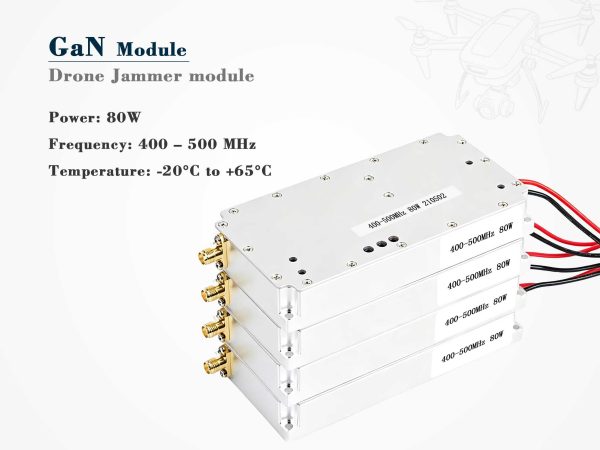
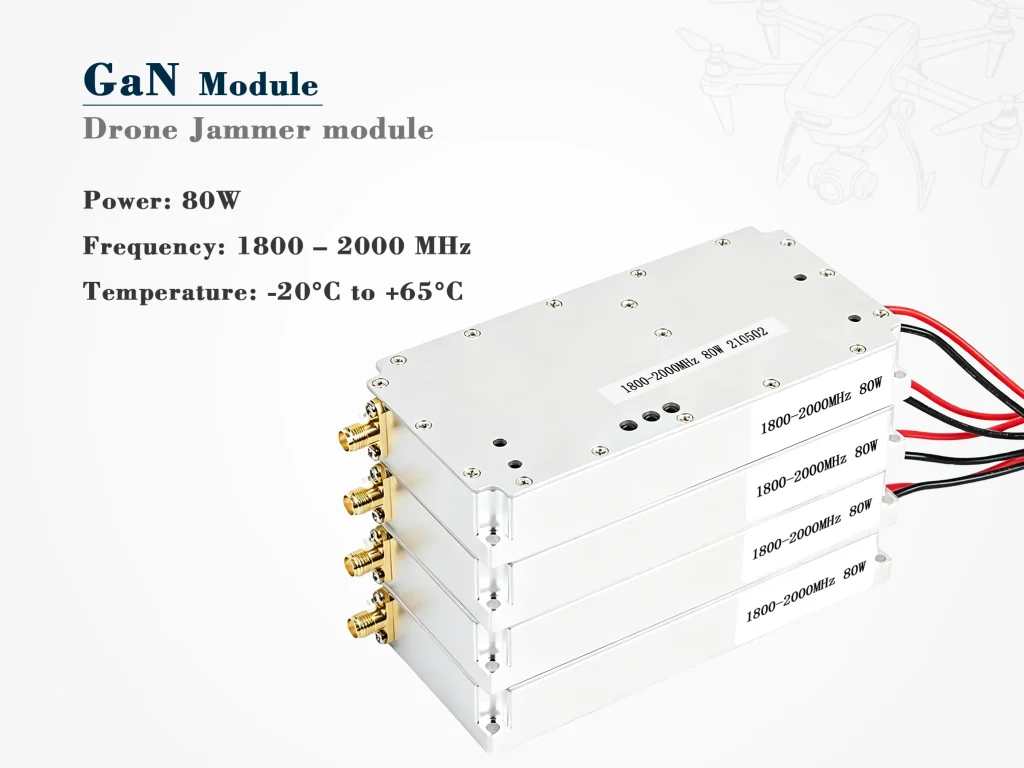
80W UAV Jamming Module 1800-2000MHz GaN
80W UAV jamming module: 1800–2000MHz, GaN output, DC24–29V, 10A, built-in sweep source, SMA female, 0.57kg, -20~+65°C.

Technical Specifications
| Parameter | Specification | Notes |
| Frequency range | 1800–2000 MHz | Covers common UAV control and video links |
| Output power | 80W | Typical, GaN output stage |
| Supply voltage | DC24V–29V | Regulated DC input |
| Current draw | 10.0A max | At full load |
| Modulation source | Built-in high-speed sweep source | Analog scan |
| Analog scan speed | High-speed sweep | Internal source |
| Input / output impedance | 50Ω | SMA female output |
| Protection LEDs | Power, overvoltage, overtemperature | Status indication |
| Operating temperature | -20~+65°C | Ensure airflow |
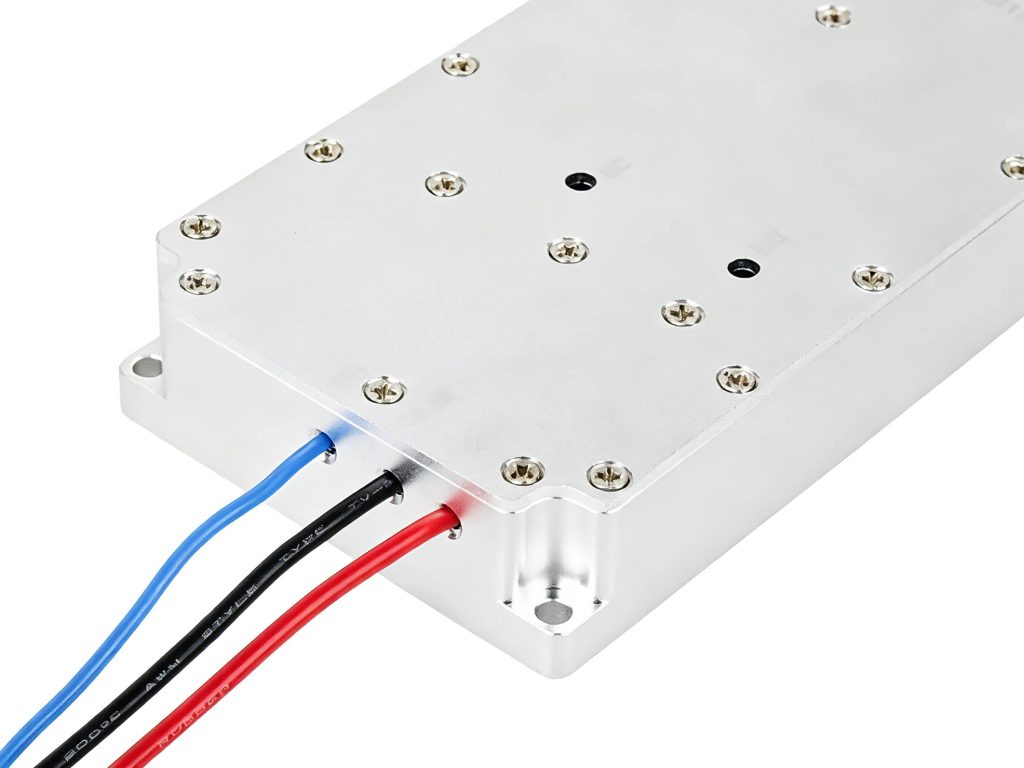
| Dimensions (L×W×H) | 168.5×84.5×23 mm | Compact metal housing |
| Weight | 0.57 kg | Approx. |
| Base material | Metal | Aluminum alloy (typical) |
Product Details
The 80W UAV Jamming Module is a GaN-based analog module built for 1800–2000MHz. It packs a high-speed sweep source, an 80W output stage, and absorption-type VSWR protection into one metal housing. At 168.5×84.5×23mm and 0.57kg, it fits compact counter-UAV systems, RF test benches, and OEM enclosures where space is limited but real output power is required.
Why 1800–2000MHz?
This band is widely used for UAV control, telemetry, and video links. Putting 80W into this range gives a stronger local effect than a low-power wideband source. The built-in sweep source moves the signal across the band instead of sitting on one fixed tone. That makes the module useful for link-blocking tests, receiver stress trials, and RF environment studies.
GaN Output in a Small Case
GaN devices offer high power density and good thermal behavior. In this module, the GaN output stage helps reach 80W typical while keeping the body compact. Output VSWR is ≤2.0. An absorption-type VSWR protection device is built in, which helps when the antenna is not perfectly matched. The SMA female output connects to standard antennas, filters, or combiners. This layout reduces external parts and simplifies RF chains.
Power and Control
The module runs from DC24V to 29V. Maximum current draw is 10.0A, and efficiency is ≥35%. Switch control is simple: +5V or floating means on, while grounding means off. This logic works with microcontrollers, relay boards, or manual switches. Three LEDs show power, overvoltage, and overtemperature status, so users can check operating conditions without opening the case.
Heat and Environment
Operating temperature is -20 to +65°C. At 80W, heat management still matters. Mount the module on a metal surface or heatsink when possible, and keep air moving around the housing. The overtemperature LED warns before performance becomes unstable. For outdoor use, protect the unit from rain and dust, and use an antenna with good matching. A poor match can reduce effective range and increase stress on the output stage.
What the All-in-One Design Saves
This is not just an amplifier. The sweep source, RF output stage, control logic, and protection sit in one package. That cuts cabling and setup time. For OEM users, the DC24–29V input and +5V/ground switch control are easy to integrate with existing power and control boards. The SMA female output works with common coaxial parts. When space is tight, this all-in-one format helps avoid a rack of separate modules.
Typical Integration
The 80W UAV Jamming Module is often used in counter-drone research, RF shielding checks, and drone link studies. It can drive directional antennas for focused coverage or broadband antennas for wider tests. Because it is an analog module, sweep behavior and power timing can be controlled by the surrounding system. This makes it suitable for both lab work and field prototypes.
Before You Run It
Check antenna VSWR first. Use short RF cables rated for the power. Choose a stable DC supply that can deliver more than 10.0A. If the module is part of a larger jammer, leave room for cooling and keep RF cables away from sensitive control lines. With these basics, the UAV jamming module adds a compact 1800–2000MHz high-power jamming path without a large rack.
Frequently Asked Questions
Case Studies
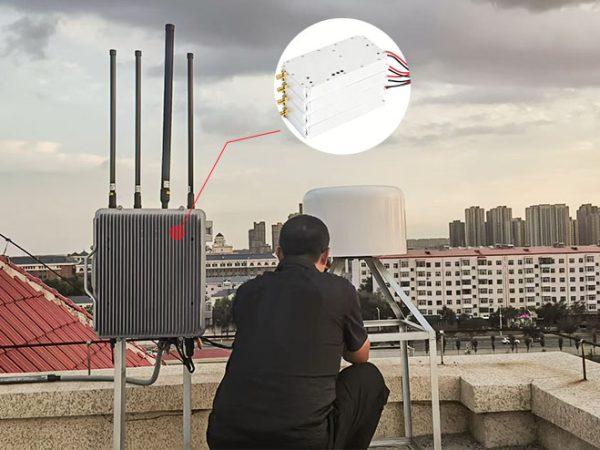
Heilongjiang Weather Center Completes Anti-Drone System Upgrade with Three High-Power Drone Jammer Modules

Tangshan Chem Plant Sealed Drone Gaps With 3 GaN Wideband Modules

How a National Prison Integrated Our Drone Jamming Module Into Their Fixed Counter-Drone System

Integrating Core RF Power: OEM Drone Jamming Module for Oil Refinery Security | Case Study
Send Us a Message
Related Products
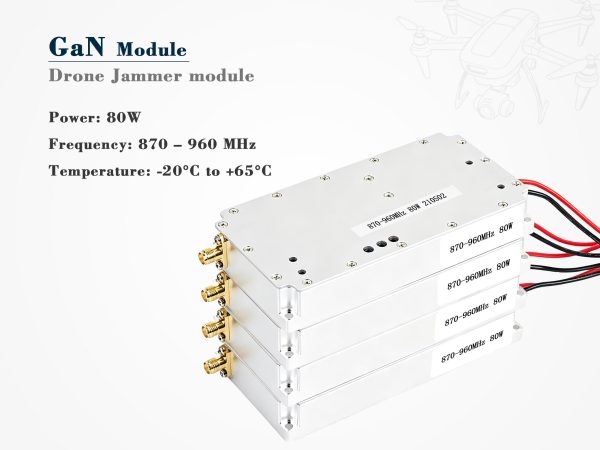
80W GaN Drone Jammer Module 870–960MHz | Analog Sweep
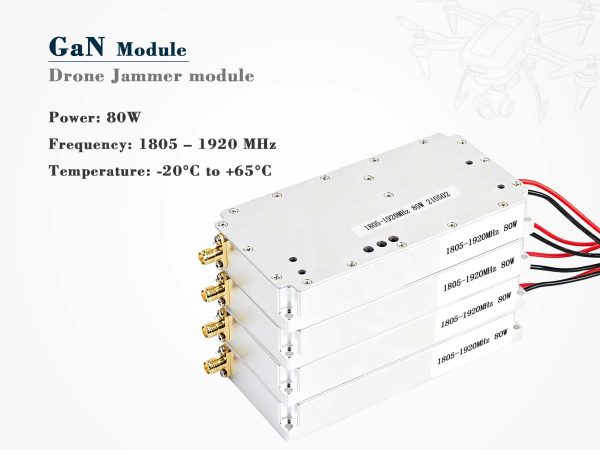
80W 1805–1920MHz GaN UAV Countermeasure Jammer Module
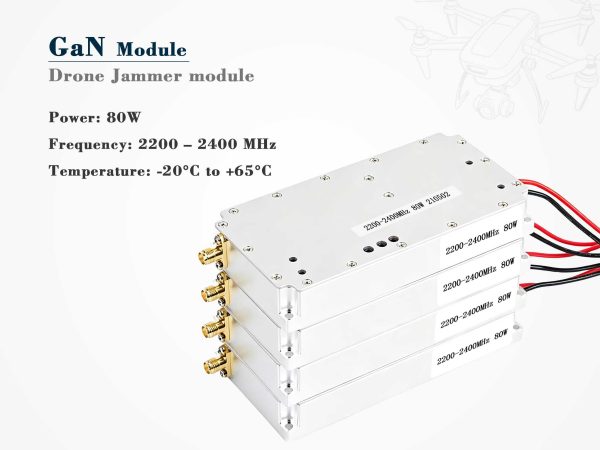
80W GaN Jammer Module: Powerful 2200–2400MHz Counter-UAS Solution