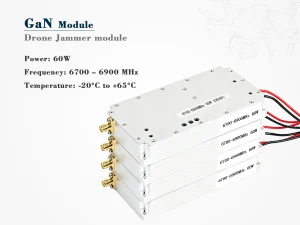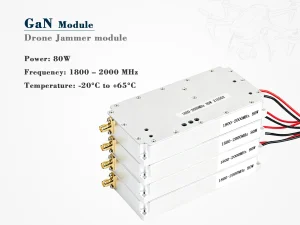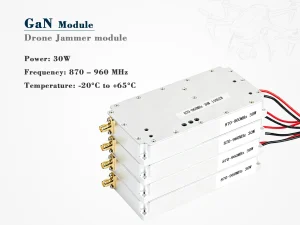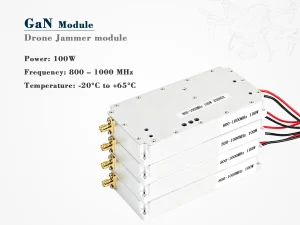
The frequency list on a LoRa FPV jammer module datasheet is often the first spec buyers read—and the first spec that misleads them.
In authorized counter-UAS programs, frequency coverage is not a marketing checkbox. It determines whether a module can address a specific drone link, whether it risks interfering with nearby services, and whether it can be legally deployed at all. As LoRa-based control links and FPV video systems continue to evolve, the band question has become a compliance and engineering issue, not just a radio issue.
Why Band Labels Are Not Plug-and-Play
A module described as “LoRa FPV” may cover sub-GHz LoRa telemetry, 2.4 GHz FPV video, 5.8 GHz FPV video, or a combination of these. The label does not guarantee that the module targets the exact frequencies used in a given region or mission. LoRa allocations differ by country, and FPV systems vary widely by manufacturer, power level, and video standard.
Buyers should treat band coverage as a three-part question: Which frequencies are targeted? Which frequencies are filtered out? Which regional variant is being sold?
The Three Band Families Buyers Actually Encounter
| Band family | Typical frequencies | Common link use | What to verify | Compliance note |
|---|---|---|---|---|
| Sub-GHz ISM | 433 MHz, 868 MHz, 915 MHz (region-dependent) | LoRa telemetry, remote control, some long-range links | Exact regional allocation, duty cycle, ERP, filtering | Jamming is not “license-free”; authorization is required. |
| 2.4 GHz ISM | 2400–2483.5 MHz | FPV video, control links, Wi-Fi, Bluetooth | Bandwidth, spurious emissions, antenna pattern | High risk of collateral interference with consumer devices. |
| 5.8 GHz ISM | 5725–5850 MHz | FPV video, some control links | Thermal performance at duty cycle, gain, cable loss | Regional power limits vary; test data is essential. |
Some FPV platforms also use 900 MHz, 1.2 GHz, or other bands. A credible supplier should explain which of these are addressed and which are outside the module’s design scope.
The Sub-GHz LoRa Question
LoRa is not a single frequency. LoRaWAN and proprietary LoRa links operate in different sub-GHz bands depending on regional spectrum rules. A module marketed for “LoRa jamming” may only cover one regional band, such as 868 MHz in Europe or 915 MHz in North America. If the datasheet does not list regional variants, the buyer cannot confirm whether the product is relevant to the target environment.
This matters for procurement because frequency mismatch is not a minor issue. A module that covers the wrong sub-GHz range may be useless against the intended link while still creating interference risks elsewhere.
FPV Bands Move Faster Than Catalogs
FPV video and control links are not standardized. While 2.4 GHz and 5.8 GHz remain common, some systems use lower or higher bands for range, penetration, or regulatory reasons. A LoRa FPV jammer module with fixed band coverage may become outdated as drone platforms change.
For that reason, buyers should ask vendors about modular band options, firmware-defined channel plans, and future update paths. A fixed-band module may be acceptable for a narrow, well-defined mission. It is a poor fit for evolving threat profiles.
Procurement Checks for Band Claims
| Check | What good evidence looks like | Red flag |
|---|---|---|
| Regional band list | Country-by-country frequency table | “Global sub-GHz” with no detail |
| Filtering data | Spectrum plots showing out-of-band rejection | No spurious emission report |
| ERP measurement | Conducted power plus antenna gain and cable loss | Wattage-only marketing |
| Duty cycle | Thermal test at full rated power | Peak power claims without timing |
| Control interface | API, Ethernet, RS-485, or GPIO documentation | Closed protocol with no integration guide |
| Firmware policy | Signed updates and version history | No lifecycle support |
Regulatory Geography Cannot Be Ignored
Even if a module covers the right frequencies, operation may still be illegal. Spectrum allocation is national, and jamming rules are stricter than ordinary radio licensing. Authorized use is typically limited to specific government, military, or law enforcement agencies, often under controlled conditions.
Procurement teams should involve legal counsel early. A technically capable LoRa FPV jammer module is not a lawful product simply because it is sold online.
Outlook
The market is moving toward modular band coverage, better filtering, and documented test data. Vendors that provide regional variants, spectrum reports, and integration APIs will have an advantage over those that rely on vague “all-band” claims. For buyers, the safest path is to match bands to an authorized threat profile, verify performance with lab data, and confirm legal authority before any deployment.
The takeaway: frequency bands are the foundation of any LoRa FPV jammer module decision. Without regional accuracy, filtering evidence, and compliance review, band coverage is just a number on a page.