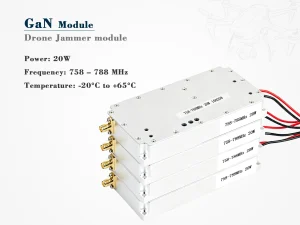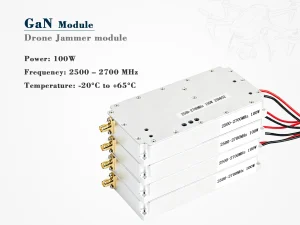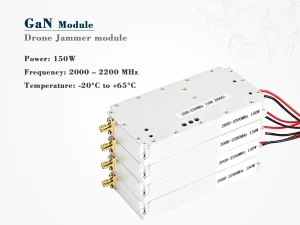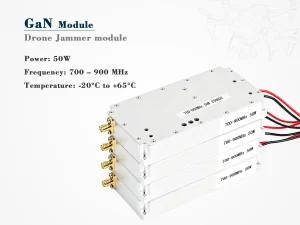
868MHz LoRa FPV jammer module order books are filling faster than suppliers can qualify new production lines, according to procurement sources tracked across European counter-UAS programs in Q3 2025. Lead times for 20 W-class units have stretched to 14–18 weeks, up from 8–10 weeks a year ago.
The shift is not uniform. Low-power evaluation modules remain readily available. The bottleneck sits in higher-power, CE-marked variants that integrators need for fixed-site and vehicle deployments.
This article looks at why 868MHz specifically has become a procurement focal point, what buyers are specifying, and where compliance friction is slowing deliveries.
Why 868MHz Matters for FPV Jamming
The 868MHz band sits inside the European ISM allocation and is widely used for low-power telemetry. Many long-range FPV control links operate here because the band offers a workable balance between range, antenna size and regulatory power limits.
For counter-UAS teams, that creates a specific problem. A jammer tuned for 2.4GHz video or 5.8GHz analogue links will not reliably disrupt an 868MHz control channel. The link budget margins are different, and the modulation is different.
Industry sources describe a shift in threat profiles: more low-cost FPV platforms now pair 868MHz control with alternative video bands. That combination forces defenders to address multiple frequency windows at once.
“We used to see 868MHz as a niche. Now it is on every requirements document we receive,” said a procurement manager at a European systems integrator. “The question is no longer whether to cover it, but how much power and how much band agility we need.”
Inside a 868MHz LoRa FPV Jammer Module: Key Components
A typical module sold to integrators bundles an RF front end, a power amplifier stage, control logic and thermal management. The 868MHz centre frequency affects component selection, filter design and antenna matching.
| Block | 868MHz-Specific Consideration | Buyer Check |
|---|---|---|
| RF front end | Narrowband filtering around 868MHz reduces out-of-band emissions | Confirm 863–870MHz coverage for EU variants |
| PA stage | Lower frequency means larger matching components; GaN offers efficiency gains | Request thermal derating curves |
| Control interface | UART and Ethernet dominate; some buyers want CAN bus for vehicle use | Verify protocol documentation |
| Firmware | Channel masks must allow 868.0–868.6MHz sub-band selection | Ask about signed firmware updates |
| Antenna port | 50-ohm SMA or N-type; VSWR protection is essential | Check VSWR fault reporting |
| Compliance | CE marking under the Radio Equipment Directive | Request RED test summary |
Power Classes and Use Cases
Suppliers currently position 868MHz modules in three rough power tiers. The table below reflects typical buyer intent rather than fixed product categories.
| Power Class | Typical Use Case | Procurement Notes |
|---|---|---|
| 5–10 W | Portable or man-pack evaluation | Often bought in small quantities for trials |
| 20–30 W | Vehicle-mounted and mobile checkpoints | Longest lead times; CE documentation critical |
| 40 W+ | Fixed-site perimeter protection | Requires cold-plate or active cooling design |
Market Signals: Lead Times and Pricing Pressure
Procurement data from European integrators shows uneven supply conditions. Lower-power modules are commoditizing, while higher-power units remain constrained.
| Module Class | Average Lead Time (Q3 2025) | Price Trend (YoY) |
|---|---|---|
| 5–10 W, 868MHz | 4–6 weeks | Flat to slightly down |
| 20–30 W, 868MHz | 14–18 weeks | Up 8–12% |
| 40 W+, 868MHz | 20–26 weeks | Up 15%+ |
Two factors explain the divergence. First, higher-power PA components face broader demand from other RF sectors. Second, CE marking and RED testing add calendar time that cannot be compressed easily.
Compliance and Certification Hurdles
Selling a jammer module in Europe is not a plug-and-play exercise. The Radio Equipment Directive (RED) applies, and enforcement posture varies by member state.
Buyers should expect suppliers to provide:
-
RED test reports covering emissions and immunity
-
Declaration of Conformity with applicable standards
-
RoHS and REACH documentation
-
End-use and export classification statements
One integrator noted that suppliers who treat compliance as an afterthought are being filtered out at the RFQ stage. “We cannot afford to discover a documentation gap after the module is designed into a platform,” the procurement manager said.
Integration Best Practices for 868MHz Modules
Integrators shared several practical lessons from field deployments.
Antenna separation matters more at 868MHz. Longer wavelengths mean physical spacing between jammer and sensitive receivers must be planned early. Retrofits often run into layout constraints.
Thermal design should be validated at sustained duty cycle. Many datasheets quote peak output; real deployments often run at 50–70% duty cycle for extended periods.
Firmware version control is a procurement issue. Buyers should require a documented update path and, where possible, source-code escrow for long-life programs.
Test before you certify. Pre-compliance testing on the integrated platform catches antenna mismatch and enclosure resonance issues before formal RED testing.
For a structured buyer checklist, see our LoRa jammer module selection guide.
What to Ask Suppliers Before Signing
A short list of questions separates mature suppliers from assemblers.
-
Can you provide RED test summaries for the exact 868MHz variant?
-
What is the sustained output power at 25°C and at 55°C ambient?
-
Does the module report VSWR and over-temperature faults over the control interface?
-
What is the firmware update mechanism, and is rollback supported?
-
Can you document second-source qualification for critical PA components?
Buyers who ask these questions early report fewer integration surprises and faster qualification cycles.
Outlook
Demand for the 868MHz LoRa FPV jammer module segment appears set to remain firm through 2026. The constraint is not conceptual interest but qualified production capacity and compliance throughput.
Integrators that lock in suppliers with documented CE files and thermal validation data now will be better positioned when multi-year program requirements harden.