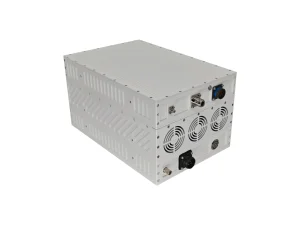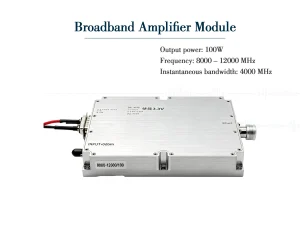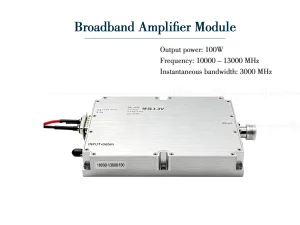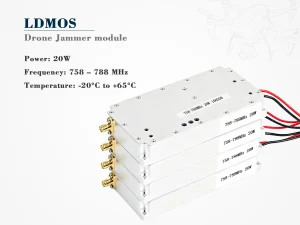
A 5.8GHz drone jammer module is an RF subsystem, not a finished product. It is usually selected for counter-drone projects that need to address 5.8GHz video or control links in authorized environments. The module’s real value depends less on a single power rating and more on how well RF output, filtering, antenna matching, thermal design, and control logic work together. Because RF transmission is regulated in most markets, every design should be reviewed against local spectrum rules before deployment. For the underlying signal-chain logic, see Drone Jammer Module Working Principle.
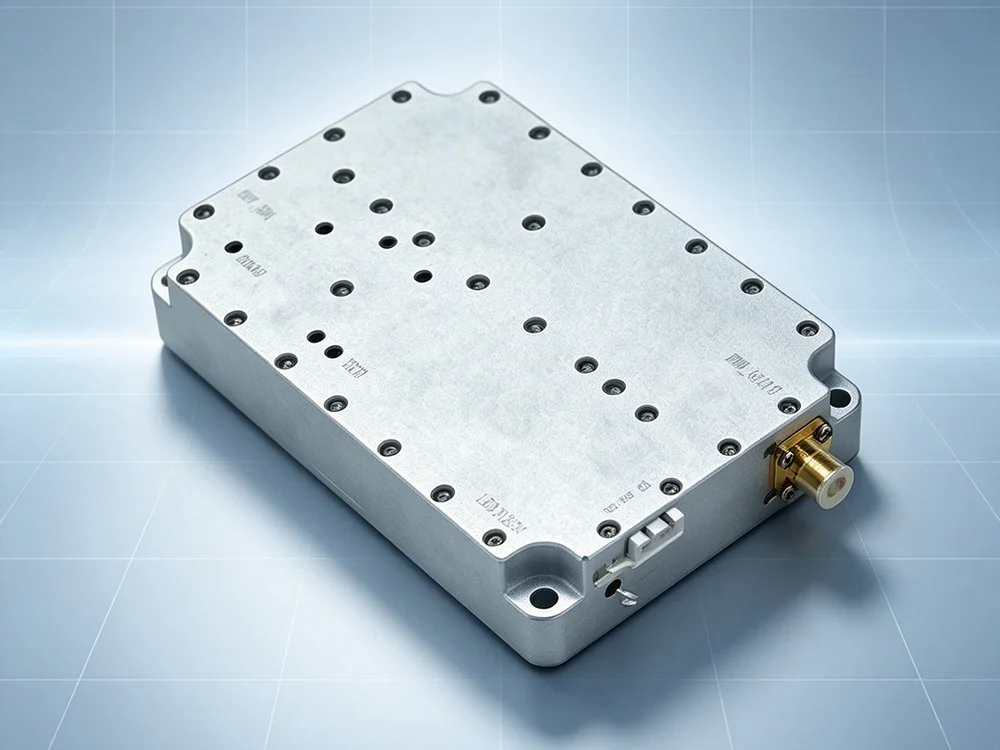
What the Module Does—and Does Not Do
The module concentrates RF energy in the 5.8GHz band to disrupt targeted wireless links. It does not automatically cover other drone bands, and it should not be treated as a universal counter-drone solution. Effective range depends on antenna gain, polarization, environment, output power, receiver sensitivity, and the drone’s link budget. A well-designed module also includes filtering and shielding to limit out-of-band emissions.
Key Integration Variables
| Design Area | What to Verify | Why It Matters |
|---|---|---|
| Frequency coverage | 5.8GHz band plan, channel overlap, band edges | Avoid unintended interference and regulatory violations |
| Output power and gain | Conducted power, EIRP, tolerance, duty cycle | Defines link-budget impact and thermal load |
| PA linearity and efficiency | Harmonics, spurious emissions, heat generation | Affects EMI, reliability, and spectral cleanliness |
| Filtering | Band-pass response, rejection, insertion loss | Reduces out-of-band interference and protects nearby systems |
| Antenna system | VSWR, polarization, beamwidth, cable loss | Poor matching can reduce range and stress the PA |
| Control interface | Enable logic, telemetry, fail-safe behavior | Supports safe operation, logging, and system integration |
| Thermal design | Heatsink size, airflow, derating curve | Sustained output depends on heat removal, not peak specs alone |
A Practical Integration Checklist
-
Confirm the target band plan and applicable regulatory limits before selecting hardware.
-
Match the antenna to the module’s operating band and verify VSWR under real cable and connector conditions.
-
Size the power supply and thermal path for sustained duty cycle, not just short pulses.
-
Test harmonics, spurious emissions, and shielding in a controlled RF environment.
-
Define fail-safe behavior, operator controls, and event logging.
-
Validate performance in authorized test conditions before any field deployment.
Deployment and Compliance Notes
Deployment should be handled by trained operators working within clearly defined legal boundaries. Spectrum monitoring, site surveys, and interference mitigation plans are part of a responsible system design. The module should be integrated into an enclosure with proper grounding, cooling, and labeling. In many jurisdictions, transmitting in protected or licensed bands—or using jammer equipment outside approved scenarios—is illegal. This article is a technical overview, not legal advice or authorization to transmit.
Bottom Line
Choose a 5.8GHz drone jammer module by reviewing filtering, thermal margin, antenna compatibility, control logic, and documentation—not by output power alone. A disciplined integration process reduces RF risk and improves system reliability in lawful, authorized use cases.