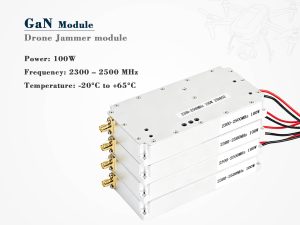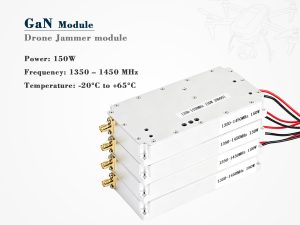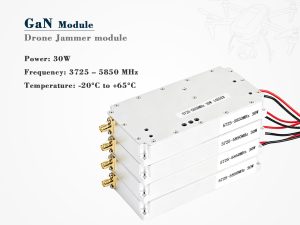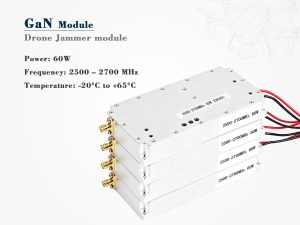
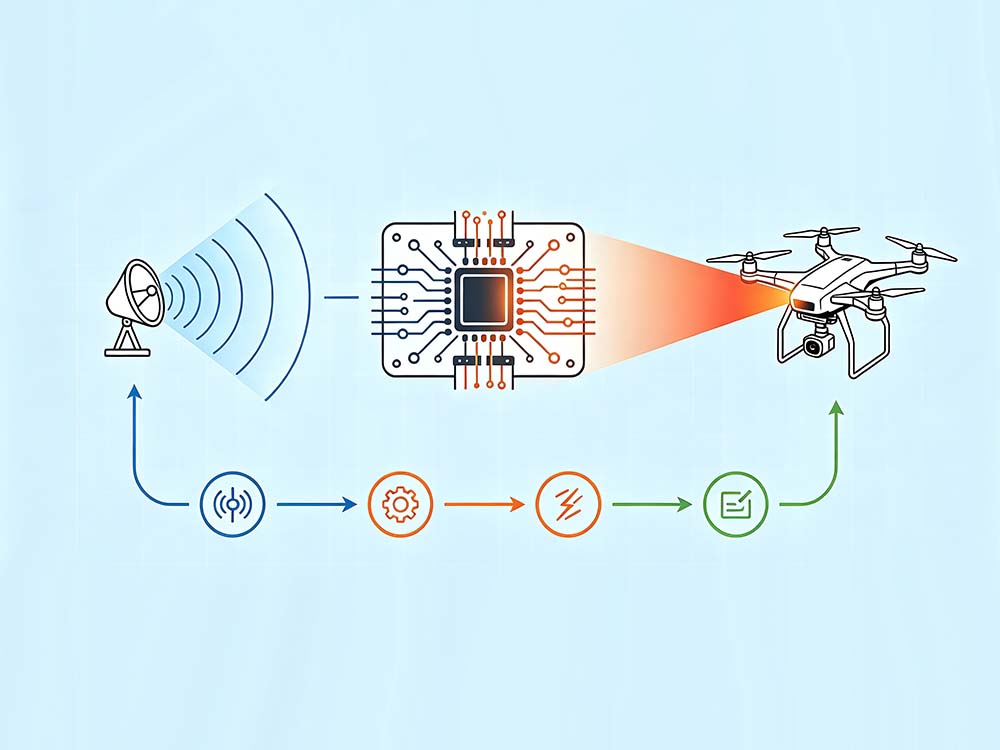
The drone jammer module working principle relies on disrupting the communication links between a drone and its operator. This process involves detecting the drone’s control signal, identifying its frequency, and transmitting interference on the same channel.
What Is the Drone Jammer Module Working Principle?
At its core, the drone jammer module working principle targets three main links: the uplink from controller to drone, the downlink from drone to controller, and GPS navigation signals. By overwhelming these links with noise or false data, the module forces the drone to either hover, return to home, or land.
The module does not need to jam every frequency at once. Instead, it focuses on the specific band used by the target drone. This selective approach reduces power consumption and limits interference with other devices.
Signal Detection and Classification
The module first scans the environment for radio frequency (RF) activity. It looks for known drone bands, such as 2.4 GHz and 5.8 GHz. Once a signal is found, the processor classifies its modulation type, which helps determine the best jamming approach. Modern modules use software-defined radio (SDR) to scan quickly. SDR allows the module to adapt to new drone protocols through software updates.
Jamming Techniques
Different techniques exist. Spot jamming focuses on one frequency. Sweep jamming moves across a range. Barrage jamming covers multiple frequencies at once. Protocol-aware jamming mimics legitimate signals to confuse the drone’s receiver.
Frequency Bands and Power
Most modules cover 2.4 GHz, 5.8 GHz, and GPS L1/L2. Output power per band ranges from 10 W to 100 W. Higher power increases range but also raises the risk of interfering with nearby devices.
| Component | Function |
|---|---|
| RF detector | Scans for drone signals |
| Signal processor | Identifies frequency and modulation |
| Jammer oscillator | Generates noise or false signals |
| Power amplifier | Boosts jamming signal |
| Antenna | Radiates jamming energy |
Step-by-Step Breakdown of the Drone Jammer Module Working Principle
The drone jammer module working principle can be divided into six stages. First, the module monitors the spectrum. Second, it detects a potential drone signal. Third, it classifies the signal’s frequency and protocol. Fourth, it generates a jamming waveform. Fifth, it amplifies that waveform. Sixth, it radiates the signal through a directional antenna. This sequence repeats continuously to maintain disruption.
Key Components and Their Roles
The drone jammer module working principle depends on each component performing its role reliably. The RF detector must have high sensitivity to catch weak signals. The processor needs fast processing power to react in milliseconds. The oscillator must produce stable frequencies. The amplifier must handle high power without overheating. The antenna must match the frequency band for efficient radiation.
Integration with Detection Systems
A jammer module works best when paired with a detection system. Radar, RF scanners, and optical sensors can identify an incoming drone before jamming begins. This reduces the time the jammer is active and lowers the risk of disrupting legitimate communications. Many security teams use a layered approach, combining detection, jamming, and physical countermeasures.
Practical and Regulatory Notes
Deploying a jammer module requires careful planning. In many countries, private use is illegal. Only authorized agencies may operate jammers. Always check local laws before purchasing. The FCC’s jammer enforcement page provides official guidance. For a list of proven hardware, see our guide on top drone jamming modules for security. For detailed specs, read our article on drone jammer module specifications.
In summary, the drone jammer module working principle combines detection, classification, and targeted interference. Understanding this process helps security teams select the right equipment and deploy it legally and effectively. When evaluating a module, consider frequency coverage, output power, and duty cycle. These factors determine whether the module can handle the expected threat. Always prioritize legal compliance and coordinate with authorities before deployment.