The Problem

A People’s Liberation Army unit stationed outside Xi’an runs one of the most active counter-drone training and testing programs in the region. Their inventory already included hand-held drone guns, vehicle-mounted directional jammers, and a handful of fixed rooftop systems protecting sensitive buildings. The equipment worked, but it was aging — mostly early-generation RF chains built around narrow bands and discrete amplifiers that were becoming less reliable.
The real trigger for the upgrade came when they started facing newer drones. These weren’t just 2.4 GHz and 5.8 GHz off-the-shelf models. They included drones using lower UHF bands for command and control, plus a growing number of 3.5 GHz platforms. The unit’s existing jamming modules couldn’t touch those frequencies. Rather than buying entirely new guns, trucks, and fixed mounts, the unit’s technical officer put out a clear requirement: source modern RF modules we can physically drop into our existing platforms. Same connectors, same DC rails, same control interface — just a lot more frequency coverage and higher reliability.
That’s where we came in.
The Order
We worked with the unit’s procurement team and their designated systems integrator over the course of several weeks, going back and forth on frequency allocations, power budgets, and thermal limits inside their legacy enclosures. The final order came through as five module types, 50 units each — 250 modules in total.
Here is exactly what shipped:
| Model | Frequency Range | RF Power | Quantity |
|---|---|---|---|
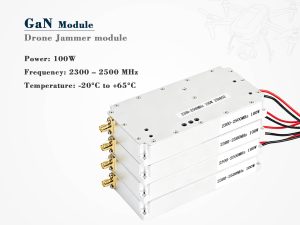
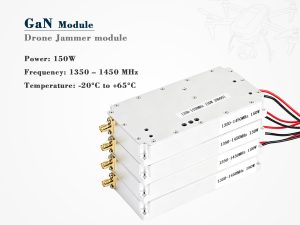
| High-power L-band jammer module | 840–1000 MHz① | 100 W | 50 |
| Wideband GaN jammer module | 720–1020 MHz② | 50 W | 50 |
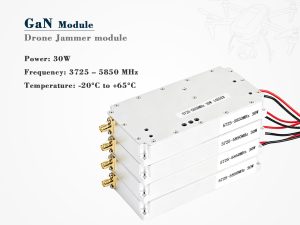
| LDMOS C-band jammer module | 5725–5850 MHz③ | 50 W | 50 |
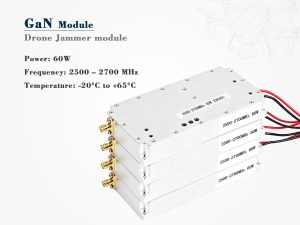
| GaN VHF jammer module | 135–175 MHz④ | 60 W | 50 |
| Mid-band jammer module | 3400–3600 MHz⑤ | 20 W | 50 |
Each module came in a standard sealed aluminum chassis with mounting flanges, SMA output ports, DC input (24–48 V), and an RS-485 control bus. No fans, no air intakes. The control protocol was our usual plain-text ASCII command set: ARM, DISARM, STATUS, and a few diagnostic queries. The modules were all designed to switch on in under 500 nanoseconds once a command hit the serial port.
The Integration
The 250 modules were split across three platform types the unit already operated.
Drone guns (hand-held). The unit had roughly 30 directional jammer guns. Each gun was essentially a rifle-style housing with a battery pack, a trigger, and a small electronics bay in the front grip. We mated one 840–1000 MHz 100 W module and one 5725–5850 MHz 50 W module into each gun, replacing the old single-band amplifiers. The integrator designed a small aluminum bracket that held both modules stacked, fed by the existing 36 V battery bus. The trigger signal, which used to directly switch a power FET, now went into a tiny microcontroller that translated it into an ARM command on the RS-485 line. The guns gained two new frequency bands and an extra 3 dBm of effective radiated power, all without changing the gun’s external dimensions.
Vehicle-mounted systems. About 12 tactical vehicles had roof-mounted pan-tilt jamming units. These units already had space for two amplifier modules and directional antennas. The integrator replaced the original modules with one 720–1020 MHz 50 W GaN module and one 3400–3600 MHz 20 W module per vehicle. The 3.5 GHz band was a completely new capability they’d never had before. On a few command vehicles, they also added the 135–175 MHz 60 W GaN module to cover low-VHF drone control links that are common in certain imported drone models.
Fixed-site installations. The remainder of the modules — especially the high-power 100 W 840–1000 MHz units and additional 5725–5850 MHz LDMOS modules — went into weatherproof enclosures on the rooftops of four key buildings inside the base. These fixed nodes were tied into the base’s existing radar-triggered perimeter system, essentially the same architecture used in other sites: the radar identifies a threat, the command system sends an ARM command over fiber to the appropriate node, and the jammer module activates within a fraction of a second.
What the Testing Showed
After the integration was complete, the unit ran a three-week evaluation, throwing every drone platform in their inventory at the upgraded systems. We received a redacted summary of the results that we are allowed to share.
-
Across all three platform types, more than 60 drone sorties were flown in test scenarios. 58 out of 60 were successfully jammed, either forcing an immediate return-to-home or a controlled landing inside a designated safe zone.
-
The two failures were traced to a loose SMA connection on a vehicle system on day one, which was tightened and never repeated.
-
The new frequency bands — especially 3400–3600 MHz and 135–175 MHz — were the key enabler in 14 sorties where the older modules would have had no effect.
-
On the fixed-site installations, the system demonstrated an average response time of 1.6 seconds from radar trigger to jamming signal on target, with no interference to the base’s own UHF and VHF communication nets.
The officer in charge of the testing sent us a short note that concluded: “The module-level approach saved us at least 18 months and 40% of the budget compared to procuring new integrated systems. The ability to bring up completely new frequency bands inside our existing chassis is a force multiplier.”
Why This Matters
This project wasn’t about our company shipping a finished product. It was about delivering a specific capability in a form factor that someone else had already designed for. The unit’s technicians handled the mechanical integration. Their software team wrote the control logic. We just made sure the RF module would fire up every single time they sent an ARM command, in whatever enclosure they put it in, across a frequency range that most off-the-shelf jammers don’t cover.
And because the drone jammer modules are built around GaN and LDMOS technology with no moving parts, the unit’s maintenance chief told us he expects the amplifiers to outlast the rest of the gun and vehicle electronics. When new drone threats appear — and they will — the unit can swap in a module for a new band without recertifying the whole platform. That’s the kind of future-proofing military procurement teams rarely get.