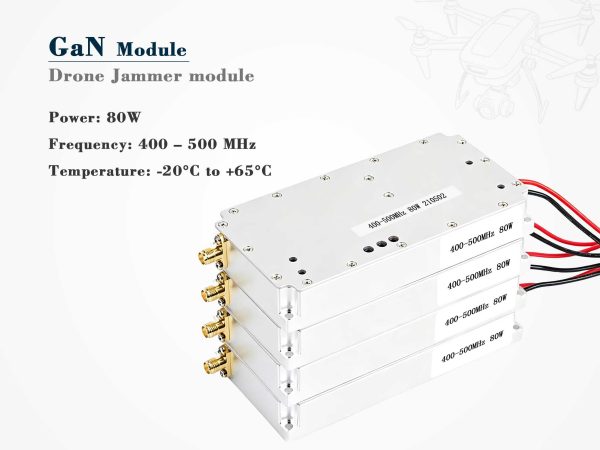
80W 4800–5000MHz Drone Jammer Module with VSWR Protection
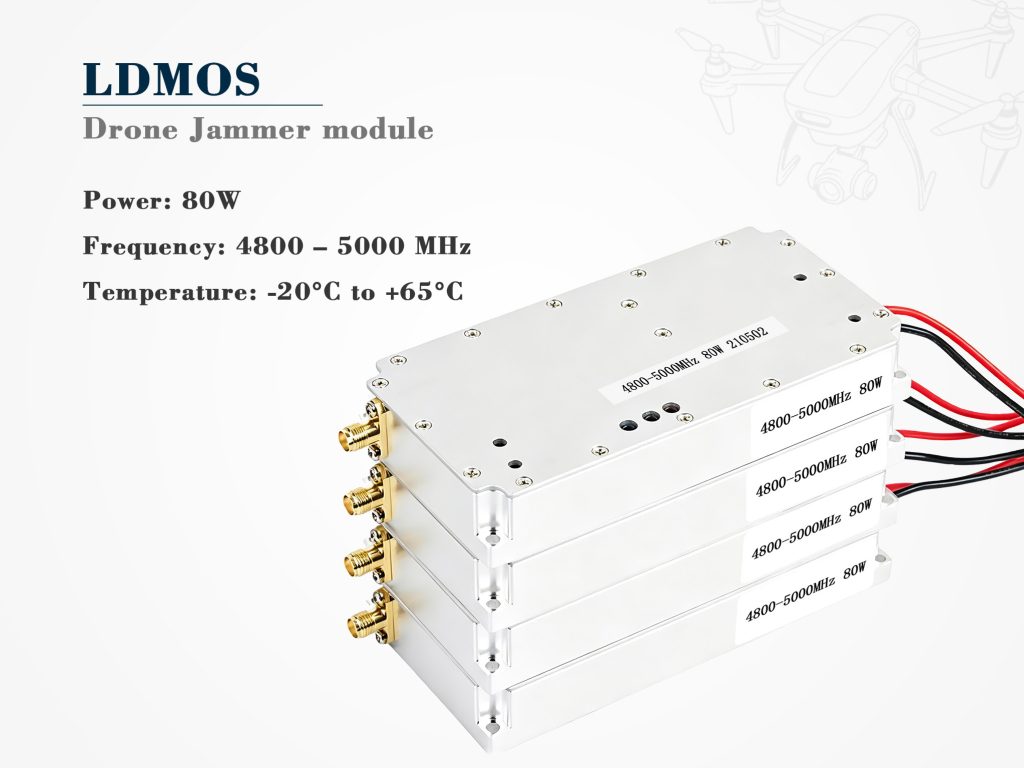
80W drone jammer module for 4800–5000MHz with built‑in analog sweep and absorptive VSWR protection. DC 24–29V, 10A, SMA out, 168×84×23mm. Heavy‑duty counter‑UAS.
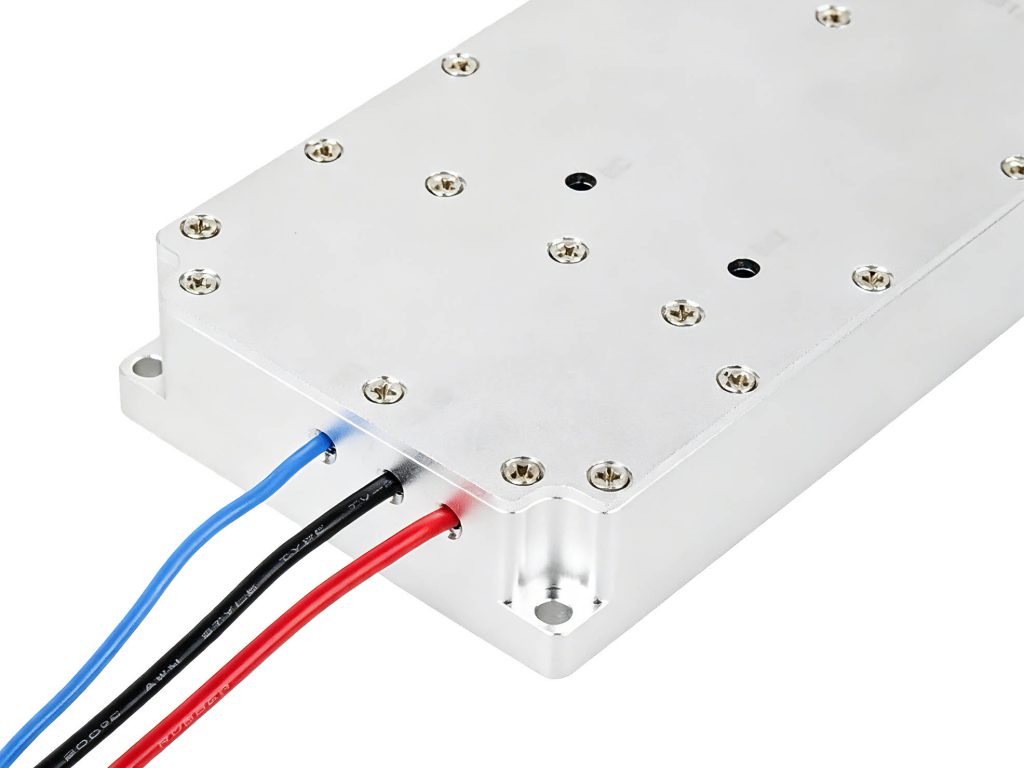
Technical Specifications
| Parameter | Specification | Notes |
| Frequency range | 4800 – 5000 MHz | Full 200 MHz coverage |
| Output power | 80W (typical) | Measured at 50Ω load, 26V supply |
| Supply voltage | DC 24V – 29V | Nominal 26V recommended |
| Current draw | ≤ 10.0A | At maximum output power |
| Modulation source | Built‑in high‑speed analog sweep | VCO‑based, no external generator |
| Analog scan speed | > 50 MHz/ms | Covers band in < 4 ms |
| Input / output impedance | 50Ω (RF output) | Control input is high‑impedance TTL |
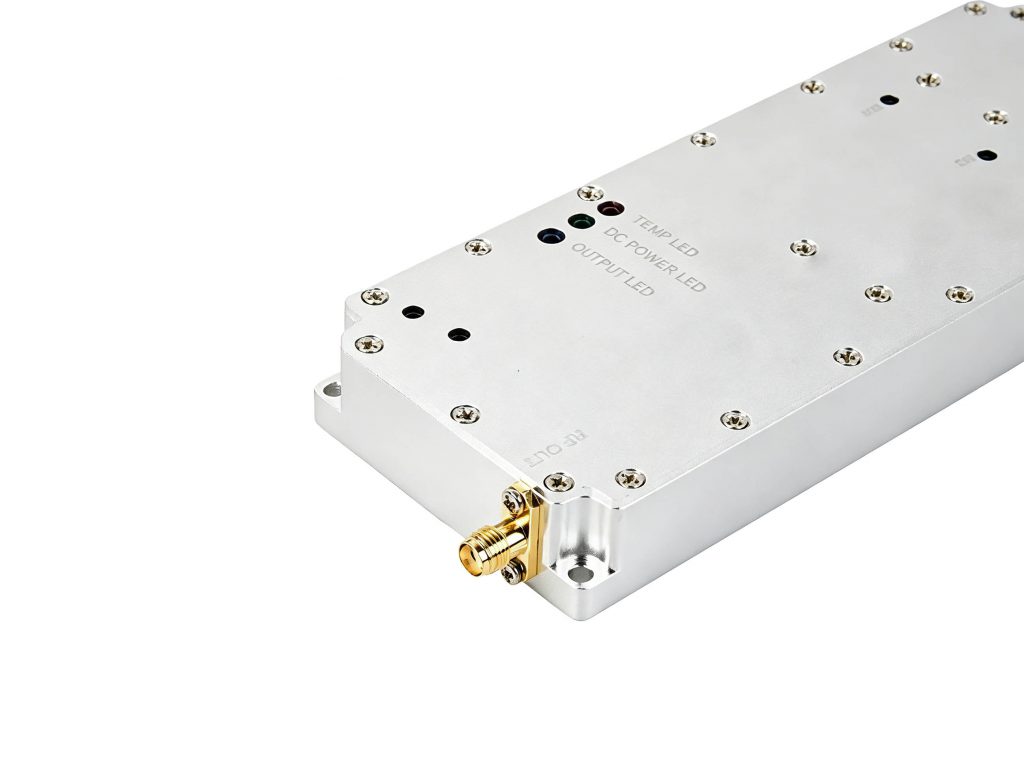
| Protection LEDs | Built‑in absorptive VSWR protection; over‑temp & over‑current (internal) | No external LED pins – protection is automatic and self‑resetting |
| Operating temperature | -20°C to +65°C | Ambient, with adequate heatsinking |
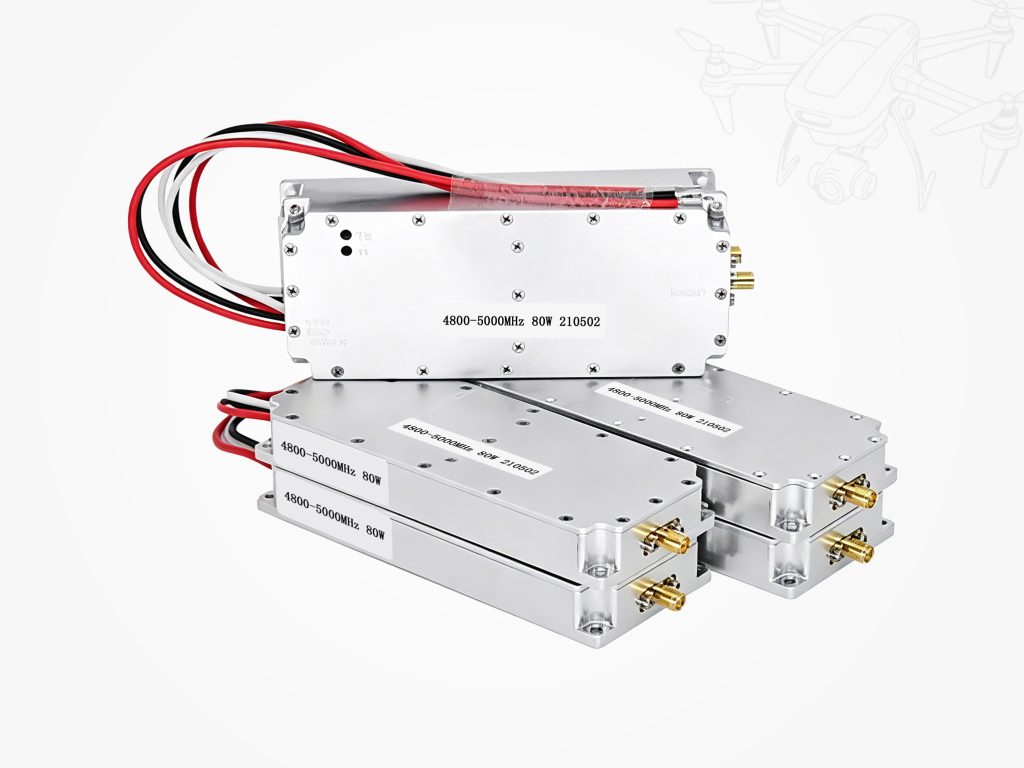
| Dimensions (L×W×H) | 168.5 × 84.5 × 23 mm | Excluding connectors and mounting tabs |
| Weight | 0.57 kg | Approximately |
| Base material | Aluminium alloy (6061) | Provides thermal spread and structural strength |
Product Details
Why 4.8–5.0GHz Is the New Frontier in Drone Jamming
If you’ve been tracking the drone industry lately, you’ll know that 4.8–5.0GHz is rapidly becoming a crowded neighbourhood. More and more drone manufacturers are shifting their high‑definition video downlinks and command links into this range – especially for 5G‑based telemetry and beyond‑visual‑line‑of‑sight operations. The band sits right between the classic 2.4GHz control and 5.8GHz video frequencies, offering a sweet spot for bandwidth and propagation that’s hard to ignore. Some modern military and industrial drones are also using this spectrum for secure data links, making it a critical target for any comprehensive counter‑UAS system.
This drone jammer module covers the entire 4800–5000MHz band with a genuine 80W of swept interference. It’s a purpose‑built solution for operators who need to shut down drone links in this increasingly important frequency range.
80W of Raw Jamming Power
Eighty watts is not messing around. With a 12–15dBi directional antenna, this module can reach effective jamming distances of 1 kilometre or more in open terrain – often pushing 1.5 kilometres under good line‑of‑sight conditions. That kind of reach is essential for protecting large perimeters, whether you’re securing an airfield, a military base, or a sprawling industrial complex.
The module draws roughly 10A at 26V, translating to about 260W of DC input. With an efficiency of ≥35%, you get that 80W of RF output – and the rest is heat. At 35% efficiency, this unit runs a bit warmer than the 40% units we offer in other bands. It’s physics: wider bandwidth and higher power come with some trade‑offs. We’ll get into thermal management shortly, but the short of it is – this module needs proper cooling, no shortcuts.
Built‑In Absorptive VSWR Protection – a Non‑Negotiable Feature
This drone jammer module includes built‑in absorptive VSWR protection, which is essentially an internal isolator that absorbs reflected power from antenna mismatches. Why does that matter? If your antenna gets knocked out of alignment, damaged, or disconnected while the module is running, the reflected power can destroy the amplifier stage in milliseconds. The protection circuit absorbs that reflected energy and dissipates it as heat inside the module, keeping your expensive output transistors safe. It’s a feature you don’t appreciate until you need it – and when you do, it’s a lifesaver.
The specified output VSWR is ≤2.0, which is standard for a broadband amplifier in this power class. Even if the load swings beyond that, the protection circuitry automatically kicks in. No external monitoring, no manual intervention – it just works.
Control and Integration – Simple and Predictable
Despite the high power, the control interface remains refreshingly simple. A +5V or floating input turns the module on; grounding it turns it off. You can drive it from a GPIO pin, a mechanical toggle switch, or a relay. No serial protocols, no I²C, no firmware headaches.
The RF output is a standard SMA female connector, compatible with any 50Ω antenna or external filter. Since the module has its own internal sweep source, you don’t need to feed an external RF signal – just connect the antenna, apply power, and you’re jamming.
Power supply requirements are straightforward: DC 24–29V, with a current capability of at least 12A to provide headroom. This range covers 6‑cell Li‑ion battery packs, lead‑acid batteries, and industrial power supplies. For portable applications, you’ll need a substantial battery – but that’s what it takes to deliver 80W.
Size, Weight, and Build Quality
At 168.5 × 84.5 × 23mm and 0.57kg, this module is solid without being unwieldy. It’s larger than our 20W units, but it’s still remarkably compact for 80W of RF power. The aluminium baseplate (6061 alloy) doubles as a heat spreader, and mounting holes are provided for secure attachment to a heatsink or chassis.
The weight increase to 0.57kg (compared to 0.55kg for the 3.5GHz version) reflects the broader bandwidth and slightly different internal layout. It’s a well‑built unit that feels substantial in hand – the kind of quality you expect from a professional‑grade jammer module.
Thermal Management – No Compromises
Let’s be real – 80W amplifiers generate serious heat. At 35% efficiency, you’re dissipating nearly 170W of waste heat. Without a heatsink, you might get 5–8 seconds of operation before the internal over‑temperature protection shuts you down. With a substantial passive heatsink (say, 200×100×40mm with fins), you can run a 30% duty cycle – 30 seconds on, 60 seconds off. Add a high‑airflow fan, and continuous operation is achievable, provided the heatsink temperature stays below 65°C.
The drone jammer module includes internal over‑temp and over‑current protection. There are no external LED indicators – the protection trips automatically and resets once conditions return to normal. It’s a self‑preserving design that won’t let you destroy the module through thermal neglect.
The Sweep Advantage – Fast and Thorough
The internal analog VCO sweeps the entire 4800–5000MHz band at speeds exceeding 50MHz per millisecond. That means the whole 200MHz range is covered in under 4 milliseconds. Against frequency‑hopping drones, this is devastating – the jammer cycles through every possible channel so rapidly that the drone can’t maintain a stable link on any frequency. This isn’t a single‑point jammer; it’s a true broadband denial system that adapts to whatever the drone throws at it.
Who Should Use This Drone Jammer Module?
This drone jammer module is for serious operators – defence contractors, government security teams, and large‑scale integrators who need to counter drone threats in the 4.9GHz band. It’s also suitable for R&D labs testing drone resilience against high‑power jamming. The 4800–5000MHz range is particularly relevant for modern 5G‑based drone operations, so if you’re dealing with that class of threat, 80W is the right tool for the job.
Final Thoughts
The 80W 4.8–5.0GHz drone jammer module is a heavy‑duty solution for a frequency band that’s only going to get busier. The combination of raw power, built‑in VSWR protection, integrated sweep source, and straightforward control makes it a reliable workhorse for demanding counter‑UAS applications. Yes, it needs proper cooling – but if you give it that, it’ll deliver day in and day out.
Frequently Asked Questions
Case Studies
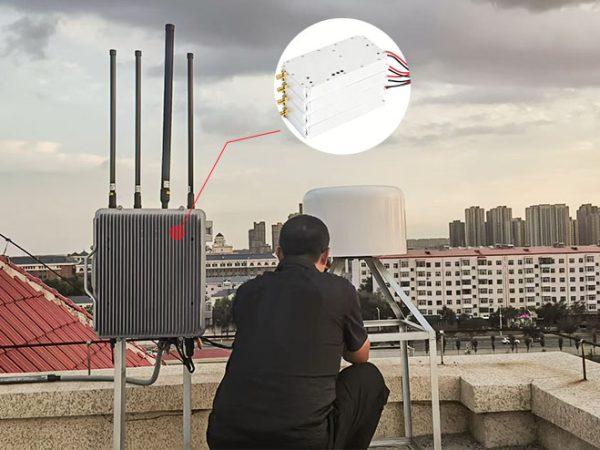
Heilongjiang Weather Center Completes Anti-Drone System Upgrade with Three High-Power Drone Jammer Modules

Tangshan Chem Plant Sealed Drone Gaps With 3 GaN Wideband Modules

How a National Prison Integrated Our Drone Jamming Module Into Their Fixed Counter-Drone System

Integrating Core RF Power: OEM Drone Jamming Module for Oil Refinery Security | Case Study
Send Us a Message
Related Products
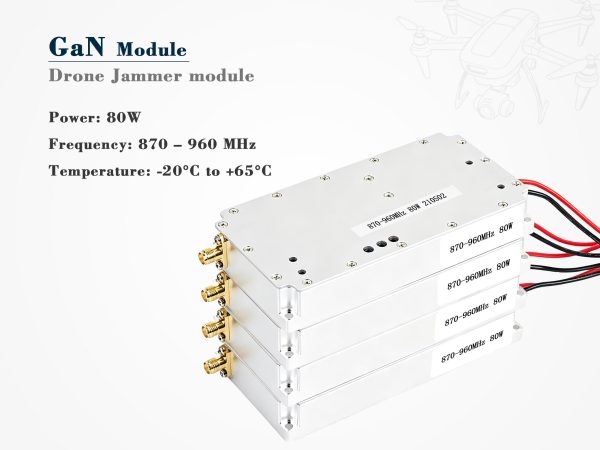
80W GaN Drone Jammer Module 870–960MHz | Analog Sweep
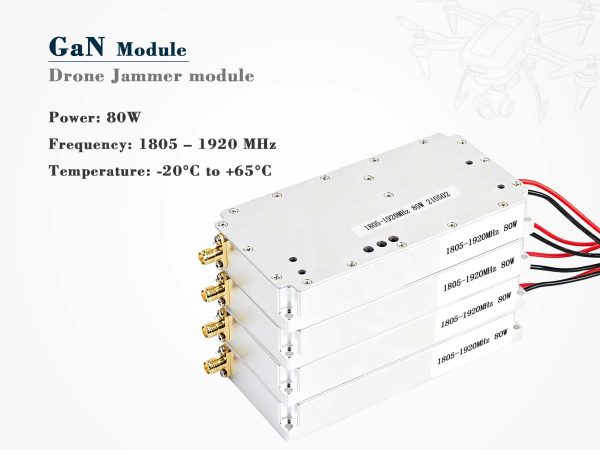
80W 1805–1920MHz GaN UAV Countermeasure Jammer Module
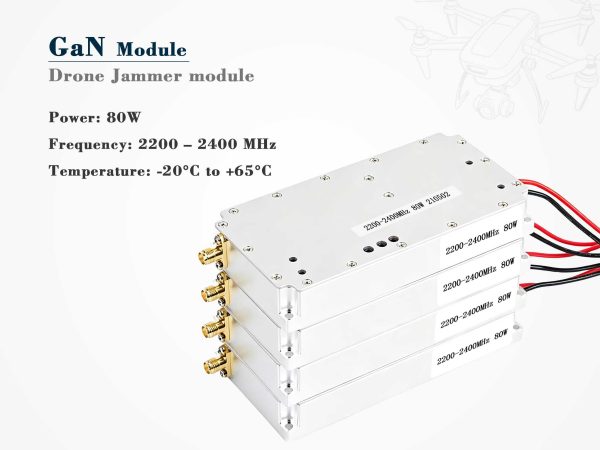
80W GaN Jammer Module: Powerful 2200–2400MHz Counter-UAS Solution