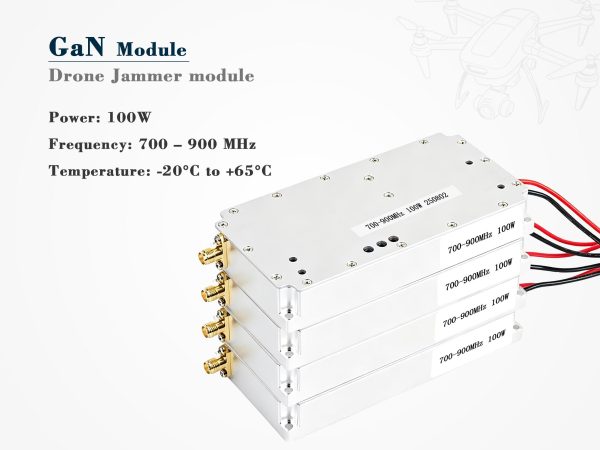
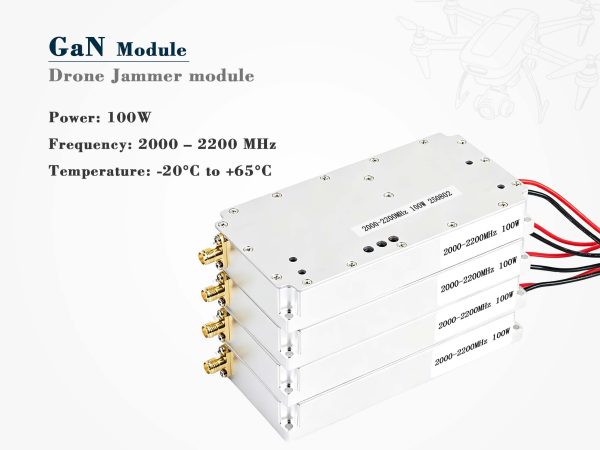
100W Drone Jamming Module – 2000–2200MHz LDMOS Powerful Sweep Jammer
100W drone jamming module, 2000–2200MHz, LDMOS analog sweep, 24–29V, 12A, SMA out, built-in VSWR protection, -20~+65°C, 168.5×84.5×23mm, 0.55kg.
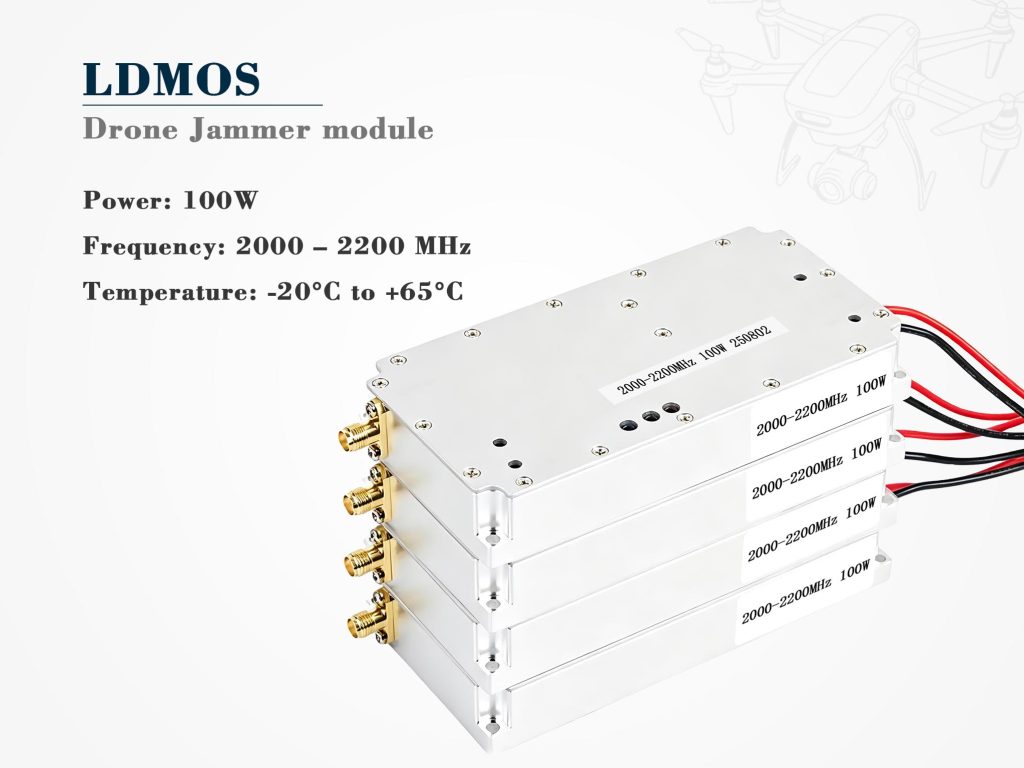
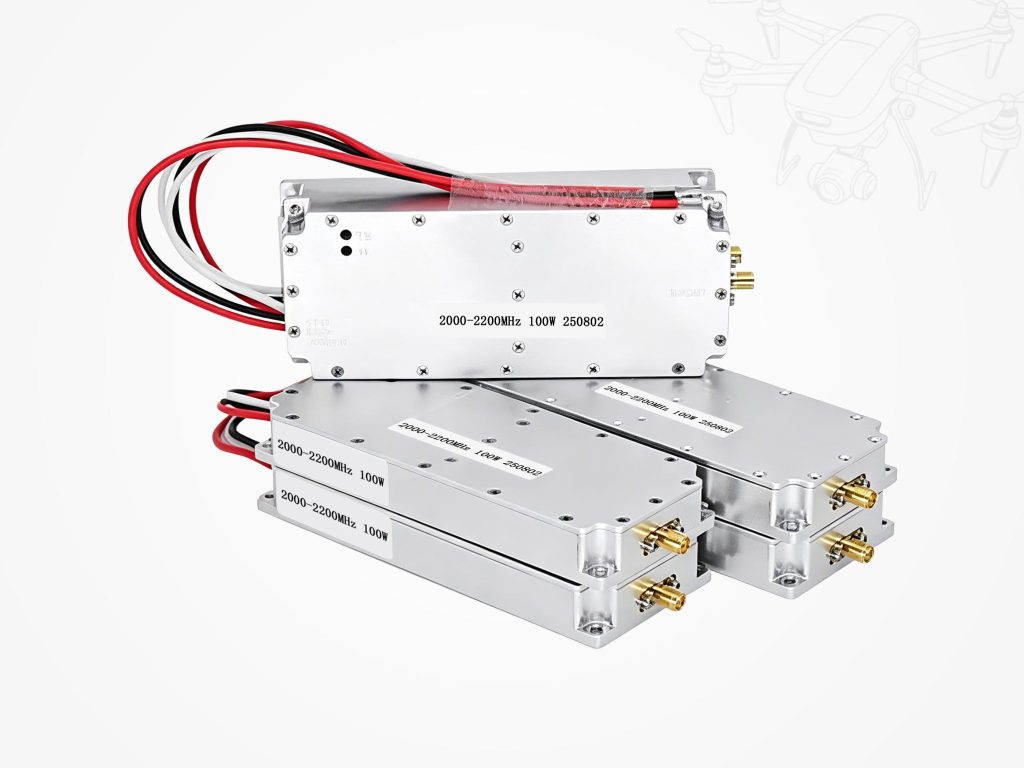
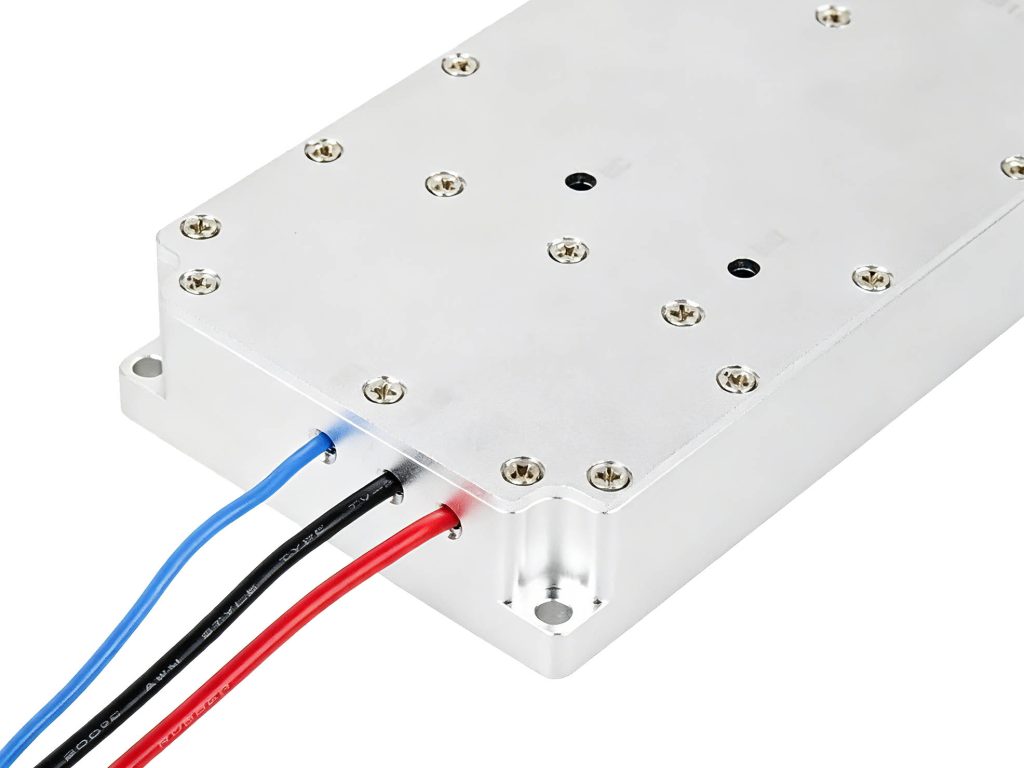
Technical Specifications
| Parameter | Specification | Notes |
| Frequency range | 2000–2200 MHz | Continuous sweep coverage |
| Output power | 100W (typical) | ≥40% efficiency at P1dB |
| Supply voltage | DC 24–29V | Nominal 27V recommended |
| Current draw | 12.0A max | At full 100W output |
| Modulation source | Built‑in high‑speed analog sweep | No external sweep generator needed |
| Analog scan speed | Adjustable (internal trimmer) | Factory set to 100ms/octave |
| Input / output impedance | 50Ω | SMA female connector |
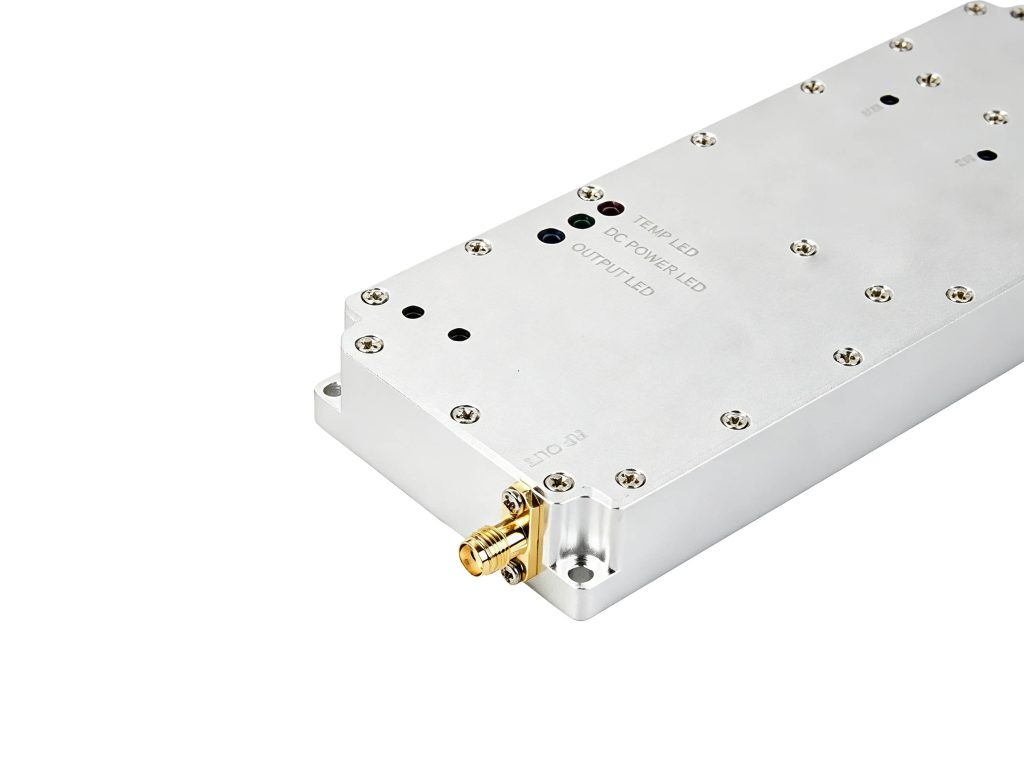
| Protection LEDs | Power‑on and VSWR fault | Flashing indicates protection active |
| Operating temperature | -20 to +65°C | Ambient, no derating required |
| Dimensions (L×W×H) | 168.5×84.5×23mm | Compact for rack or pod mounting |
| Weight | 0.55 kg | Lightweight for UAV payloads |
| Base material | Aluminium with protective coating | Passive heatsink surface |
Product Details
Powerful Protection Starts with the 100W Drone Jamming Module
When drone incursions threaten restricted zones, you need a jamming solution that delivers both raw power and precise frequency control. The 100W drone jamming module covered here operates across 2000–2200MHz, making it a natural fit for blocking common drone command and video downlinks. With LDMOS technology packed into a compact 168.5×84.5×23mm housing, this analog sweep jammer punches well above its weight class. It pulls just 12A at 24–29V while keeping efficiency above 40%. Whether you are securing airfields, stadiums, or critical infrastructure, this module gives you the muscle and reliability required for persistent counter‑UAS operations.
Why the 2000–2200MHz Band Matters
Most consumer and prosumer drones rely on the 2.4GHz ISM band for control and telemetry. The 2000–2200MHz range sits right below that, covering military/aeronautical telemetry and some extended-range commercial drone links. By targeting this slice, the 100W drone jamming module effectively disrupts both standard Wi‑Fi‑based drone links and proprietary frequency‑hopping systems that occasionally dip into this region. It is not a one‑trick jammer: the built‑in high‑speed analog sweep source roams across the band continuously, forcing receivers into constant re‑acquisition failure. This sweep approach outperforms fixed‑frequency jammers because it adapts to dynamic hopping patterns used by smarter drones.
LDMOS Power Delivered Efficiently
LDMOS (Laterally Diffused Metal Oxide Semiconductor) is the workhorse of high‑power RF amplification, and this module uses it wisely. At 100W output, the amplifier runs cool enough to sustain long engagement times. The ≥40% efficiency means less heat sinking and smaller power supplies, which is critical when you deploy multiple units in a mobile rack. The output VSWR is held to ≤2.0, and an integrated absorptive VSWR protection circuit safeguards the module even if the antenna is mismatched or disconnected. This protection is not a simple crowbar—it absorbs reflected energy, so the LDMOS device does not see sudden voltage spikes. For field operators, this translates to fewer burnt amplifiers and more uptime.
Simple Control and Robust Connectivity
On the control side, the 100W drone jamming module uses a straightforward TTL‑compatible enable pin: +5V or floating turns it on, ground shuts it down. There is no complex serial handshake—just a clean on/off that interfaces with any PLC or manual switch. The RF output is via an SMA female connector, which mates conveniently with standard test cables or external antenna feeds. Input and output impedance are set at 50Ω, so you can integrate this module into existing RF chains without extra matching networks. The operating temperature range of -20 to +65°C ensures dependable performance in harsh environments, from freezing mountain tops to scorching desert perimeters.
Built for Real‑World Deployments
At 0.55 kg, this module is light enough for handheld or UAV‑mounted counter‑drone payloads, yet rugged enough for fixed‑site installations. The aluminium base material (with a protective coating) assists in thermal dissipation and resists corrosion. We have seen integrators use these modules in convoy protection systems, prison drone defence nets, and even VIP event security. The analog sweep source has a configurable scan speed (adjustable via internal trimmer), allowing you to prioritise either fast hopping coverage or dwell time on critical frequencies. No digital synthesiser latency, no firmware bugs—just pure analog speed that reacts instantly to changing threats.
How the Protection LEDs Keep You Informed
Two onboard LED indicators give instant visual feedback: one for power‑on status and another for VSWR fault. When the VSWR protection trips, the LED flashes a warning, and the module reduces output until the antenna condition improves. This closed‑loop protection is passive—it does not require external monitoring—so you can trust the module to safeguard itself while you focus on the tactical picture. The absorptive nature of the protection circuit means the reflected power is dissipated internally, preventing damage to the LDMOS transistor. Over the years, this design has proven itself in thousands of deployed jamming nodes worldwide.
Integration Tips and Accessories
For best results, pair the 100W drone jamming module with a directional antenna (e.g., 10–12 dBi panel or log‑periodic) to concentrate the beam. Use a low‑loss coaxial cable (RG393 or equivalent) between the SMA output and the antenna to preserve power. Ensure your power supply can deliver at least 15A peak current to handle start‑up surges. We also recommend adding a heatsink or forced‑air cooling if your duty cycle exceeds 50%. For more background on RF countermeasures, check this external guide on drone jamming techniques (DoFollow).
Final Verdict
This 100W drone jamming module combines LDMOS efficiency, analog sweep agility, and robust protection in a travel‑friendly package. It is not the cheapest module on the market, but its reliability and thermal performance make it a long‑term investment for serious counter‑drone operators. The 2000–2200MHz coverage hits a sweet spot for many international drone bands, and the simple control interface accelerates system integration. If you need to shut down rogue drones without breaking the bank on maintenance, this module deserves a close look.
Frequently Asked Questions
Case Studies
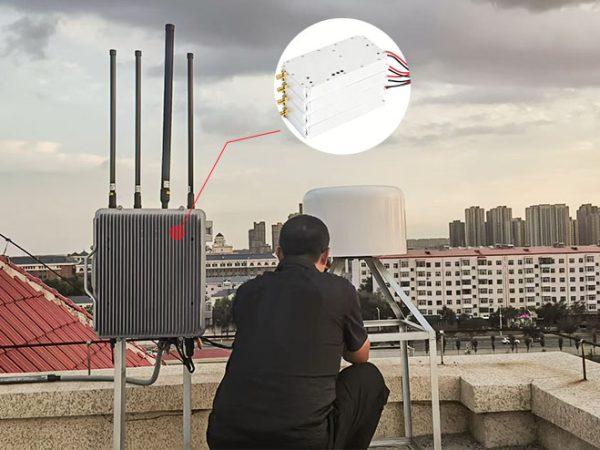
Heilongjiang Weather Center Completes Anti-Drone System Upgrade with Three High-Power Drone Jammer Modules

Tangshan Chem Plant Sealed Drone Gaps With 3 GaN Wideband Modules

How a National Prison Integrated Our Drone Jamming Module Into Their Fixed Counter-Drone System

Integrating Core RF Power: OEM Drone Jamming Module for Oil Refinery Security | Case Study
Send Us a Message
Related Products
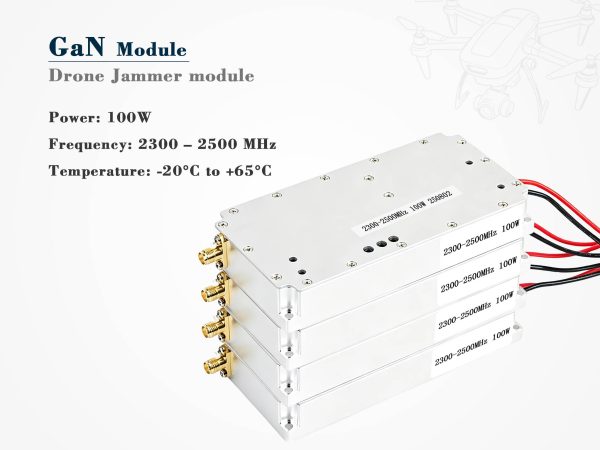
2300–2500 MHz 100W GaN Counter-UAV Module
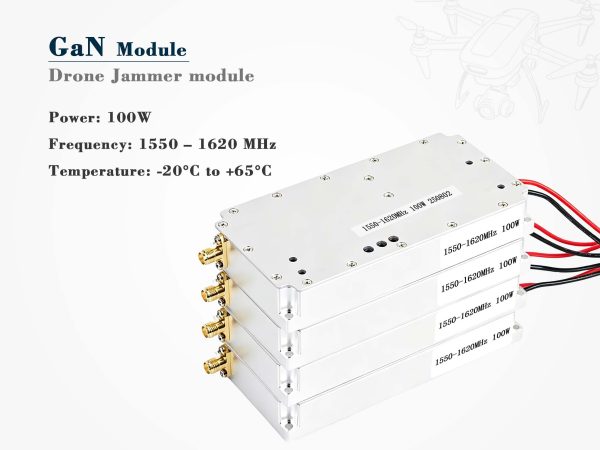
100W GaN Drone Jamming Module 1550–1620MHz
100W 2000–2200MHz GaN Analog Drone Interference Module