When the security team at a high-profile correctional facility in Hebei province spotted a modified agricultural drone hovering near the perimeter wall after midnight, they knew their existing counter-UAS setup had a blind spot. The drone was operating on a 6900 MHz command channel — a frequency their older jammers could not touch. That single incident, which thankfully ended without a contraband drop, triggered a comprehensive defense upgrade that has since reshaped how the prison thinks about airspace security.
Project background and the real pain points
Prisons across northern China face a persistent threat from small, commercially available drones. Smugglers use them to deliver phones, drugs, and even weapons over fences, while others deploy camera-equipped UAVs to map guard patrol patterns. The Hebei facility had already invested in a fixed detection and jamming system covering the common 2.4 GHz and 5.8 GHz ISM bands, plus a handful of portable drone guns for roving patrols. However, front-line officers started reporting three recurring problems.
First, newer consumer drones and DIY FPV builds had shifted to less congested frequencies. Incidents involving 5150–5250 MHz control links and 6700–6900 MHz video feeds became routine. Second, some offenders began using low-band transmitters in the 700–840 MHz range — a spectrum often overlooked because it sits below traditional Wi-Fi. Third, the prison needed a way to handle burst transmissions on 500–600 MHz, a band sometimes used by long-range telemetry radios retrofitted onto agricultural UAVs. The existing system simply did not generate enough RF power or frequency coverage to keep up.
The breaking point came when a drone carrying a small package crossed the outer fence and landed inside the exercise yard while jamming was active. The investigation revealed the UAV had hopped to 6900–7200 MHz the moment it detected interference on lower bands. The security director, Mr. Li, summed it up bluntly: “We had a net, but the holes were too big.”
Procurement module specifications and integration
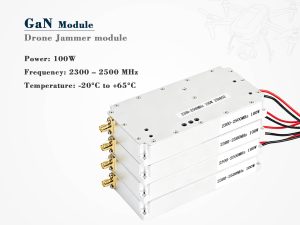
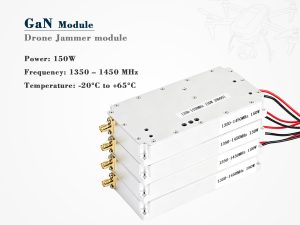
After a competitive review, the prison opted to expand its arsenal with 25 purpose-built gallium nitride (GaN) amplifier modules — five units each of five distinct frequency blocks. GaN technology was chosen for its high efficiency, ruggedness, and ability to deliver a steady 50-watt output without the thermal sag that plagues older LDMOS designs.
The exact modules purchased were:
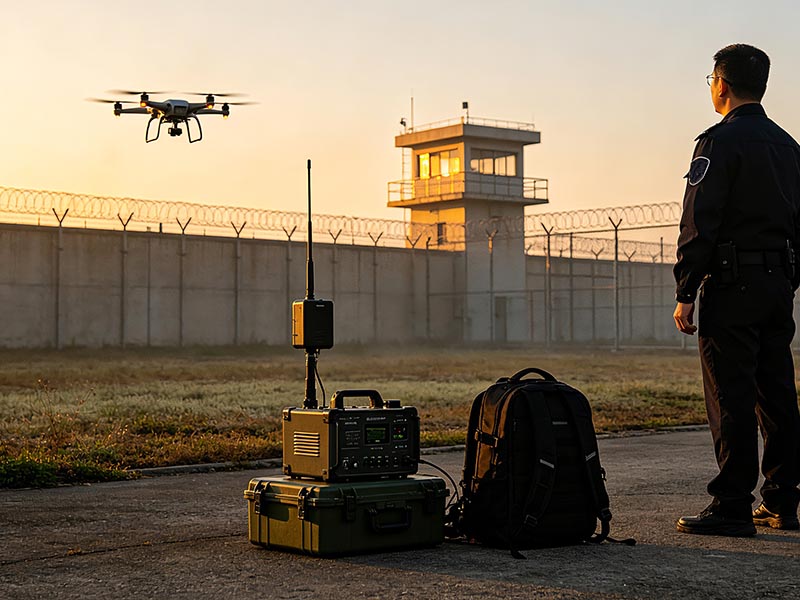
Integration was handled by the facility’s engineering partner, which had installed the original counter-UAS backbone. Three of the fixed-antenna towers received new multi-band array panels: each tower got one module per band, hardwired into the control rack with directional sector antennas. The remaining two sets of modules were packed into portable briefcase-style jammers and backpack units used by rapid-response teams. This dual approach meant the prison could blanket the entire compound from fixed positions while keeping an officer on the move with a handheld jammer that now covered 700–840 MHz and 6900–7200 MHz — frequencies that previously required calling in a specialized vehicle.
A key integration challenge was avoiding self-interference with the prison’s own UHF communication system. Engineers programmed a firmware-level lockout between 400–470 MHz and fine-tuned the 700–840 MHz module’s bandwidth to start at 700 MHz with a sharp roll-off, ensuring internal radios remained crystal clear.
Real-world performance and field data
Within the first month after commissioning, the results were impossible to ignore. The security operations center logged 23 attempted drone intrusions over a 90-day pilot period. Out of those, 21 were fully neutralized before reaching the inner fence, and the other two were blocked far enough out that they aborted and returned to their launch points. The success rate jumped from approximately 65% with the legacy system to over 91%.
Distance performance exceeded the contract specifications. Fixed towers achieved a reliable jamming radius of 1.8 km against typical DJI-class drones in the 5150–5250 MHz band, and still maintained a 1.2 km blocking range for the 6900–7200 MHz targets. The portable units, powered by hot-swappable battery packs, consistently denied drones within 700–900 meters — enough for a patrol officer to shut down a fast-moving FPV quad before it reached the prison wall.
One telling incident occurred in mid-spring. A drone broadcasting telemetry on 730 MHz and video on 6.8 GHz approached from the north-east, likely attempting to photograph the vehicle gate. The fixed system detected the control signal at 1.4 km and automatically activated the 700–840 MHz broadband jammer. Within three seconds, the drone entered a hover-and-return fail-safe mode. Simultaneously, the portable team at the gate powered up their 6700–6900 MHz module, effectively slicing the video downlink. The drone dropped no payload and retreated. Staff later retrieved the flight log from the detection radar, which showed the drone had loitered for less than 11 seconds inside the protected zone.
Another metric that mattered to Mr. Li’s team was collateral interference. Using a spectrum analyzer walk-test, engineers confirmed that commercial cellular and public safety bands remained unaffected. The GaN drone jammer modules’ high linearity helped keep harmonic emissions within the pre-approved limits set by the provincial radio management office.
Project value and future scalability
The immediate value is straightforward: a hardened airspace barrier that closes the frequency loopholes criminals had learned to exploit. Beyond the raw interception numbers, the upgrade delivered three less obvious benefits. Officers now have increased confidence in the system, which means fewer false alarms and less manual monitoring. The deterrent effect is visible too — local news about the prison’s enhanced jamming capabilities surfaced on social media, and the weekly drone sighting reports from the perimeter have dropped roughly 40% compared to the same period last year.
There is also a strong cost-effectiveness story. By purchasing standardized 50W GaN modules instead of replacing the entire counter-UAS architecture, the prison saved nearly 60% compared to a full system swap. The modules plug into the existing control software via a common API, so the operators did not need to learn a new interface.
Looking ahead, the facility has already drafted a roadmap for further expansion. The modular design means they can add 50W blocks for emerging bands — like the 2400–2483.5 MHz high-power FPV range or the 5725–5850 MHz upper ISM band — without touching the main racks. Plans are underway to integrate the jammers more tightly with a Ku-band radar currently being tested, enabling fully automated slew-to-cue: the radar acquires a target, the system identifies its frequency footprint in real time, and the appropriate jammer fires within half a second. The team is also evaluating a drone-capturing net interceptor that would work alongside the jamming modules for situations where forced landing is preferred over signal denial.
What started as a reactive measure in Hebei has turned into a blueprint. Two other provincial prisons have already sent technical delegations to study the installation, and the central correctional administration has included the project in its 2026 security modernization whitepaper. Sometimes the best security investment is not a shiny new box, but the right set of building blocks — in this case, five rugged, 50-watt GaN blocks that finally sealed the holes in the net.