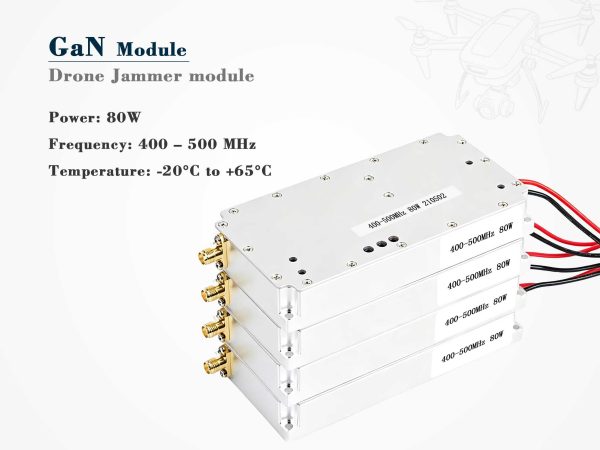
80W Anti Drone Module – 600–700 MHz GaN Analog Jammer
80W anti drone module for 600–700 MHz counter-UAS. GaN analog jammer, 24–29V DC, 10A max, built-in sweep source, SMA female, 168.5×84.5×23mm.
Technical Specifications
| Parameter | Specification | Notes |
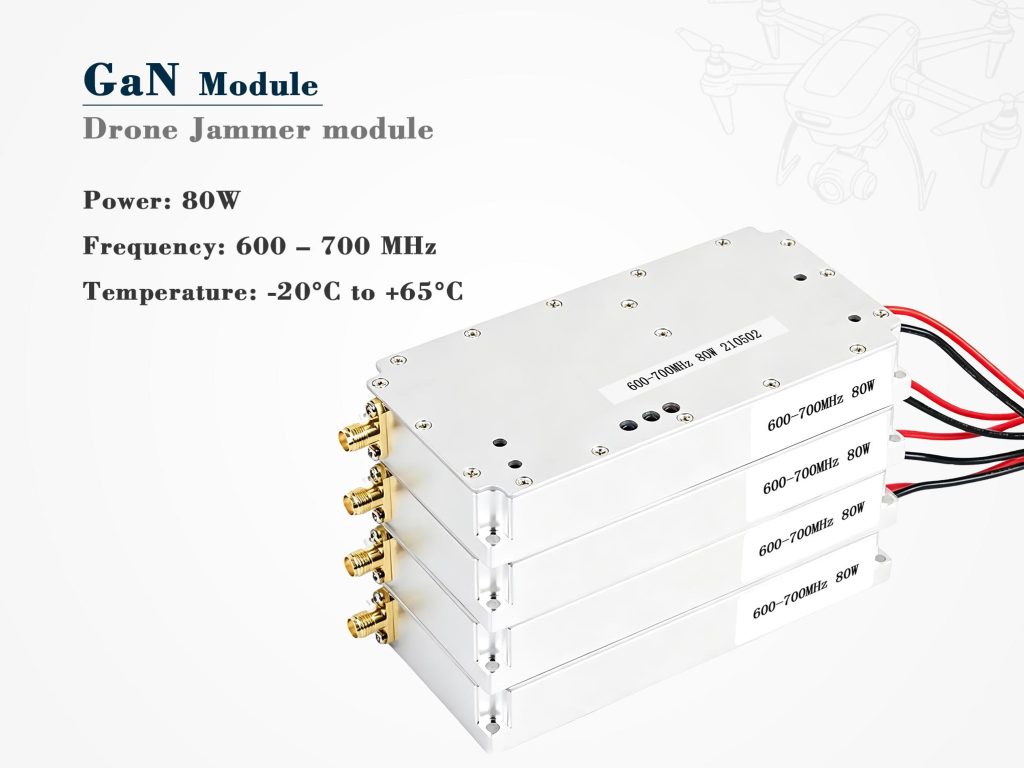
| Frequency range | 600–700 MHz | Covers common UHF drone control and video links |
| Output power | 80 W | GaN power stage, 50Ω load, VSWR ≤2.0 |
| Supply voltage | DC 24–29 V | 28 V nominal recommended |
| Current draw | ≤10.0 A | At full 80 W output |
| Modulation source | Built-in high-speed sweeping source | No external DDS required |
| Analog scan speed | High-speed sweep | Disrupts frequency-hopping links |
| Input / output impedance | 50 Ω | SMA female output connector |
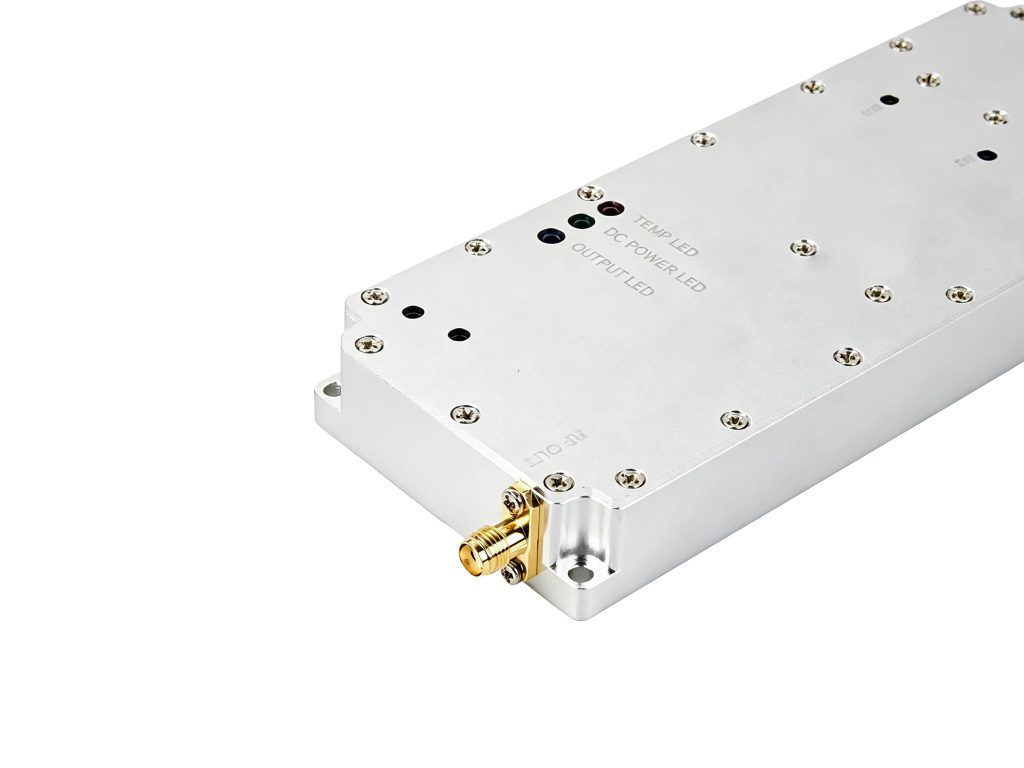
| Protection LEDs | Power, VSWR, over-temperature | Built-in status indicators |
| Operating temperature | -20 to +65 °C | Airflow recommended for continuous duty |
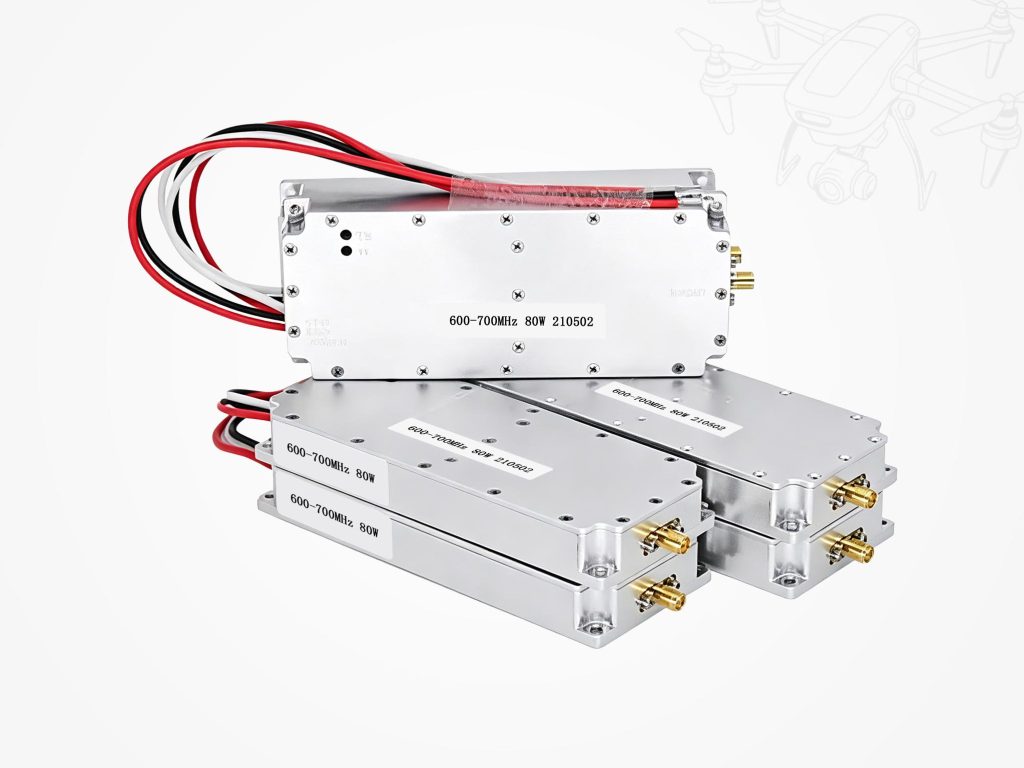
| Dimensions (L×W×H) | 168.5×84.5×23 mm | Compact aluminum housing |
| Weight | 0.55 kg | Suitable for mobile/trailer deployments |
| Base material | Aluminum alloy housing / GaN-on-SiC RF path | Combines thermal and RF performance |
Product Details
When a counter-UAS system needs serious RF output in the 600–700 MHz band, this 80W anti drone module is designed as a compact all-in-one analog jammer. Instead of wiring a separate sweep generator, driver amplifier, and protection board, the unit combines a high-speed sweeping source and a GaN power amplifier inside a 168.5×84.5×23mm aluminum housing. That keeps installation simpler for vehicle-mounted, fixed-site, or trailer-based drone defense builds.
The 80W anti drone module is specified for 80W output into a 50Ω load, with an output VSWR tolerance of up to 2.0. It runs from a DC 24–29V supply and draws no more than 10.0A at full output. A 28V/12A supply is a practical choice. Typical efficiency is at least 40%, which matters when the jammer shares a battery bank or runs for long shifts. Because the RF path is GaN-based, the module stays compact and produces less waste heat than older LDMOS designs at the same power level.
Control is straightforward. The switch control line enables output when it sees +5V or is left floating, and grounding the pin turns the module off. That makes it easy to connect to a microcontroller, a relay, or a manual toggle switch. The module also includes built-in absorptive VSWR protection, so a damaged antenna or disconnected load is less likely to take out the output stage. Protection LEDs show normal operation, VSWR fault, and over-temperature status. For continuous duty, airflow over the housing is recommended.
One reason this 80W anti drone module works as an analog integrated solution is the built-in high-speed sweep source. There is no need for an external DDS or arbitrary waveform generator to produce a broad jamming signal across 600–700 MHz. The sweep rate is fast enough to disrupt frequency-hopping command and video links in this band. The analog front end also avoids the digital control latency found in some software-defined jammers, keeping the response simple and predictable.
The 80W anti drone module measures 168.5×84.5×23mm and weighs 0.55kg, so it is light enough for mobile counter-UAS trailers, temporary fixed sites, or enclosure-based systems. The RF output is SMA female, and the system impedance is 50Ω. The 23mm height allows multiple modules to be stacked when additional bands are needed. Use a short, low-loss cable between the module and the antenna; at this power level, poor cabling or cheap connectors quickly become heat sources.
For integrators, the 80W anti drone module is mainly used in airport perimeter defense, critical infrastructure protection, convoy security, and event security. Because it covers 600–700 MHz, it is especially useful against drones that rely on lower UHF command or video links rather than 2.4GHz/5.8GHz bands. In multi-band systems, this unit is often combined with higher-frequency modules to cover a wider threat set. Typical deployments use a weatherproof enclosure with filtered DC input and, when multiple transmitters are co-located, an external RF isolator on the antenna port.
When planning a system, treat the 80W anti drone module as a nominal 300W DC load at full transmit. That helps with battery sizing and thermal planning. If the module is mounted in a sealed box, add forced air or a heat sink. The absorptive protection is a safety feature, not a replacement for a proper RF path; keep the antenna VSWR as low as possible to maintain output power and efficiency.
In short, this 80W anti drone module is a practical 600–700 MHz building block for counter-UAS systems. It delivers usable 80W power, integrates the sweep source and protection, and keeps the footprint small enough for real-world deployments. System builders who need a straightforward, DC-powered RF stage in this band will find it easier to integrate than a multi-board analog chain.
Frequently Asked Questions
Case Studies
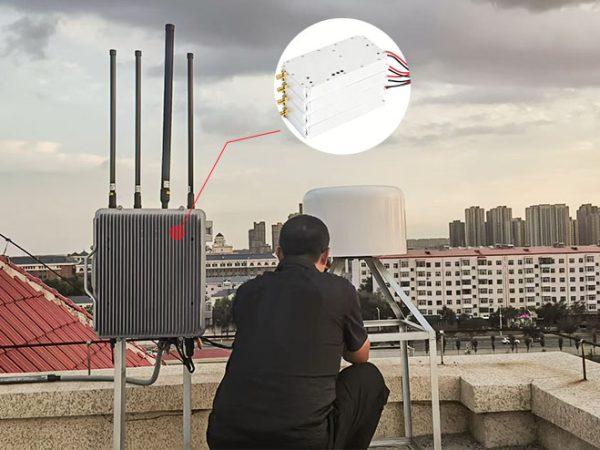
Heilongjiang Weather Center Completes Anti-Drone System Upgrade with Three High-Power Drone Jammer Modules

Tangshan Chem Plant Sealed Drone Gaps With 3 GaN Wideband Modules
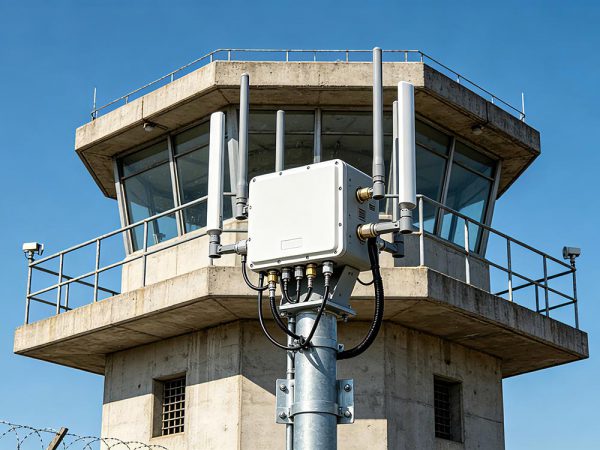
How a National Prison Integrated Our Drone Jamming Module Into Their Fixed Counter-Drone System

Integrating Core RF Power: OEM Drone Jamming Module for Oil Refinery Security | Case Study
Send Us a Message
Related Products
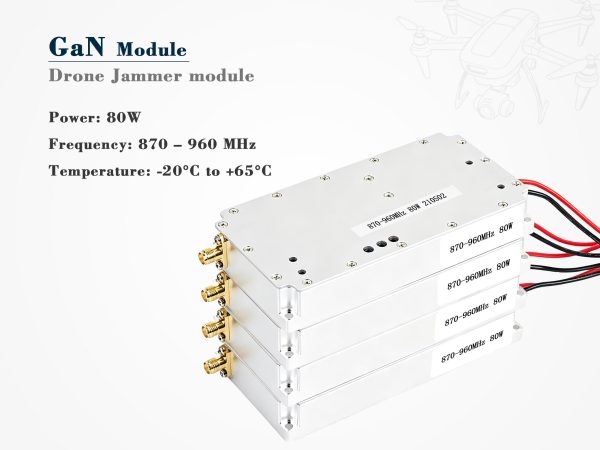
80W GaN Drone Jammer Module 870–960MHz | Analog Sweep
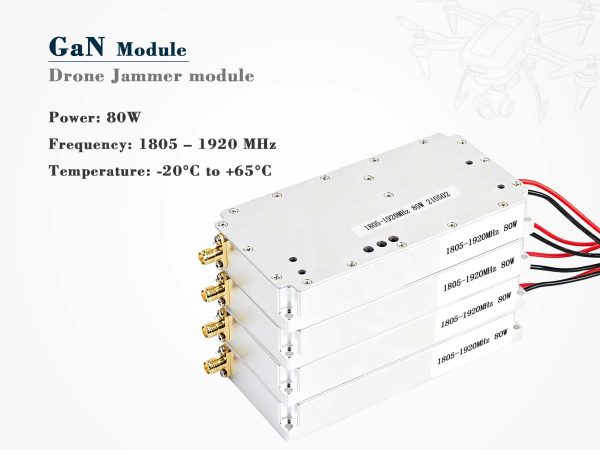
80W 1805–1920MHz GaN UAV Countermeasure Jammer Module
80W GaN Jammer Module: Powerful 2200–2400MHz Counter-UAS Solution