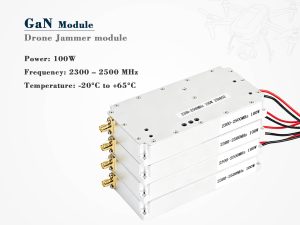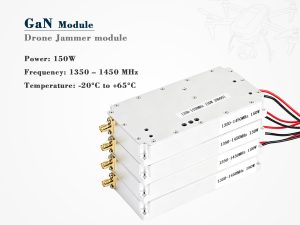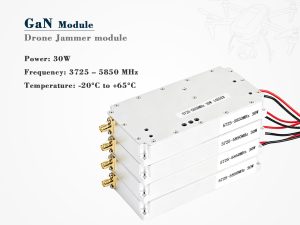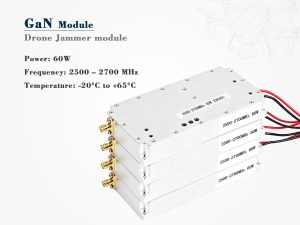
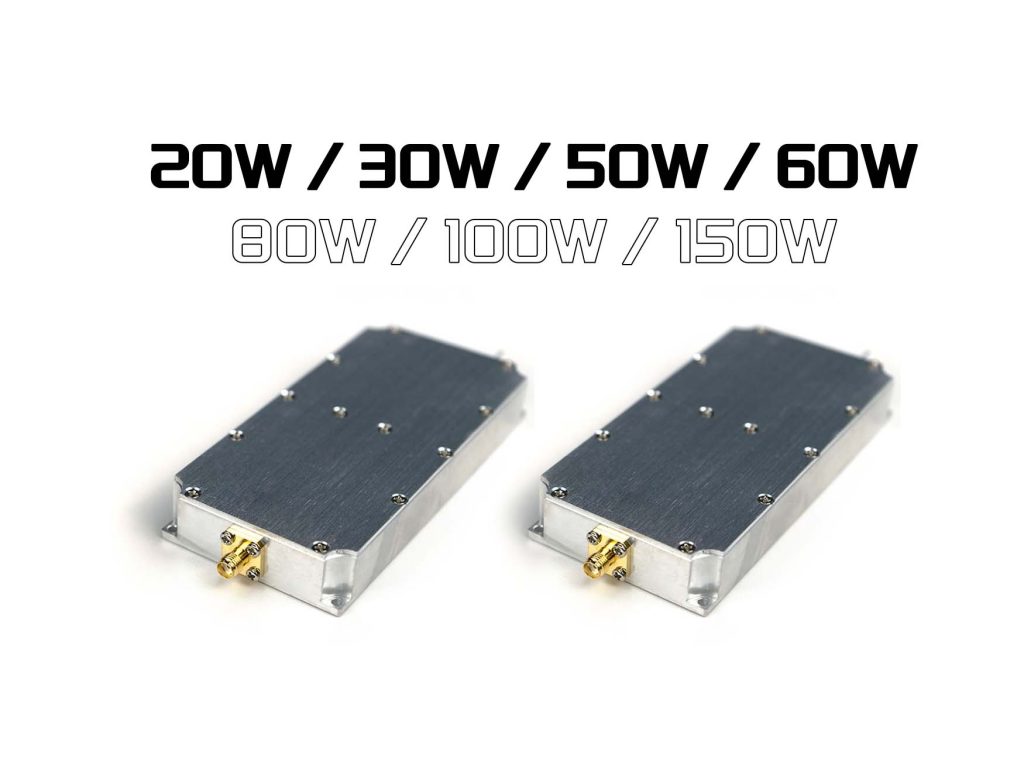
Drone jammer module power output is one of the most misunderstood specifications in counter-UAS procurement. Many buyers assume that higher wattage automatically delivers better performance. In practice, power interacts with frequency, antenna gain, duty cycle, and thermal design. A 100 W module with poor cooling may underperform a well-engineered 40 W unit.
Why Power Output Deserves Scrutiny
Drone jammer module power output determines how much energy the system can push into the target frequency. Too little power, and the jamming signal fails to reach the drone. Too much power, and you risk interfering with nearby Wi-Fi, Bluetooth, or aviation systems. The right balance depends on the deployment scenario.
Typical Power Ratings by Frequency Band
Power requirements vary by band. Lower frequencies penetrate obstacles better; higher frequencies need more power for the same range. The table below shows common ratings for security-grade modules.
| Frequency Band | Typical Power per Band | Primary Target |
|---|---|---|
| 433 MHz | 15–40 W | Legacy drone control |
| 915 MHz | 20–60 W | Industrial UAS links |
| 2.4 GHz | 20–50 W | Main control link |
| 5.8 GHz | 10–40 W | Video downlink |
| GPS L1/L2 | 10–30 W | Navigation denial |
These figures represent continuous output. Peak power may be higher, but sustained performance matters more during long engagements.
Power vs. Range: What the Numbers Mean
Range does not scale linearly with power. Doubling drone jammer module power output increases effective distance by roughly 40% in free space. Antenna gain plays an equally important role. A 30 W module paired with a high-gain directional antenna can outperform a 60 W unit using a low-gain omnidirectional antenna. Security teams should therefore evaluate the entire RF chain, not just the wattage printed on the datasheet.
Heat, Duty Cycle, and Real-World Limits
High drone jammer module power output generates significant heat. Modules rated for 100% continuous duty include active cooling, such as fans or liquid loops. Units rated for 10% duty cycle may overheat after a few minutes of use. Always check the duty cycle before buying.
Power also affects battery life in portable units. A 50 W handheld module drains its battery far faster than a 15 W model. Field teams must weigh runtime against jamming strength.
Legal and Safety Considerations
In most countries, operating a jammer is illegal for private entities. Only authorized government agencies may deploy them. Even then, power limits are often capped to prevent spectrum pollution. The FCC’s jammer enforcement page (DoFollow) provides official guidance. To understand how power fits into the broader system, read our explanation of the drone jammer module working principle.
FAQ
Q: Is higher power always better?
A: No. Excessive power increases interference risk, heat, and legal exposure. Match power to the threat and environment.
Q: What is a typical power output for fixed sites?
A: Fixed installations often use 40–100 W per band, paired with directional antennas.
Q: Can I increase power with an external amplifier?
A: In theory, yes, but this usually violates regulations and may damage the module. Always follow manufacturer guidelines.
Choosing the right drone jammer module power output requires balancing range, cooling, duty cycle, and legal limits. Review the full RF chain, not just the wattage, to ensure reliable performance in the field.