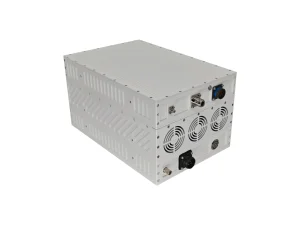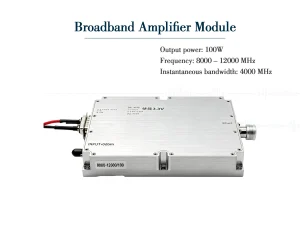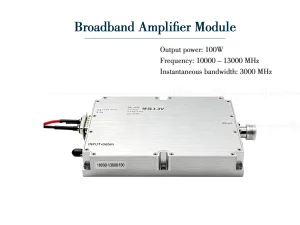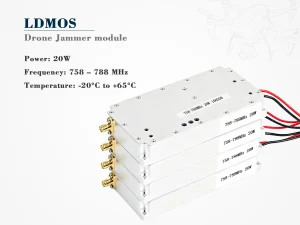
In counter-UAS projects, RF modules are often compared by output power, but FPV jammer module frequency bands are the more important starting point. FPV systems rarely rely on a single link: video, remote control, and telemetry may sit in different bands, and each band brings its own bandwidth, antenna, thermal, and compliance constraints. For a foundational overview of terminology and architecture, see our guide to what is an FPV jammer module.
This article takes a spectrum-first view for authorized, legal deployments. It is not a recommendation to interfere with communications outside approved environments.

Begin with the link budget, not the band label
A frequency band on a datasheet does not guarantee field performance. The module must match the target link’s bandwidth, hopping behavior, antenna gain, ERP, duty cycle, and polarization. A narrowband 2.4 GHz module may miss frequency-hopping control signals; a high-power 5.8 GHz module may create unnecessary collateral interference or thermal stress. Buyers should request band-specific data for emission masks, harmonic suppression, VSWR protection, and thermal derating rather than accepting a single aggregate power figure.
Frequency bands commonly discussed in FPV RF planning
| Band | Common FPV role | Module design focus | Compliance caution |
|---|---|---|---|
| 433 / 868 / 915 MHz | Long-range control and telemetry in some regions | Narrowband vs. wideband coverage; regional ISM differences | 868 and 915 MHz are not globally interchangeable; verify local allocation |
| 1.2 / 1.3 GHz | Video and some control links | Filtering near GNSS and avionics; antenna efficiency | High risk of adjacent-band interference; authorized use only |
| 2.4 GHz | RC control and some video/telemetry | Frequency-hopping coverage; bandwidth and sweep strategy | Shared with Wi-Fi and Bluetooth; collateral impact must be assessed |
| 5.8 GHz | Analog and digital FPV video | Wideband coverage; PA linearity; thermal load | High duty cycle demands robust cooling and power management |
| GNSS L1/L2 | Navigation, not an FPV link | Usually a separate module; strict emission limits | Highly regulated; legal review is mandatory |
The table shows why “more bands” is not automatically better. A module with many bands but poor filtering can create co-site interference, while a well-filtered single-band module may fit a fixed-site role better than a broadband unit.
Match band architecture to the mission profile
For fixed sites, directional antennas and band-specific channels can improve control and reduce unnecessary emissions. For mobile teams, multiband omni-directional antennas are often preferred, but lower ERP and disciplined duty cycles may be necessary. Indoor event security, perimeter protection, and mobile patrols place different demands on size, weight, power, and cooling. The procurement question should be: which bands, with what bandwidth, at what ERP, under which antenna and duty-cycle conditions?
RF chain details that decide field performance
Band selection is only one layer. The RF chain must control harmonics and spurious emissions, maintain PA linearity, survive VSWR mismatch, and manage heat during repeated use. Control interfaces should support logging, fail-safe behavior, and health monitoring. For multi-band modules, channel isolation and co-site filtering deserve as much attention as raw output power.
Compliance and test plan
Authorized users should confirm spectrum authorization, human exposure limits, EMC requirements, and local prohibitions before deployment. A practical test plan includes conducted RF measurements, radiated pattern checks, thermal soak tests, VSWR mismatch tests, and co-site interference evaluation. Documentation should record band settings, ERP, antenna type, and operating duration.
Procurement scorecard
Ask vendors for band-specific emission data, not just total power. Compare filtering, cooling, control software, warranty support, and test reports. A strong FPV jammer module frequency bands strategy is a system decision: spectrum, antenna, thermal design, compliance, and operator training must align before the module reaches the field.