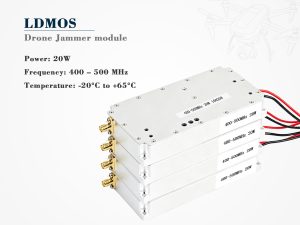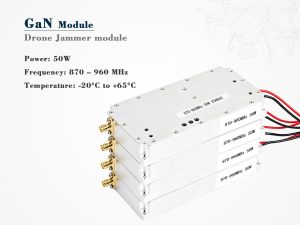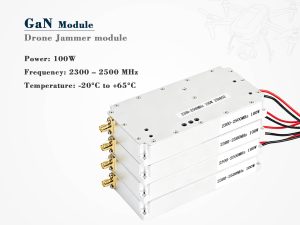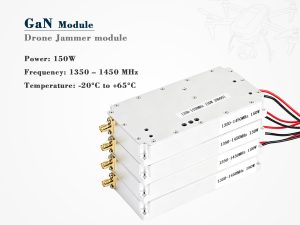
When engineers evaluate LoRa drone jammer modules, two specs dominate the conversation: frequency bands and output power. Get the band wrong, and the module is useless against the target link. Get the power strategy wrong, and the system may create more interference, heat, and legal exposure than operational value. This article focuses on those two variables and how they interact in real C-UAS designs.

A quick legal note: radio jamming is prohibited in most countries for civilian use. The following is technical and procurement-oriented information for authorized government, military, law enforcement, and licensed test environments.
The Two Variables That Matter Most
Frequency bands determine whether the module can touch the target’s LoRa link. Power determines how far and how reliably that interference reaches the receiver. But power is not a single number. Conducted power, antenna gain, cable loss, bandwidth, duty cycle, and thermal design all shape the final effect.
| Variable | What It Controls | Common Mistake |
|---|---|---|
| Frequency band | Compatibility with the drone’s LoRa link | Assuming all LoRa uses the same band |
| Conducted power | RF energy at the module output | Comparing conducted power to EIRP |
| Antenna gain | Direction and effective radiated power | Ignoring how gain multiplies EIRP |
| Bandwidth | Spectrum width affected | Using wideband noise against narrow LoRa |
| Duty cycle | Average power over time | Running continuous and overheating |
| Cooling | Sustainable output | Trusting peak specs for long missions |
Regional LoRa Bands at a Glance
LoRa is not a single global frequency. Regional plans differ, and drone makers may use licensed, unlicensed, or custom sub-GHz bands. A LoRa drone jammer module must match the target’s band, not just the LoRa name.
| Region / Plan | Common LoRa Band | Notes for Jammer Module Design |
|---|---|---|
| Europe (ETSI) | 863–870 MHz | Duty cycle and power limits are strict; shared spectrum |
| North America (FCC) | 902–928 MHz | Wider band; frequency agility matters |
| China (CN) | 470–510 MHz | Regional plan; local approval required |
| India | 865–867 MHz | Narrow allocation; precise filtering needed |
| Japan | 920–928 MHz | ARIB rules; limited power |
| Global 2.4 GHz LoRa | 2400–2483.5 MHz | Less common for drone control; crowded band |
| 433 MHz ISM | 433.05–434.79 MHz | Used in some regions and legacy devices |
In practice, a module covering 863–870 MHz will not affect a drone using 915 MHz. A 915 MHz module will not help in Europe. Multi-band modules exist, but each added band increases cost, filtering complexity, antenna design challenges, and regulatory risk.
Conducted Power vs EIRP
The most common source of confusion is the difference between conducted power and EIRP. Conducted power is measured at the module’s RF output before the antenna. EIRP is what actually leaves the antenna system. Antenna gain and cable loss change the result.
| Term | Definition | Example |
|---|---|---|
| Conducted power | Power at the module connector | 10 W (40 dBm) |
| Antenna gain | Passive gain in a direction | 10 dBi |
| Cable loss | Loss between module and antenna | 1 dB |
| EIRP | Effective isotropic radiated power | 40 + 10 − 1 = 49 dBm ≈ 79 W |
That example shows why two modules with the same “10 W” label can behave very differently. A high-gain directional antenna can push EIRP far above conducted power. It can also narrow the beam, which helps reduce unintended interference but demands accurate aiming.
Typical Power Tiers and Their Trade-Offs
Power tiers are often marketed as simple upgrades: 5 W, 10 W, 20 W, 50 W, 100 W. In reality, each tier changes the thermal envelope, power supply, safety perimeter, and legal classification.
| Power Tier (Conducted) | Typical Role | Advantages | Drawbacks |
|---|---|---|---|
| 1–5 W | Portable or embedded modules | Low heat, small size, easy power | Short range; limited penetration |
| 10–20 W | Vehicle or fixed small-cell C-UAS | Balanced range and cooling | Needs directional antennas and duty limits |
| 30–50 W | Larger fixed sites | Longer reach; more link margin | Significant heat, power, and interference risk |
| 80–100 W+ | Specialized authorized systems | High link budget for difficult RF | Large cooling, strict safety, high regulatory burden |
Higher power does not guarantee success. If the target uses frequency hopping, encryption, or a different band, more power may only raise the noise floor for everyone else. It can also trigger automatic gain control in receivers, which sometimes helps the target rather than disrupting it.
Bandwidth, Duty Cycle, and Heat
A LoRa signal is relatively narrow and uses chirp spread spectrum. A jammer module that spreads energy across a wide band may waste power. A narrower, well-targeted signal can be more efficient, but it requires accurate frequency knowledge and stable oscillators.
| Parameter | Effect on Performance | Operational Consequence |
|---|---|---|
| Bandwidth | Wider bands cover more frequencies but dilute power | More interference risk; less efficient jamming |
| Duty cycle | Average power over time | Continuous operation demands better cooling |
| Thermal design | Heat removal from amplifiers | Peak power cannot be sustained without it |
| Power supply | Voltage and current stability | Poor supply causes spectral splatter and failures |
| Filtering | Out-of-band suppression | Reduces interference with nearby networks |
For field use, the sustainable duty cycle often matters more than the peak watt rating. A 20 W module that runs at 20% duty cycle may deliver less average disruption than a 10 W module designed for continuous operation in the same band.
Antenna Choices Change the Power Equation
Antennas are not accessories; they are part of the power specification. Omnidirectional antennas cover a wide area but spread energy. Directional Yagi, panel, or horn antennas concentrate energy toward the target. The right choice depends on whether the operator knows the drone’s direction.
| Antenna Type | Gain Range | Best Use | Trade-Off |
|---|---|---|---|
| Omnidirectional | 2–6 dBi | Wide-area warning or mobile patrol | Lower EIRP in any one direction |
| Panel / sector | 8–15 dBi | Fixed site with known approach paths | Limited coverage angle |
| Yagi | 10–18 dBi | Portable directional targeting | Manual aiming required |
| Horn | 15–25 dBi | Test ranges and specialized systems | Bulky; very narrow beam |
A directional antenna also reduces the risk of disrupting LoRaWAN gateways, smart meters, and industrial sensors outside the target area. That is not just a legal issue; it is good spectrum citizenship.
Compliance and Power Limits
Power limits are not universal. They vary by country, band, application, and operator status. Even in authorized C-UAS programs, regulators may require power caps, geographic restrictions, time limits, and coordination with spectrum authorities.
| Compliance Question | Why It Matters |
|---|---|
| Is jamming permitted for this user? | Civilian use is generally prohibited |
| What is the maximum allowed EIRP? | Conducted power alone is not enough |
| Are there band-specific duty cycle rules? | ETSI and other regimes restrict transmission |
| Is the module certified? | Certification may not cover jamming modes |
| Are export controls triggered? | RF jamming equipment may be controlled |
| Is there an audit log? | Authorities may require records |
Buyer’s Short List
When comparing LoRa drone jammer modules, ask for these details in writing:
| Item | What to Request |
|---|---|
| Frequency plan | Exact tuning range and step size |
| Conducted power | Minimum, maximum, and adjustable levels |
| EIRP calculation | Antenna gain and cable loss assumptions |
| Bandwidth | Instantaneous and tunable bandwidth |
| Duty cycle | Continuous and intermittent ratings |
| Cooling | Airflow, conduction, or liquid requirements |
| Spurious emissions | Filtering and out-of-band performance |
| Control interface | API, serial, Ethernet, or proprietary |
| Safety features | VSWR, over-temperature, over-current, shutdown |
| Legal status | Certifications, export code, and authorized use |
Questions Engineers Ask
Does higher power always mean longer range?
Not always. Range depends on link budget, antenna gain, frequency, terrain, and the target receiver’s sensitivity. EIRP and antenna direction often matter more than raw watts.
Can one module cover all LoRa bands?
Some wideband modules exist, but they usually sacrifice efficiency, filtering, and power density. Multi-band designs are often better than one very wideband unit.
Is 2.4 GHz LoRa relevant for drones?
It can be, but 2.4 GHz is crowded with Wi-Fi, Bluetooth, and video links. Sub-GHz LoRa is more common for long-range telemetry and control.
What is the biggest mistake in power selection?
Buying for peak watts instead of sustainable EIRP, duty cycle, and thermal performance. The second biggest mistake is ignoring local law.
Bottom Line
Frequency bands and power are the two pillars of LoRa drone jammer module performance. Band matching decides whether the module can reach the target link. Power strategy—conducted power, antenna gain, EIRP, bandwidth, duty cycle, and cooling—decides whether it works reliably and legally. For most authorized programs, the smartest approach is narrowband, directional, power-limited operation with clear logging, not maximum watts.