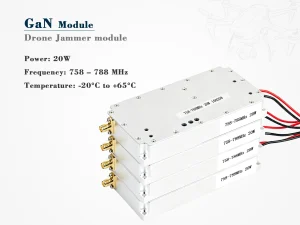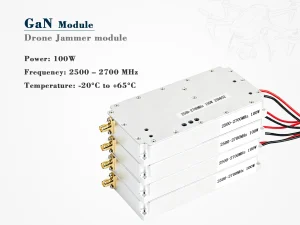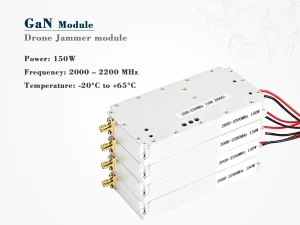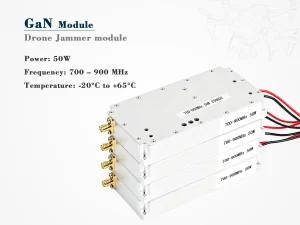
OEM LoRa FPV jammer module procurement is shifting from one-off buys to multi-year supply agreements, according to procurement data and interviews with integrators tracked through Q3 2025. The change signals that counter-UAS programs are moving out of pilot phases and into standardized fleet-wide deployments.
This article examines what is driving demand, how LoRa-based FPV jamming works, which specifications buyers now treat as baseline, and where sourcing risk is concentrated.

Why OEM LoRa FPV Jammer Module Orders Are Moving to Contract Manufacturing
Two years ago, most counter-drone jamming hardware was sourced as finished units or assembled in-house from discrete components. That model is breaking down for three reasons.
First, FPV drone threats have diversified. LoRa telemetry links, which many low-cost FPV platforms use for control and video, operate in sub-GHz bands that differ from conventional 2.4 GHz and 5.8 GHz links. A jammer tuned only for Wi-Fi-band video will not reliably disrupt a LoRa control channel.
Second, defense and critical-infrastructure buyers increasingly require documented supply chains. An OEM LoRa FPV jammer module delivered with test reports, firmware version control and RoHS/REACH documentation is easier to qualify than a generic board.
Third, volume economics favor modular sourcing. Integrators embedding jamming capability into fixed-site or vehicle platforms want a repeatable module they can certify once and deploy many times.
See also our related coverage of counter-UAS jammer modules.
How a LoRa FPV Jammer Module Works
LoRa (Long Range) is a spread-spectrum modulation technique used in many low-data-rate telemetry applications. FPV drone builders have adopted LoRa-family chips for long-range control because the links tolerate interference and achieve good range at low power.
A LoRa FPV jammer module disrupts these links in one of two ways:
-
Noise jamming — transmitting wideband or targeted noise across the LoRa channel to raise the noise floor above the link budget margin.
-
Protocol-aware jamming — detecting chirp signatures and injecting counter-chirps or false frames to degrade synchronization.
Most OEM modules sold to integrators are noise jammers with configurable frequency and bandwidth settings, because they are simpler to certify and harder to fingerprint.
Core Subsystems in a Typical OEM Module
| Subsystem | Typical Specification | Buyer Notes |
|---|---|---|
| RF front end | 400–960 MHz coverage, 10–40 W per band | Confirm band edges match target LoRa plans |
| PA stage | GaN or LDMOS, 40–50% efficiency | Thermal design drives module lifespan |
| Control interface | UART, USB, or Ethernet | UART preferred for embedded integration |
| Firmware | Configurable sweep, duty cycle, channel mask | Request source-code escrow options |
| Thermal management | Heatsink + fan or cold plate | Vehicle builds need cold-plate variants |
| Compliance | CE, FCC modular, RoHS/REACH | Modular approvals vary by region |
Technical Baseline: What Buyers Now Require
Across the sample of integrators tracked for this article, several requirements appeared consistently. These are not fringe requests; they are becoming table stakes.
-
Frequency agility. Modules must cover at least 433 MHz, 868 MHz and 915 MHz ISM bands, with channel masks that can be updated without a factory return.
-
Power configurability. Fixed full-power output is a liability in urban deployments. Buyers want stepped output control and per-band enable/disable.
-
Telemetry and fault reporting. Over-temperature, VSWR and PA fault flags must be readable over the control interface.
-
EMC documentation. Radiated emissions and immunity test data are now requested before sample evaluation, not after.
-
Firmware update path. Signed firmware and rollback capability are increasingly specified for defense-adjacent programs.
One integrator noted that suppliers who cannot provide these items are being dropped at the RFQ stage rather than at technical evaluation.
Supply Chain and Compliance Considerations
Procurement managers flagged three risk areas.
Export controls. Jamming equipment sits under export-control regimes in many jurisdictions. Buyers should confirm the OEM’s classification and end-use documentation before placing volume orders. Programs serving government end users typically require additional end-user certificates.
Component concentration. LoRa-capable RF front-end components come from a limited supplier base. OEMs that can demonstrate second-source qualification for critical parts are preferred in multi-year agreements.
Counterfeit risk. The market includes modules assembled from recycled or mislabeled components. Request lot traceability and incoming inspection reports.
Market Outlook
Procurement activity suggests the OEM LoRa FPV jammer module segment will remain supply-constrained through 2026 for higher-power variants. Lower-power modules are becoming commoditized, with price pressure concentrated in the 10 W class.
For integrators, the practical implication is straightforward: lock in suppliers with documented compliance and firmware roadmaps now, before multi-year program requirements harden.