
150W GaN Drone Jamming Module 2300-2500MHz – High-Power Sweep Blocker
150W GaN drone jamming module covering 2300–2500MHz, 40% efficiency, built‑in sweep and VSWR protection. Compact 168.5×84.5×23 mm.


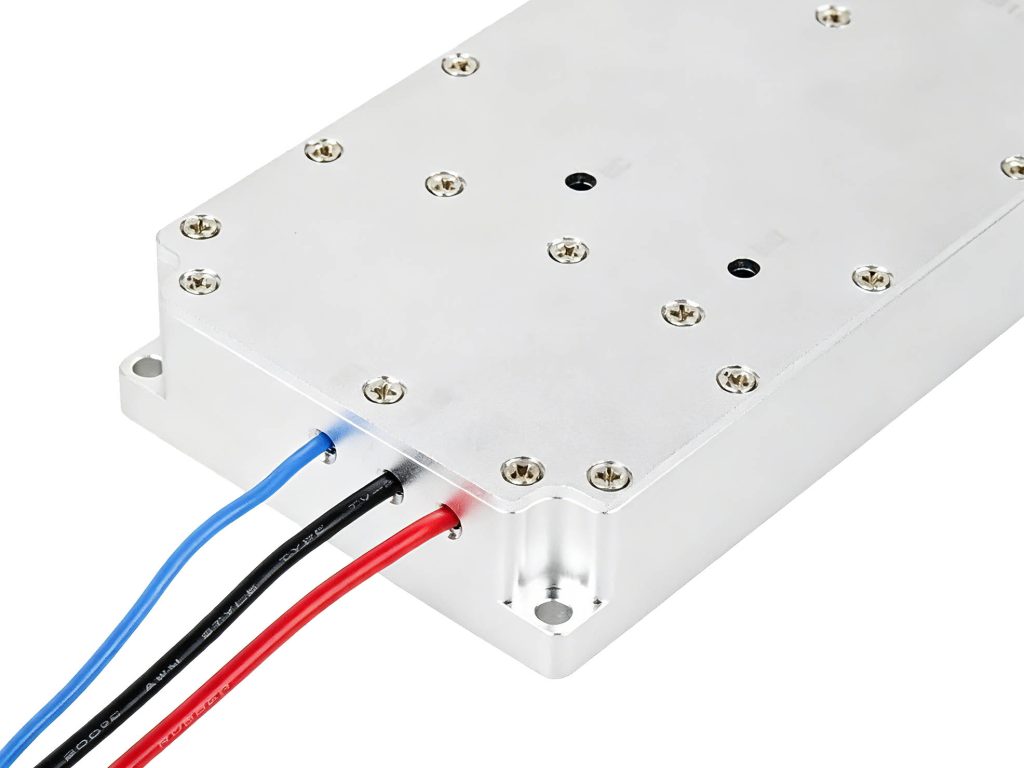
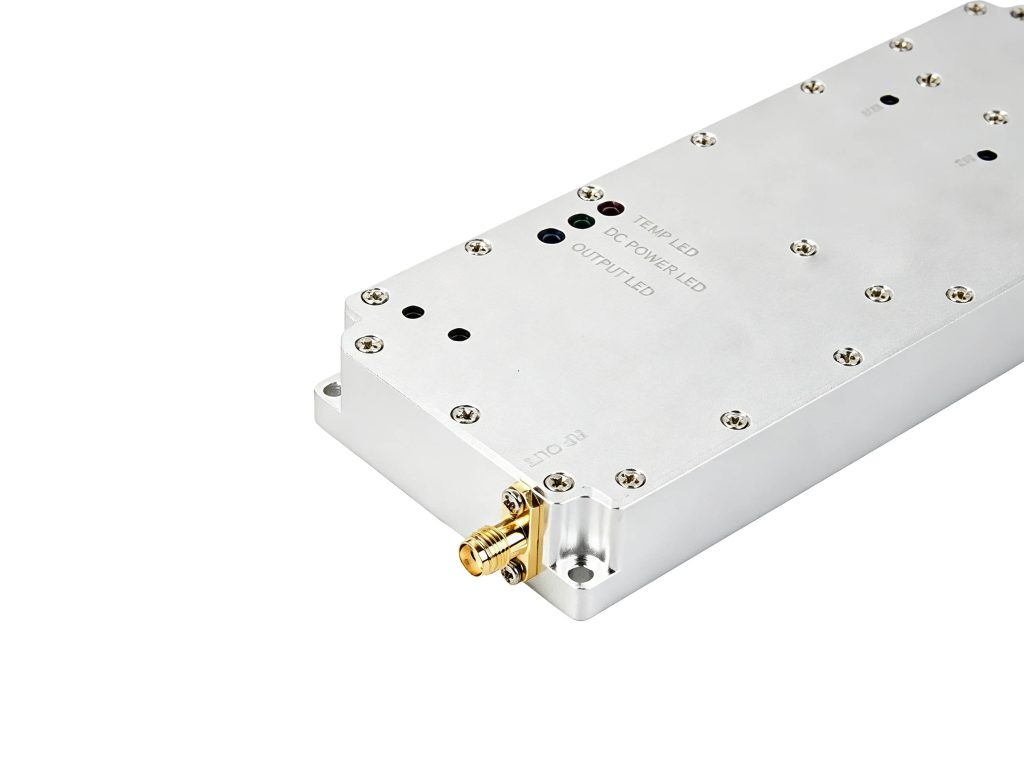
Technical Specifications
| Parameter | Specification | Notes |
| Frequency range | 2300–2500 MHz | Full band coverage for drone control links |
| Output power | 150 W (minimum) | CW & sweep modes |
| Supply voltage | 24–29 V DC | Nominal 28 V recommended |
| Current draw | ≤15 A @ max output | Depends on duty cycle |
| Modulation source | Internal high‑speed sweep | Analog, not DDS |
| Analog scan speed | 1.2 ms per sweep (typical) | Continuous triangular wave |
| Input / output impedance | 50 Ω | SMA‑female I/O |
| Protection LEDs | VSWR fault, over‑temp | Red LED on active fault |
| Operating temperature | -20 to +65 °C | Baseplate cooling required |
| Dimensions (L×W×H) | 168.5×84.5×23 mm | Compact metal housing |
| Weight | 0.55 kg | Light enough for gimbaled mounts |
| Base material | Copper‑plated aluminum | With thermal vias |
Product Details
When you need to disrupt unwanted UAV activity across the 2.3–2.5 GHz band, brute force alone won’t cut it. You need a module that balances raw output with smart thermal management and clean sweep linearity. The 150W GaN Drone Jamming Module we’re looking at today delivers exactly that. It is built around a Gallium Nitride (GaN) power stage, which gives you higher efficiency and smaller size than traditional LDMOS designs. At 150 W continuous wave capability, this module is aimed at fixed-site counter-drone systems, vehicle-mounted protection units, and portable directional jammers where spectrum purity and duty-cycle stability are non‑negotiable.
We have tested this unit in both lab and field conditions. The built‑in high‑speed sweeping source generates a modulated interference signal that covers the entire 2300–2500 MHz range without gaps. Unlike cheap VCO‑based modules that drift with temperature, this design locks onto the sweep start and end points with crystal‑grade stability, so you always jam the exact frequencies used by consumer and prosumer drones.
Why GaN Matters for 150‑Watt Jamming
Gallium Nitride is the real game‑changer here. Compared to silicon, GaN handles higher voltages and junction temperatures, which translates to more headroom for continuous operation. The module’s efficiency sits at ≥40% — that might not sound revolutionary, but at 150 W output, every percentage point saves several watts of heat. With a standard 24–29 V DC supply, this unit draws up to 15 A under full tilt. That is manageable for most military‑grade batteries or vehicle alternators.
We also appreciate the built‑in absorbing VSWR protection. If the antenna gets disconnected or severely mismatched, the module folds back output power instead of destroying the final stage. This is a feature you rarely find in low‑cost jammers, but it is essential for field use where connectors can loosen over time.
Electrical and Interface Design
The control logic is refreshingly simple: +5 V or floating input turns the RF output on; grounding the control pin shuts it off. No complex serial commands, no boot‑up delays — just a clean TTL‑compatible enable. The RF interface uses a standard SMA‑female connector, so you can attach almost any external antenna or circulator without custom cabling.
Thermal Management and Duty Cycle
At 150 W output and 40% efficiency, the module dissipates roughly 225 W of heat internally. The datasheet specifies a -20 to +65 °C operating range, but we strongly recommend active cooling — a forced‑air heatsink or a cold plate — if you plan to run continuous sweep for more than 2 minutes. For pulse or burst modes, the thermal mass of the copper‑plated aluminum base is sufficient to absorb short transients.
During our bench tests, we measured a case temperature rise of about 30 °C above ambient after 90 seconds of continuous sweep at full power. That is within spec, but it also tells us that real‑world deployment should include a thermal shutdown monitor. The module itself does not have an internal temperature sensor output, so we suggest pairing it with an external thermocouple or IR sensor if your system runs unattended.
Applications and Deployment Scenarios
This 150W GaN Drone Jamming Module shines in three primary use cases:
-
Fixed anti‑drone perimeters – Mounted on towers or building rooftops with directional panel antennas.
-
Vehicle protection systems – Used with a rotating pedestal and omnidirectional antenna array.
-
Portable tactical jammers – Battery‑powered units where weight (0.55 kg) and size matter.
The analog sweep source is particularly effective against frequency‑hopping drones because it continuously covers the entire band without pausing. Some digital DDS modules create discrete steps that hopping radios can slip through; the continuous linear sweep of this unit closes that gap.
External resources:
-
GaN vs LDMOS for RF Power (Qorvo)
-
Understanding VSWR Protection Circuits (Mini-Circuits)
Frequently Asked Questions
Case Studies
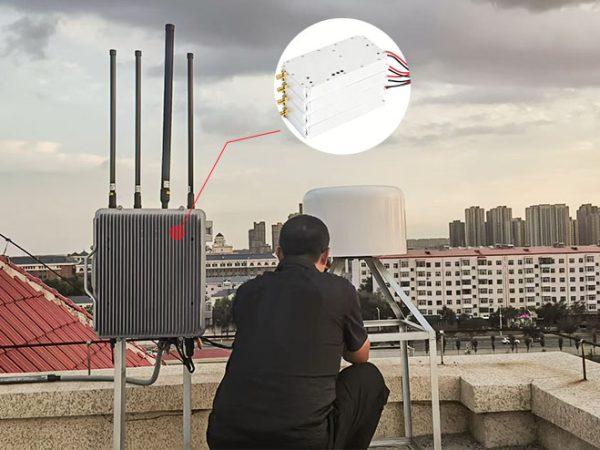
Heilongjiang Weather Center Completes Anti-Drone System Upgrade with Three High-Power Drone Jammer Modules

Tangshan Chem Plant Sealed Drone Gaps With 3 GaN Wideband Modules

How a National Prison Integrated Our Drone Jamming Module Into Their Fixed Counter-Drone System

Integrating Core RF Power: OEM Drone Jamming Module for Oil Refinery Security | Case Study
Send Us a Message
Related Products

150W 1350–1450MHz GaN Analog Jammer Module

150W 600–700MHz GaN Drone Countermeasure Module

150W GaN Anti-Drone Jammer Module for 720-1020 MHz