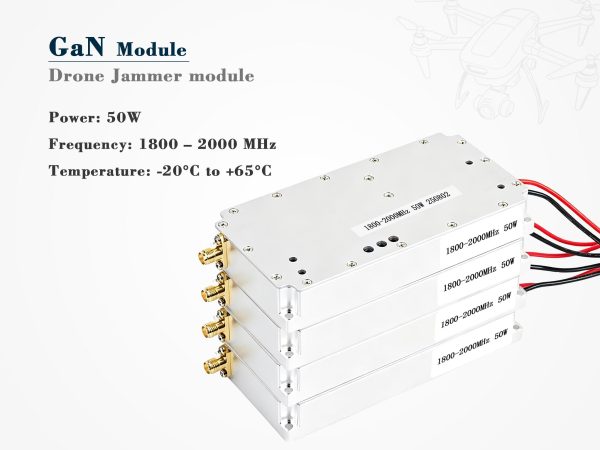
50W UAV Jammer Module 700-840MHz LDMOS
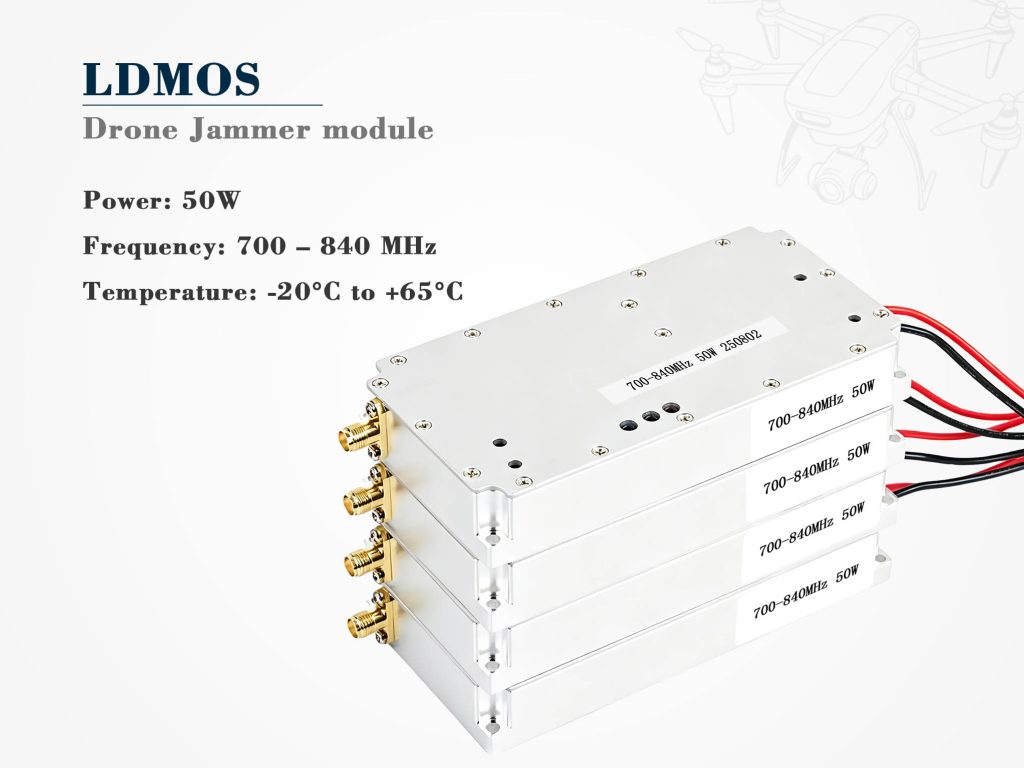
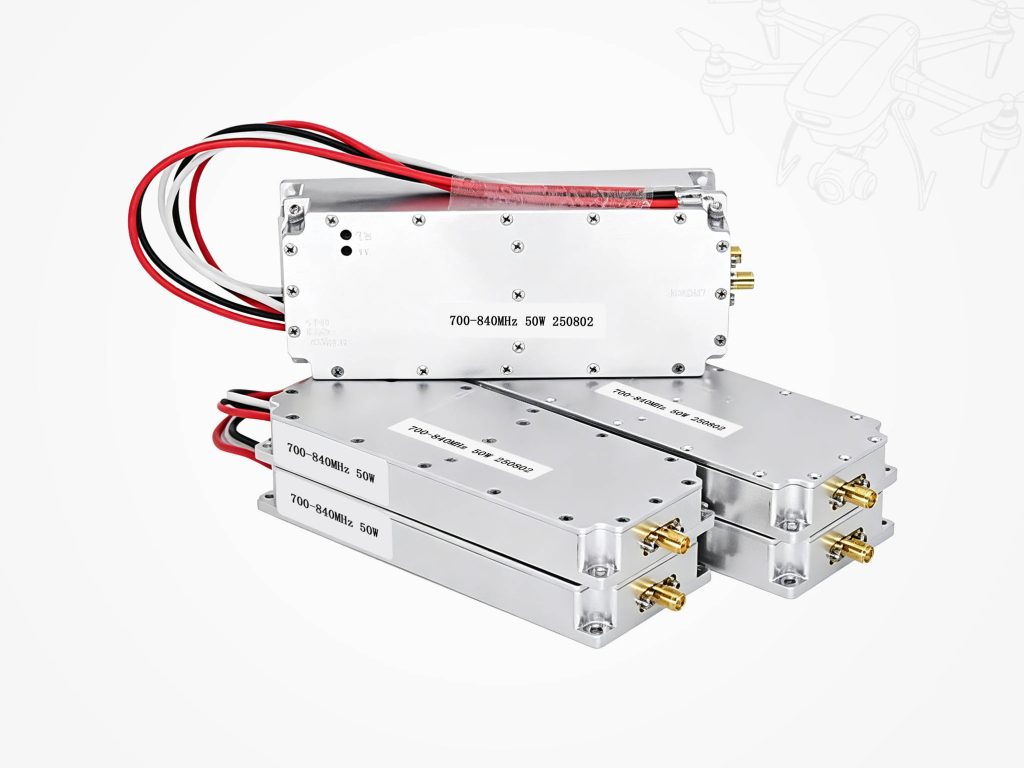
50W UAV jammer module for 700-840MHz, LDMOS, 24-28V, 3.2-4.5A, 47±1dBm, built-in noise source, 270KHz scan, SMA female, 117x58x18mm, 300g.
Technical Specifications
| Parameter | Specification | Notes |
| Frequency range | 700–840 MHz | Instantaneous wideband |
| Output power | 50 W (47±1 dBm) | Rated output |
| Supply voltage | 28 V | 24–28 V operating range |
| Current draw | 3.2–4.5 A | At 50 W output, depends on voltage |
| Modulation source | Built-in high-speed noise modulation source | Custom VCO, DDS, SDR available |
| Analog scan speed | 270 KHz | Custom 100–500 KHz |
| Input / output impedance | 50 Ohm | SMA female connectors |
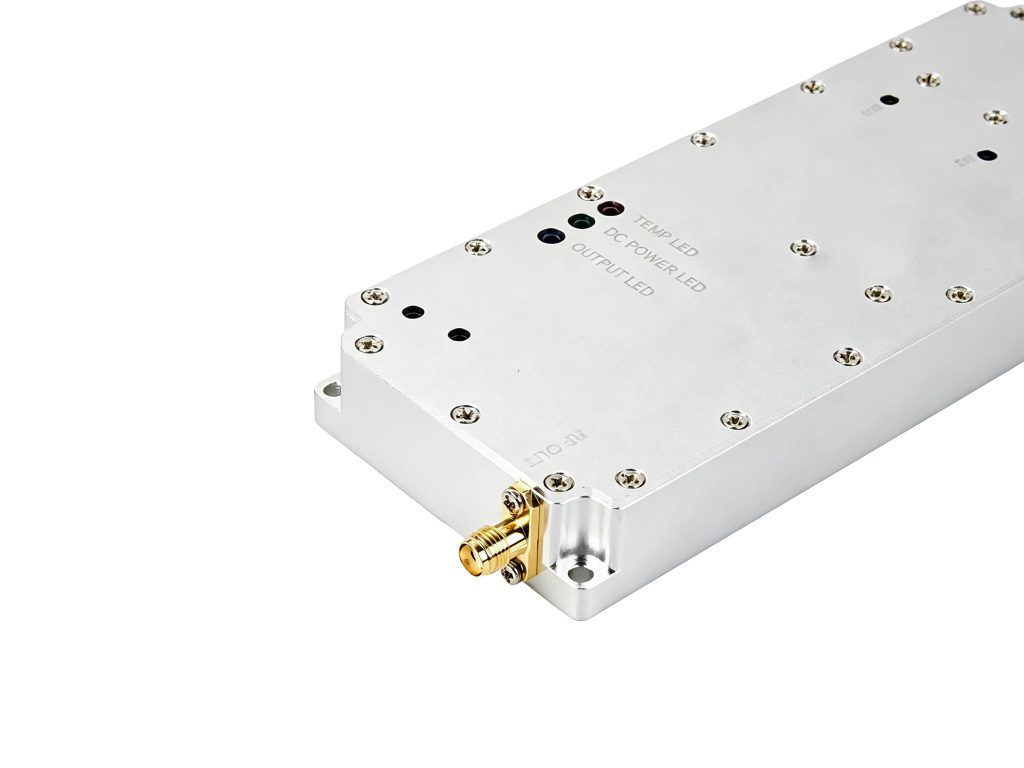
| Protection LEDs | Power switch, overvoltage, overtemperature | Status indicators |
| Operating temperature | -20°C to +65°C | Normal operation |
| Dimensions (L×W×H) | 117×58×18 mm | Custom size available |
| Weight | 300 g | Compact module |
| Base material | LDMOS on metal carrier | Custom layout available |
Product Details
If you need a compact RF blocker for the 700–840 MHz band, this 50W UAV jammer module is built around an LDMOS transistor and delivers 50 W at 47±1 dBm. It runs from a 24–28 V DC supply and uses SMA female connectors. Typical current draw is 3.2–4.5 A, depending on the input voltage. For field use, a 24 V vehicle bus or a 6S battery can usually handle it without a large DC-DC converter.
Why 700–840 MHz Matters for UAV Jamming
Many long-range drone control links, LORA telemetry channels, and some video downlinks operate between 700 MHz and 840 MHz. A 50W UAV jammer module with a broadband match can disrupt several of these signals at once. Because the module covers the full range without retuning, it works well in systems that need to hop across the band or deal with drones that switch channels quickly.
LDMOS Design and Thermal Behavior
At 50 W, LDMOS is still a practical choice. It is cost-effective, widely available, and easier to bias in compact designs than some higher-power GaN stages. The module measures 117×58×18 mm and weighs 300 g, so it fits into portable jamming cases, small payload bays, and vehicle-mounted enclosures. The metal carrier spreads heat well enough for normal operation, but continuous full-power runs should include airflow or a flat metal mounting plate.
Built-in Signal Source and Scan Speed
The 50W UAV jammer module includes a high-speed noise modulation source. The default analog scan speed is 270 KHz. That is a good starting point for barrage jamming, but the factory can adjust it from 100 KHz to 500 KHz for faster or slower patterns. For more advanced schemes, you can order the module with a VCO, DDS, or SDR input. With an external SDR, you can generate protocol-aware jamming that uses less power while still blocking control channels.
Electrical Protection and LEDs
The supply range is 24–28 V DC. At 28 V the current draw is normally at the lower end of the 3.2–4.5 A range, while at 24 V it tends to rise toward 4.5 A. LED indicators show power switch, overvoltage, and overtemperature. The operating temperature range is -20°C to +65°C. A clean supply and a DC fuse are recommended to protect the module in vehicle or battery-powered installations.
Mechanical Integration
RF ports are SMA female. At this frequency and power level, short SMA cables work well, but keep the runs as short as practical. The standard size is 117×58×18 mm or custom, and weight is 300 g. The compact layout makes it easy to replace older LDMOS bricks or stack multiple modules for multi-band coverage. If you run adjacent bands, leave enough antenna spacing or use isolators.
Typical Use Cases
Common applications include counter-UAV systems, perimeter security, LORA interference testing, and RF field trials. You can run the module as a standalone LORA blocker or feed it with an external signal source. Multiple 50W UAV jammer module units can be combined for broader coverage, but each module should be properly isolated if you plan to operate them at the same time on nearby frequencies.
Customization and Availability
Scan speed, modulation source, connectors, and mechanical size can all be customized. Since this is an LDMOS design rather than a GaN-on-SiC module, lead times are often shorter. That makes the 50W UAV jammer module a practical choice for quick deployments, OEM builds, and proof-of-concept tests where a 100 W GaN block would be overkill.
Summary
For counter-UAV work in 700–840 MHz, this 50W UAV jammer module balances output power, size, and power consumption. It is lighter than many 100 W GaN blockers and still provides enough output for short-range to medium-range jamming. The built-in noise source, 270 KHz default sweep, and SMA female ports simplify integration into new or existing systems. If you need a reliable LDMOS stage for LORA and drone control bands, this module is a practical starting point.
Frequently Asked Questions
Case Studies
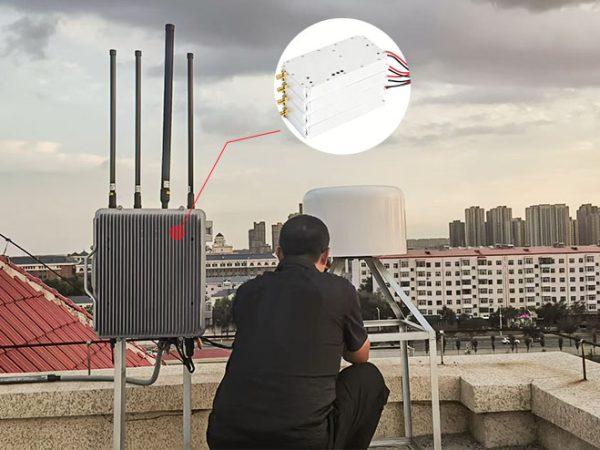
Heilongjiang Weather Center Completes Anti-Drone System Upgrade with Three High-Power Drone Jammer Modules
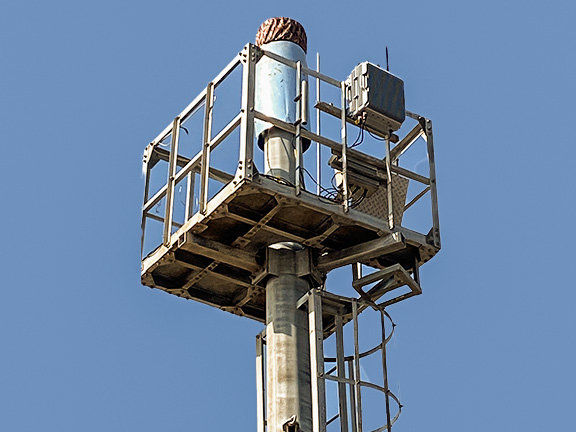
Tangshan Chem Plant Sealed Drone Gaps With 3 GaN Wideband Modules
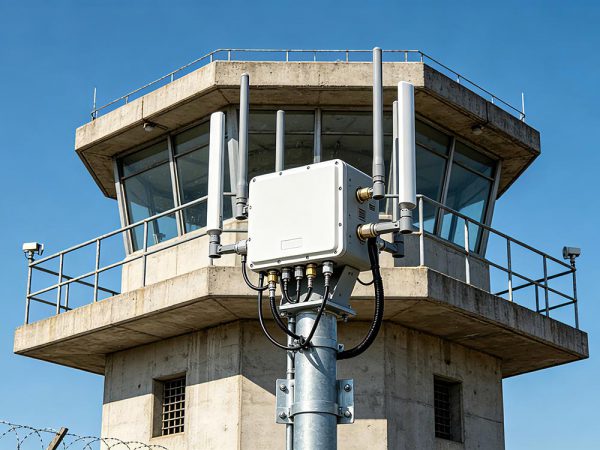
How a National Prison Integrated Our Drone Jamming Module Into Their Fixed Counter-Drone System

Integrating Core RF Power: OEM Drone Jamming Module for Oil Refinery Security | Case Study
Send Us a Message
Related Products
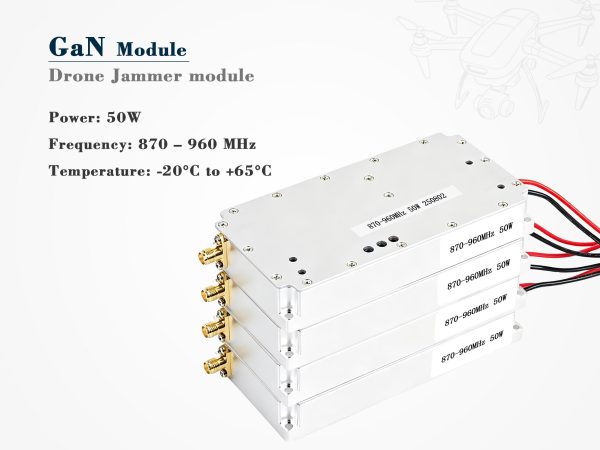
GaN 50W 870–960MHz Counter-Drone RF Module
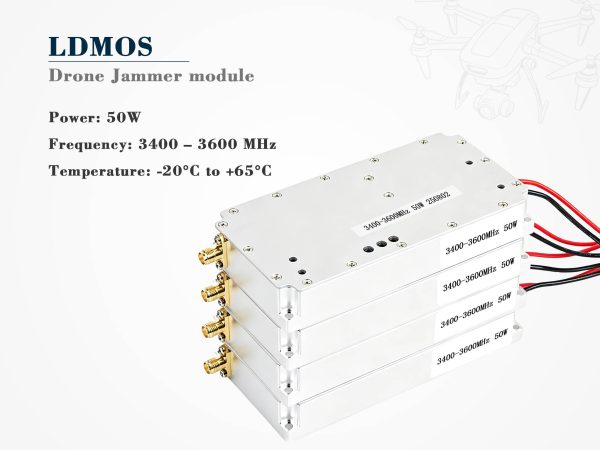
3400–3600 MHz 50W Drone Countermeasure Module
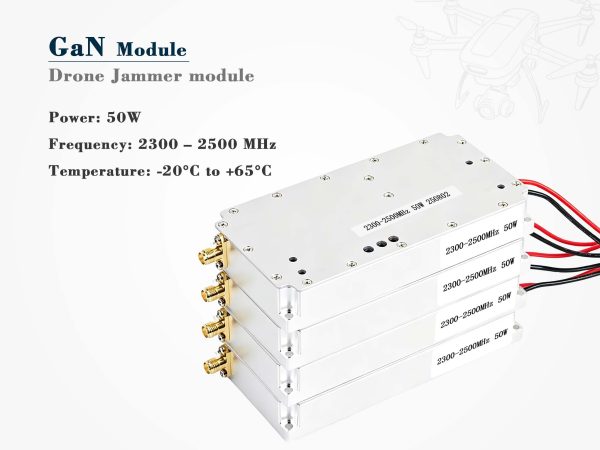
2300–2500MHz 50W GaN Module for Drone Countermeasure and Signal Shielding